guides
Indoor Gardening Cost Guide 2026 (Budget to Premium)
Real cost breakdowns for indoor gardening at every tier. Beginner kits, mid-tier hydroponic, premium grow racks. Plus what to skip.
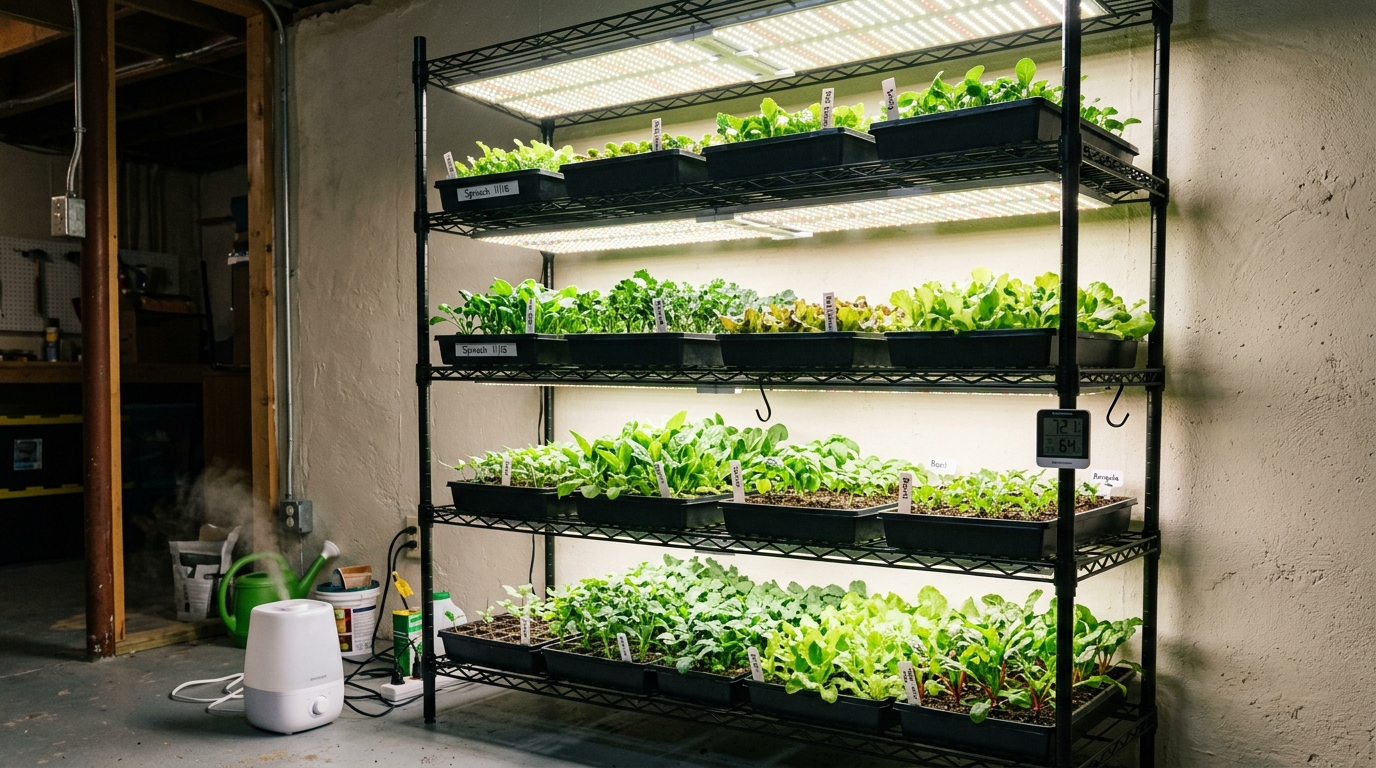
Indoor gardening sells across a $30 to $5,000 cost range, and the marketing doesn’t make the difference clear. A complete kit can mean three terracotta pots on a sunny windowsill ($30) or a 4-tier metal rack with full lighting under a grow tent ($1,500+). This guide walks through real all-in costs at every tier, plus the recurring monthly costs that most “how much does indoor gardening cost” articles skip.
What’s in a complete setup
Every indoor gardening setup needs four things:
- Light source — natural window or grow light
- Container + medium — pots + soil, or hydroponic system + growing medium
- Water + nutrients — plain water for soil; nutrient-mixed water for hydroponic
- Plants — seeds, seedlings, or pre-seeded pods
The cost of (3) and (4) are recurring monthly; (1) and (2) are upfront.
Tier-by-tier cost breakdown
Tier 0: Windowsill — $30-50 total
The honest cheapest path. Buy 4-6 small terracotta pots, a bag of indoor potting mix, a handful of seed packets, and put them on a sunny south-facing window.
Best for absolute beginners; users with adequate window light
Indoor Herb Garden Starter Kit (pots + soil + seeds, no grow light)
The cheapest legitimate path to indoor gardening. \$30-50 buys you 4-6 terracotta or biodegradable pots, a bag of indoor potting mix, packets of common herb seeds (basil, parsley, cilantro, chives, mint), plant labels, and basic care guide. Add a sunny south-facing window and you have a working indoor herb garden. The trade-off: you start from seed (4-6 week growth cycle) and you depend on natural light (limited in winter or in low-light apartments).
★★★★☆ (3,400 reviews)
Check current price on Amazon →Line items:
- Terracotta pots (4-6 × 4-inch): $15-25
- Indoor potting mix (1.5 quart bag): $8-12
- Seed packets (6 herbs): $10-20 ($2-3 per packet; each yields 50-200 plantings)
- Plant labels and basic mister: $5-10
- Total: $38-67
Recurring monthly: $0 (use rainwater or tap; resupply seeds annually at under $20/year).
Tier 1: Smart herb garden — $150-300 total
The “turnkey” tier. A pre-packaged smart garden with integrated LED and pre-seeded pods.
Best for users without a sunny windowsill, or anyone wanting zero learning curve
AeroGarden Bounty (9-pod smart herb garden)
The smart herb garden tier exists for users without natural light or without time for daily plant management. The AeroGarden Bounty is \$200-280 for 9 pods, integrated 50W LED, automatic watering reminders, and a 16-hour daily light cycle. Refill pods cost \$15-20 for 9 plants (~\$1.50-2.50 per plant), lasting 4-6 months per cycle.
★★★★☆ (6,800 reviews)
Check current price on Amazon →Line items:
- AeroGarden Bounty: $200-280
- Replacement nutrient packets (1-year supply): $15-25
- Extra pod kits (2 cycles per year): $30-40
- Plant labels (mostly included): $0
- Total upfront: $215-305
Recurring monthly: $10-15 (pods + nutrients + ~$3-5 electricity).
Tier 2: Real grow light + soil — $150-300 total
Skip the pre-packaged smart garden; buy a proper LED grow light and pots separately. More control, less convenience, similar cost.
Best for users ready to learn proper indoor gardening with real lighting
Spider Farmer SF-1000 + Pots + Soil + Timer Kit
The Spider Farmer SF-1000 at \$120-150 is a real LED grow light with Samsung LM301B diodes — strong enough for serious herb and leafy-green growing in a 2×2 ft area. Pair with 6-8 plastic or terracotta pots, indoor potting mix, a 24-hour timer (\$10-15), and seeds. Total kit \$150-300. The trade-off vs an AeroGarden: more setup, more learning, but you grow real-size plants rather than pod-sized ones.
★★★★★ (2,100 reviews)
Check current price on Amazon →Line items:
- LED grow light (Spider Farmer SF-1000): $120-150
- Light timer: $10-15
- Pots (6-8 × 4-6 inch): $20-40
- Indoor potting mix (2 quart): $10-15
- Seed packets: $10-20
- Soil moisture meter: $10-15
- Total upfront: $180-255
Recurring monthly: $5-10 (electricity for lights; seed and nutrient costs amortize to negligible).
Tier 3: Hydroponic tower — $400-1,200 total
The vertical hydroponic tower tier — automated, productive, premium experience.
Best for users committed to indoor gardening as a serious hobby or food-supply strategy
Lettuce Grow Farmstand (12-plant vertical hydroponic tower)
The Farmstand is the premium vertical hydroponic tower for serious home growers. The 12-plant base model runs \$400-600; expanding to 30 plants adds \$200-400. Integrated grow lights are an optional \$300-400 add-on (worth it if you don't have a sunny spot). Self-watering on a 24-hour cycle; you mix nutrients into the reservoir every 2-3 weeks. The math: a household eating salads 3-4×/week from their Farmstand replaces roughly \$30-50/month in grocery greens, paying back in 12-18 months.
★★★★★ (1,400 reviews)
Check current price on Amazon →Line items:
- Lettuce Grow Farmstand 12-plant: $400-600
- Glow Rings (LED grow lights) for indoor use: $300-400 if not using natural light
- Nutrient solution (6-month supply): $60-90
- Replacement seedling pods (1 year): $150-250
- pH meter + pH Down: $30-50
- Total upfront: $450-1,200
Recurring monthly: $20-40 (pods + nutrients + electricity).
Tier 4: Premium grow rack — $1,000-3,000 total
The serious-grower tier. 4-tier metal rack with full LED lighting, year-round production at scale.
Best for serious indoor growers; year-round leafy greens at meaningful scale
4-Tier Metal Grow Rack + 4 LED Grow Light Panels
A 4-tier metal rack with LED lights under each shelf gives you 32-40 sqft of growing area in a 2×4 ft floor footprint. Each tier holds 1020 seed-starting trays for spring seed-starts, or leafy greens for daily harvests, or microgreens for high-density production. The rack itself runs \$100-200; outfitting with proper LED grow lights (4× Spider Farmer SF-1000 or 2× SF-2000) adds \$400-600. Add fans for circulation, a digital thermo-hygrometer, and a humidifier for total kit cost \$1,000-2,000.
★★★★★ (1,200 reviews)
Check current price on Amazon →Line items:
- 4-tier metal rack: $100-200
- LED grow lights (4× SF-1000 or 2× SF-2000): $400-600
- Hanging hardware + timers: $30-50
- Clip-on fans (2-4): $30-60
- Digital thermo-hygrometer: $15-25
- Seed-starting trays + humidity domes: $30-60
- Indoor potting mix (4+ bags): $30-50
- Seeds, fertilizer, soil meter: $30-60
- Optional humidifier: $30-60
- Total upfront: $700-1,200 (minimum) to $1,500-2,500 (premium build)
Recurring monthly: $30-80 (electricity dominates; fertilizer and seeds amortize cheaply).
Recurring monthly cost summary
| Product | Best for | Rating | Notes | |
|---|---|---|---|---|
| Tier 0: Windowsill (no grow light) | $0-3/month | — | Water + seeds + occasional fertilizer. | — |
| Tier 1: Smart herb garden (AeroGarden) | $10-15/month | — | Pod refills + nutrients + electricity. | — |
| Tier 2: Real LED + soil | $5-10/month | — | Electricity dominates; reusable pots. | — |
| Tier 3: Hydroponic tower | $20-40/month | — | Pods + nutrients + electricity. | — |
| Tier 4: Premium grow rack | $30-80/month | — | Lights + fans + replenishment supplies. | — |
What’s not worth buying
Three categories that show up in “indoor garden starter” articles but aren’t worth the spend:
- “Smart” plant pots with app integration under $80. The sensors are usually wildly inaccurate, the apps are buggy, and a $5 soil moisture meter outperforms them.
- AI plant care apps with subscription fees. Plant identification apps (free tier) are useful; ongoing subscription-based “AI plant care assistants” are mostly marketing for very basic guidance you can get free from r/IndoorGarden.
- Premium “designer” pots over $30 each. The pot doesn’t make the plant grow. Cheap plastic or terracotta pots work equally well at 1/5 the cost. Spend the money on more plants instead.
Cost vs grocery store comparison
A household that eats fresh herbs and salad greens 3-4× per week spends roughly $50-80/month on grocery store fresh greens (organic) or $30-50/month (conventional).
Indoor garden replacement cost (after upfront equipment):
- Tier 1 (smart herb garden): saves $15-30/month after pod costs
- Tier 2 (real LED + soil): saves $30-50/month after electricity
- Tier 3 (hydroponic tower): saves $10-25/month after nutrients and pods
- Tier 4 (premium grow rack): saves $30-60/month, plus seasonal vegetables
Payback timeline:
- Tier 1: 12-18 months
- Tier 2: 4-9 months
- Tier 3: 18-30 months
- Tier 4: 24-48 months
The cheaper tiers pay back faster because there’s less to recover. The premium tiers produce more food but take longer to break even on equipment.
FAQ
Frequently asked questions
Is indoor gardening actually cost-effective?
How much electricity does an indoor garden use?
AeroGarden is expensive — is it worth it?
What's the cheapest path to fresh herbs at home?
Are hydroponic towers worth $400-1,200?
Do I need to buy "indoor" specific potting soil?
Bottom line
Realistic all-in budgets:
- Testing the habit / minimal: $30-50 (windowsill pots + seeds)
- Smart turnkey: $215-305 (AeroGarden Bounty + extras)
- Real LED + soil: $180-255 (SF-1000 + pots + seeds)
- Hydroponic tower: $450-1,200 (Lettuce Grow Farmstand or Gardyn)
- Premium grow rack: $700-2,500 (4-tier rack + multi-panel LED)
Pick the tier that matches your eating patterns and time availability. A $200 AeroGarden used daily produces more value than a $1,500 grow rack used once a week.
For specific picks: grow lights, hydroponic systems, smart herb gardens, setup guide, pillar overview.