guides
How to Grow Rosemary Indoors: Complete Growing Guide
Grow rosemary indoors with 6-8 hours of direct sun or a grow light, sandy fast-draining soil, and infrequent watering. Step-by-step herb guide.
 Priya Anand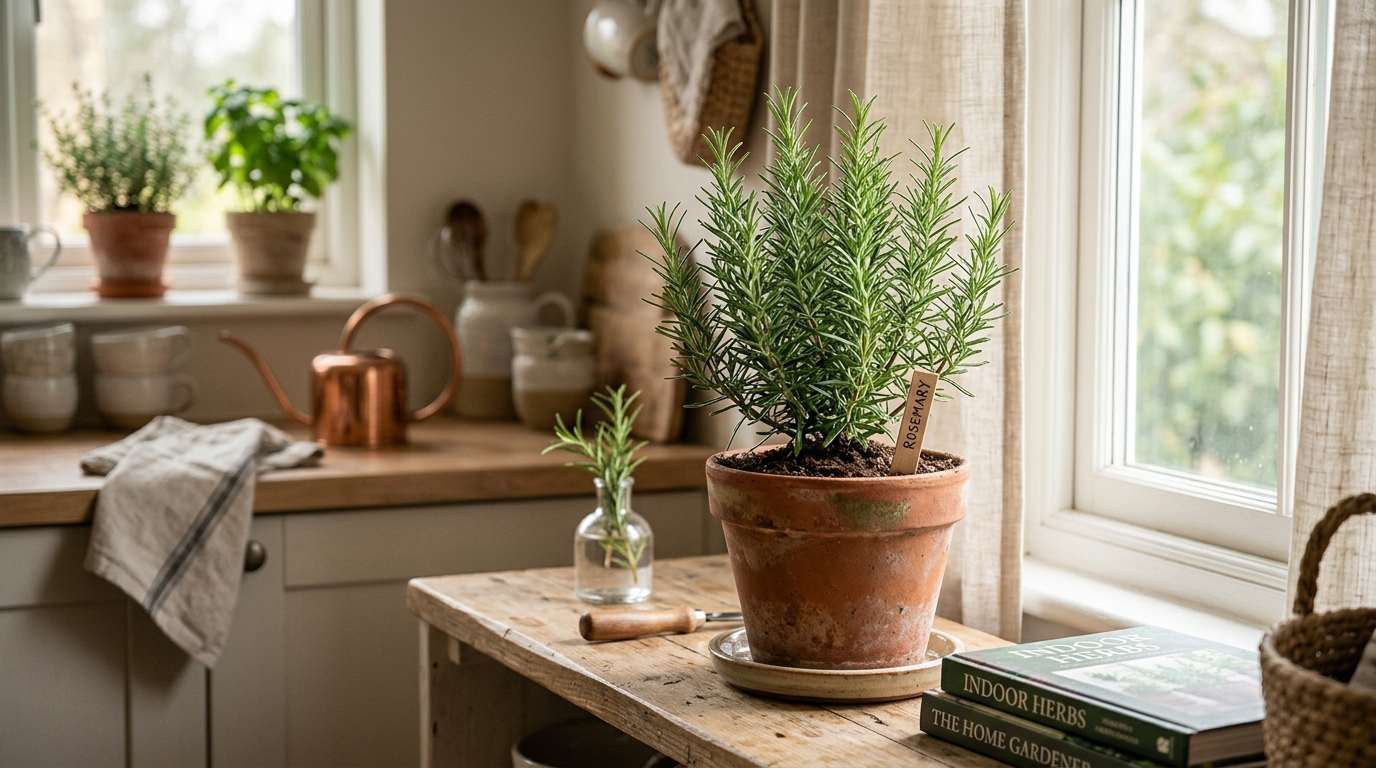
Rosemary grows best indoors in a 6-inch terracotta pot filled with a sandy, fast-draining mix and placed in your brightest south-facing window — ideally 6–8 hours of direct sun daily — or under a full-spectrum grow light running 14–16 hours per day. Water only when the top 2–3 inches of soil are completely dry. Tuscan Blue and Arp are the top culinary varieties for indoor containers; both produce intensely aromatic leaves and tolerate container life well.
Of all the Mediterranean culinary herbs, rosemary is simultaneously the most dramatic success and the most frustrating failure for indoor growers. When conditions are right — abundant light, extremely fast-draining soil, and restrained watering — a single plant can grow for decades, eventually becoming a fragrant woody shrub that fills a corner of any kitchen or living room. When conditions are even slightly off — soggy soil, poor airflow, or a dim window — rosemary declines slowly and often irreversibly. Understanding rosemary’s native habitat is the key to keeping it alive indoors: the rocky limestone cliffs and dry coastal hillsides of the Mediterranean basin, where thin soil dries quickly, sun beats down for long hours, and salt-laden breezes keep humidity low and airflow constant.
Is growing rosemary indoors worth it?
Rosemary is one of the most rewarding long-term herb investments for a home kitchen. Unlike annual herbs that need yearly replanting, rosemary is a woody perennial that lives for a decade or longer as a container plant when given proper care. A single healthy plant provides continuous fresh rosemary year-round, eliminating the need to buy $4 fresh herb packets — which routinely go limp in a refrigerator before they are used — from the grocery store.
The culinary case for fresh rosemary is compelling. The aromatic diterpene compounds (notably camphor, borneol, and rosmarinic acid) that give rosemary its distinctive resinous, pine-like fragrance degrade significantly during drying and packaging. A jar of dried rosemary from a grocery store spice rack may have been processed months or years before purchase. Fresh rosemary picked moments before cooking delivers a depth of fragrance and complexity that dried rosemary simply cannot match, especially in long-cooked dishes like roasted chicken, lamb, focaccia, and roasted root vegetables.
Beyond the culinary value, rosemary is ornamentally beautiful as an indoor plant. It develops an attractive gnarled, woody trunk over time, produces small blue-purple flowers that attract beneficial insects when given enough light, and carries a fragrance that perfumes a room naturally. A well-tended rosemary plant in an attractive pot becomes a permanent feature of a kitchen or sunny living room rather than a disposable seasonal herb.
What you need to grow rosemary indoors
| Product | Best for | Rating | Notes | |
|---|---|---|---|---|
| Terracotta pot 6-8 inch with drainage hole | Wicking excess soil moisture and giving rosemary roots room to spread | ★★★★★ | Rosemary grows considerably larger than thyme or basil and benefits from a 6-8 inch pot from the start. Terracotta is essential rather than merely preferred: its porous clay walls actively pull moisture from the root zone, providing an extra margin against the overwatering that kills most indoor rosemary. Always confirm a large drainage hole — rosemary sitting in standing water for even 24 hours can develop root rot. | Check price |
| Coarse perlite or horticultural sand | Replicating the rocky, fast-draining soil rosemary evolved in | ★★★★★ | Mix standard potting soil 50/50 with perlite or coarse horticultural sand. For even better drainage, use a commercial cactus-and-succulent potting mix as the base. Rosemary native soils are thin, rocky, and alkaline — any standard peat-heavy mix holds far too much moisture and will eventually cause root rot without generous amendment. | Check price |
| Rosemary transplant — Tuscan Blue or Arp variety | Starting with a vigorous culinary rosemary variety suited to container growing | ★★★★★ | A nursery transplant is far faster than growing from seed — rosemary germinates slowly (14-21 days) and takes 3-4 months to reach harvestable size from seed. Look for Tuscan Blue (upright, intense flavor, compact) or Arp (cold-tolerant, excellent indoors through winter). Avoid unlabeled generic rosemary from grocery store herb sections, which are often stressed and poorly suited to long-term indoor growth. | Check price |
| Full-spectrum LED grow light | Supplementing low winter light or growing rosemary away from a bright south-facing window | ★★★★★ | Rosemary needs more light than nearly any common culinary herb. Even a south-facing window may not sustain it through winter in northern latitudes. A full-spectrum LED panel running 14-16 hours daily, 4-6 inches above the canopy, produces the same growth quality as full outdoor sun. Without adequate light, rosemary stretches, loses flavor concentration, and becomes vulnerable to mildew and pests. | Check price |
| Small oscillating fan | Preventing powdery mildew by ensuring airflow around rosemary foliage | ★★★★★ | Powdery mildew — a white fungal coating on leaves — is the second most common cause of indoor rosemary failure after root rot. It thrives in stagnant, humid air and can devastate a plant in weeks. A small fan running on low for a few hours daily, pointed near but not directly at the plant, reduces mildew risk dramatically and also strengthens stems through gentle movement. | Check price |
| Outlet timer for grow light | Automating a consistent 14-16 hour light schedule for rosemary without daily manual switching | ★★★★★ | A $10-15 mechanical outlet timer removes the need to manually switch a grow light daily and ensures rosemary gets a stable, consistent photoperiod. Irregular light schedules produce uneven, weaker growth. Pairing a timer with a quality LED panel is the most reliable way to maintain culinary-grade rosemary growth through short winter days. | Check price |
Step 1: Choose the right rosemary variety
Rosemary (botanically Salvia rosmarinus, formerly Rosmarinus officinalis) encompasses dozens of cultivars that vary in growth habit, cold tolerance, flavor profile, and suitability for container growing. Selecting the right variety for indoor use saves years of frustration.
Best indoor culinary varieties:
- Tuscan Blue — the top recommendation for indoor containers. Upright, columnar growth to 3–4 feet tall in a large pot, with dense dark green needles and intense pine-and-camphor flavor. Excellent for all culinary applications. A 6-inch pot sustains it for 1–2 years before repotting.
- Arp — the most cold-tolerant variety available, reliably surviving temperatures down to 0°F outdoors. Indoors, this means it handles the cooler conditions near winter windows without stress. Slightly more gray-green than Tuscan Blue, with excellent culinary flavor. The best choice if your indoor space drops below 55°F in winter.
- Blue Spires — compact, upright growth with strong flavor and good disease resistance. Slightly smaller than Tuscan Blue, making it ideal for a kitchen counter where space is limited. A dependable all-around container variety.
- Prostratus (creeping rosemary) — a low, trailing habit that cascades beautifully over the edge of a hanging planter or elevated pot. Produces small lavender-blue flowers prolifically. Slightly milder flavor than upright varieties, but still fully culinary. Excellent when ornamental effect matters as much as harvest volume.
- Barbecue rosemary — a robust upright variety with notably long, thick stems ideal for using as skewers or flavor infusions on the grill. Strong, rich flavor with good vigor in containers.
Starting from transplant vs. seed:
Rosemary from seed is a rewarding but slow project. Seeds germinate in 14–21 days at 70–75°F soil temperature with bottom heat, but have notoriously low germination rates (30–50% even under ideal conditions). From germination to a harvestable plant takes 3–4 months. For most indoor growers, a nursery transplant is the practical choice — a healthy 3-inch transplant from a garden center or herb section is harvestable within 3–4 weeks and costs only $3–6.
Step 2: Pot and soil setup
Rosemary’s root system is adapted to thin, rocky, alkaline soils that dry out rapidly. Replicating these conditions in a container is essential — the main ways indoor rosemary fails are consistently traced to soil that holds too much moisture.
Choosing the right pot:
- Select a terracotta pot at least 6 inches wide and 6 inches deep for a single transplant
- An 8-inch pot gives more room for root expansion and requires less frequent repotting
- Terracotta’s porous clay walls actively draw moisture outward from the root zone — this passive wicking provides an essential safety margin against overwatering that plastic or glazed pots cannot offer
- The pot must have a large drainage hole; multiple small holes are acceptable but one large hole is better than clogged small ones
- Elevate the pot on pot feet or a small saucer with stones to prevent roots from sitting in any standing water
Soil mix:
Standard bagged potting soil retains far too much moisture for rosemary. Choose one of these approaches:
- Option 1 (simplest): Purchase a bagged cactus-and-succulent potting mix and use it straight, or add 20–30% additional perlite for extra insurance.
- Option 2 (custom): Mix 1 part standard potting soil with 1 part coarse perlite and 1 part coarse horticultural sand. This produces an exceptionally fast-draining medium.
- Optional: Add a tablespoon of agricultural limestone or crushed oyster shell per 6-inch pot to raise pH slightly. Rosemary prefers a pH of 6.0–8.0, slightly more alkaline than most potting mixes.
Planting:
Cover the drainage hole with a small piece of mesh screen to prevent soil loss. Fill the pot to within 1 inch of the rim. For a transplant, handle the root ball gently — rosemary is more sensitive to root disturbance than most herbs. Do not break apart the root ball. Set the plant at the same depth as in its nursery container and firm soil around it lightly. Water once thoroughly after planting to settle the roots, then allow the soil to dry out fully before the next watering session. This initial dry-down period is important for encouraging deep root growth.
Best for providing the fast-draining base medium that rosemary, thyme, and lavender need indoors
Hoffman 10410 Organic Cactus and Succulent Soil Mix
A cactus-and-succulent potting mix is the easiest route to the fast-draining, mineral-rich medium rosemary evolved in. Hoffman's blend contains limestone-adjusted pH and coarse sand already incorporated — you can use it straight from the bag for rosemary, or blend it 70/30 with standard potting mix for slightly more moisture retention. Compared to amending a peat-heavy mix from scratch, this saves time and produces more consistent drainage. A 4-quart bag handles 2-3 herb pots thoroughly at around $8-10.
★★★★★ 4.6 · 6,200 reviews
Check current price on Amazon→Step 3: Provide intense light
Light is the most critical variable for indoor rosemary — more so than for any other common culinary herb. In its native Mediterranean habitat, rosemary grows under intense, direct summer sun for 10–14 hours per day. Indoors, replicating this intensity is the single biggest challenge.
Window placement:
A south-facing window providing 6–8 hours of direct sun is the minimum viable location for rosemary. In the Northern Hemisphere, south-facing windows receive the most direct sun throughout the year. East- and west-facing windows (3–4 hours of direct sun) are generally insufficient for strong rosemary growth and flavor production — plants may survive but growth is leggy and flavor is noticeably weaker.
In summer, the intensity through a south-facing window can cause heat stress if the plant is pressed against the glass. Keep rosemary 6–12 inches from the pane on the hottest days and ensure good airflow around the plant.
Using a grow light:
From October through March in most of the northern United States, even a south-facing window may provide inadequate light intensity for strong rosemary growth. A grow light is the most reliable solution:
- Run a full-spectrum LED panel for 14–16 hours daily
- Position it 4–6 inches above the top of the plant
- A timer ensures consistent light periods without daily manual switching
The aroma test: rub a few rosemary needles between your fingers. Strong, immediate pine-and-camphor fragrance = adequate light. Mild or barely detectable scent = increase light intensity or duration immediately.
Insufficient light shows as:
- Elongated, widely-spaced needles on thin, floppy stems
- Pale gray-green rather than deep green needles
- Little to no fragrance when leaves are touched
- Slow or no new growth over several weeks
Step 4: Water rosemary correctly
Root rot from overwatering kills more indoor rosemary than any other cause — more than insufficient light, more than cold, more than pests. Rosemary evolved in a climate with dry summers and well-drained rocky soil; the root zone dries completely between rains. Indoor rosemary must be managed with the same discipline.
Core rule: Water only when the top 2–3 inches of soil are completely dry. Insert a finger to the second or third knuckle — the soil should feel dry and crumbly, not cool or slightly damp. In summer, this typically means watering every 10–14 days. In winter, extend the interval to 14–21 days as growth slows.
How to water:
Pour water slowly and thoroughly until it flows freely from the drainage holes. Then stop, empty the saucer 20–30 minutes later, and do not water again until the soil has dried out as described above. Deep, infrequent watering encourages roots to grow downward in search of moisture, producing a more drought-tolerant and resilient plant than shallow, frequent watering.
Signs of overwatering (act immediately):
- Browning or blackening of needle tips that progresses from the bottom of the plant upward
- Soft, mushy, or blackened stems at the soil line — this is root rot entering the crown
- Soil with a sour, anaerobic odor
- Plant appears wilted or limp despite moist soil
If you detect root rot early, remove the plant from the pot, allow the root ball to dry for 24 hours in a warm location, cut away any brown or black roots with sterile scissors, repot in completely fresh dry soil mix, and withhold water for 7–10 days. If root rot has reached the crown and main stems, the plant is generally unrecoverable.
Signs of underwatering:
- Slight wilting of stem tips that recovers within hours of watering
- Needles curling or drying slightly at the tips
- Soil pulling away from pot sides entirely
Brief underwatering is always recoverable. When in doubt, wait another 2–3 days before watering.
Step 5: Manage temperature and airflow
Rosemary grows best in temperatures between 60–75°F — conditions comfortable for most human living spaces. However, two temperature-related issues commonly affect indoor rosemary:
Avoid heating vents and radiators: Forced-air heating creates very low humidity (10–20% relative humidity) and can desiccate rosemary needles in winter. Keep rosemary away from direct airflow from vents. If your indoor air is very dry in winter, placing a small tray of pebbles and water near (not under) the pot raises local humidity modestly without wetting the roots.
Cold windows in winter: Windowsills can drop to 40–50°F directly against the glass on cold nights, stressing or damaging rosemary. If winter temperatures fall below 55°F near your window, move the plant a few inches back from the glass on the coldest nights or place insulating material between the plant and the window.
Airflow and powdery mildew prevention:
Powdery mildew is rosemary’s most common disease problem indoors. The white fungal powder spreads rapidly in stagnant, humid air and can cover a plant completely in 2–3 weeks. Prevention is far easier than treatment:
- Position a small fan to create gentle air movement near the plant for several hours daily
- Space rosemary away from walls and other plants to allow airflow on all sides
- Avoid misting the foliage — rosemary does not benefit from misting and wet needles promote mildew
If powdery mildew appears, prune away all visibly affected stems, improve airflow immediately, and apply a diluted neem oil solution to remaining foliage weekly until symptoms clear.
Step 6: Fertilize sparingly
Like thyme and oregano, rosemary produces its most intense aromatic oils under lean conditions. In its native rocky habitat, rosemary grows in near-mineral soils with very low nutrient content — intense fertilization indoors encourages lush, flavorless growth rather than the dense, resinous foliage that makes it culinarily valuable.
Feed lightly: apply a diluted liquid fertilizer at half or quarter strength once per month from March through September. A balanced formula (such as 10-10-10) or an herb-specific fertilizer both work. Skip fertilizing from October through February, when the plant grows slowly and has reduced nutrient needs.
Fresh potting mix contains adequate nutrients for the first 3–4 months after repotting. Worm castings mixed into the top inch of soil at repotting time provide a slow, gentle nutrient supply that supports growth without triggering the soft, over-fertilized growth that reduces flavor.
Step 7: Harvest and prune rosemary
Regular harvesting is essential for keeping indoor rosemary compact, productive, and attractive. Without regular trimming, rosemary becomes a rapidly growing woody shrub that outgrows its container and develops long, bare lower stems.
How to harvest:
Using clean, sharp scissors or pruning snips, cut stem tips 2–3 inches from the growing end, always snipping just above a node or pair of leaves. The plant regrows vigorously from nodes below each cut. Strip individual needles from cut stems as needed in the kitchen.
The most important rule: never remove more than one-third of the plant at any single harvest. Rosemary’s root system is limited by the container, and aggressive over-harvesting stresses the plant significantly. Take modest amounts frequently — every 2–3 weeks during active growth — rather than harvesting heavily once a month.
Managing size:
Rosemary can grow surprisingly large indoors given adequate light and time — Tuscan Blue in an 8-inch pot can reach 2–3 feet tall within 2–3 years. Shape the plant annually in early spring by cutting it back by up to one-third of its total size to maintain a manageable form. Always cut back to a point where green foliage is visible on the stem — rosemary rarely regrows from completely bare, woody stems without any green.
Flowers:
When rosemary produces small blue or purple flowers (most likely in late winter or early spring even indoors, triggered by slightly cooler temperatures and increasing day length), leave them in place. Rosemary flowers are edible, beautiful, and do not significantly reduce leaf production the way basil or cilantro bolting does. Both flowers and foliage are harvestable while the plant is blooming.
Best for harvesting rosemary stems precisely without crushing woody growth
Fiskars Micro-Tip Pruning Snips
Rosemary stems are among the woodiest of all culinary herbs, and kitchen scissors compress rather than cut them cleanly — a ragged cut heals slowly and creates entry points for disease. Fiskars micro-tip snips have a sharp, narrow blade that slices cleanly through woody rosemary stems at any node, and the spring-loaded mechanism reduces hand fatigue during longer harvests. The small head fits into dense, branching rosemary growth without disturbing surrounding stems. One pair lasts years and handles all herb harvesting needs. At $12-15, it is the most impactful single tool upgrade for anyone growing Mediterranean herbs indoors.
★★★★★ 4.8 · 28,500 reviews
Check current price on Amazon→Troubleshooting common indoor rosemary problems
Brown needle tips spreading upward from the base — the most common symptom of root rot from overwatering. Inspect the roots: healthy roots are white or tan; rotted roots are brown, black, and soft. If caught early, repot in fresh dry soil, cut affected roots, and withhold water for 7–10 days. If the main stem base is soft and discolored, the plant is likely unrecoverable.
Leggy stems with widely-spaced needles — insufficient light. Elongated growth is rosemary searching for more light intensity. Increase grow light duration to 16 hours, move the light 2–3 inches closer to the canopy, or relocate the pot to the brightest south-facing window available.
White powdery coating on needles and stems — powdery mildew. Prune all visibly affected growth immediately, increase airflow with a small fan, and apply diluted neem oil weekly. Mildew spreads rapidly — act the moment you notice it.
Yellow needles dropping from the lower half of the plant — either overwatering (check roots) or a natural response to low light combined with aging lower growth. If roots are healthy and white, improve light and airflow; some lower needle drop on an otherwise healthy plant is normal.
Sparse or no new growth in winter — normal seasonal slowdown. Rosemary grows slowly from November through February even under a grow light. Maintain the light schedule, reduce watering frequency, stop fertilizing, and wait for the plant to accelerate in late February as day length increases.
Spider mites (tiny moving dots, fine webbing on stems) — more common in dry winter indoor air. Spray the entire plant with water to dislodge mites, including stem undersides. Apply neem oil solution weekly for 3–4 weeks. Improve airflow and slightly raise humidity nearby.
Woody, unproductive lower stems — normal on older plants. Cut stems back to 3–4 inches from the base in early spring, cutting just above the lowest visible green foliage. Rosemary regrows strongly from lower nodes if any green tissue remains at the base.
FAQ
Frequently asked questions
Can rosemary survive indoors in winter?
Why does my indoor rosemary keep dying?
How much light does rosemary need indoors?
How often should I water rosemary indoors?
What is the best rosemary variety for indoor growing?
Can I grow rosemary from a grocery store cutting?
Why does my rosemary have no fragrance indoors?
Bottom line
Growing rosemary indoors rewards patience and attention to two non-negotiable fundamentals: maximum light (6–8 hours of direct sun or a grow light at 14–16 hours daily) and extremely fast-draining soil watered only when the top 2–3 inches are completely dry. Get those right and a single plant provides fragrant, intensely flavored rosemary for a decade or more without replanting.
Start with a Tuscan Blue or Arp transplant in a 6-inch terracotta pot filled with a 50/50 mix of potting soil and coarse perlite, or a cactus mix used straight. Place it in your brightest south-facing window or directly under a grow light. Water every 10–14 days in summer. Keep a small fan running nearby to prevent powdery mildew. Harvest stem tips every 2–3 weeks by trimming no more than one-third of the plant at a time, and the rosemary will remain compact, productive, and deeply aromatic year-round.
For more on growing culinary herbs indoors: how to grow herbs indoors for a complete herb overview, how to grow thyme indoors for a Mediterranean companion with identical care requirements, how to grow oregano indoors for another low-water Mediterranean herb, and best grow lights if your windows cannot provide enough direct sun for robust growth.