roundups
Best DWC Hydroponic Systems for Home Growing
Top deep water culture hydroponic systems for home growers — single bucket, multi-bucket, and RDWC picks for tomatoes, herbs, and leafy greens.
 Priya Anand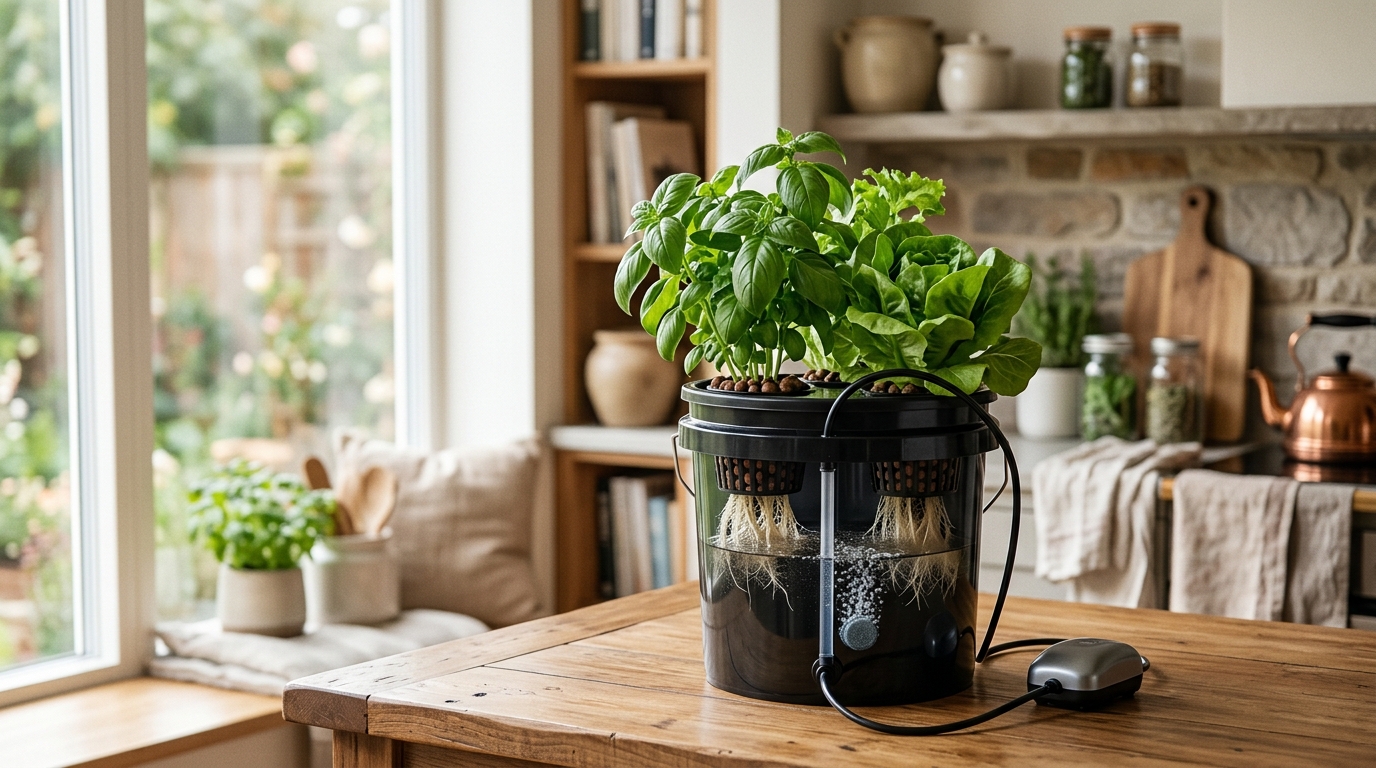
The best DWC hydroponic system for most home growers is a 5-gallon single-bucket kit like the General Hydroponics WaterFarm Complete, which grows one large plant — a tomato, pepper, cannabis, or basil specimen — faster than soil at $50–80. For growing multiple plants simultaneously, a 4-bucket recirculating kit reduces reservoir management to a single top-off point. DWC (Deep Water Culture) submerges plant roots in continuously aerated nutrient solution; it is the most forgiving hydroponic method for beginners and the best system for large fruiting plants.
How DWC hydroponics works
In Deep Water Culture, plant roots hang through a net pot lid directly into a reservoir filled with oxygenated nutrient solution. An air pump connected to an air stone keeps oxygen levels high enough that roots can breathe while fully submerged — the same principle as a fish tank aerator. Unlike NFT or drip systems, there are no channels, timers, or nutrient films to manage; the reservoir simply stays full and aerated.
A complete DWC system has four components:
- Reservoir — a lightproof bucket or tote (typically 5 gallons per large plant)
- Net pot lid — a tight-fitting lid with one or more 3-inch net cup holes for plant support
- Air pump and air stone — runs continuously to maintain dissolved oxygen above 6 mg/L
- Nutrient solution — pH-adjusted water with a two- or three-part hydroponic nutrient formula
The pump runs 24 hours a day. Water temperature must stay between 65°F and 72°F — warmer water holds less dissolved oxygen and encourages root rot pathogens. This is DWC’s primary technical constraint: in warm climates or under high-wattage lights, water chillers or insulated buckets become necessary.
DWC diverges into three variants at home scale:
- Standard DWC — one bucket per plant, each with its own air pump and reservoir. Simple, cheap, and portable. The nutrient solution in each bucket must be managed separately.
- Recirculating DWC (RDWC) — multiple buckets connected by tubing to a central reservoir and pump. All buckets share one nutrient solution, which means one pH and EC measurement controls the whole system. The best approach for growing 4–12 plants consistently.
- Kratky method — a passive DWC variant with no air pump. The plant consumes solution as it grows, creating an air gap at the surface. Works for lettuce and herbs, not for large fruiting plants.
Quick comparison
| Product | Best for | Rating | Notes | |
|---|---|---|---|---|
| General Hydroponics WaterFarm Complete | best single-bucket DWC for large plants | ★★★★★ | $50-80. 1 plant per unit. 8L reservoir. Expandable to multi-unit. | Check price |
| VIVOSUN 5-Gallon DWC Hydroponic Bucket Kit | best budget DWC starter for beginners | ★★★★☆ | $25-45. Single bucket. Air pump included. Good first system. | Check price |
| 4-Bucket DWC Recirculating System Kit | best multi-plant DWC for 4 large plants | ★★★★☆ | $100-180. 4 x 5-gallon buckets. Central reservoir. Single pH point. | Check price |
| Current Culture Under Current RDWC System | best premium RDWC for serious home growers | ★★★★★ | $300-600. Commercial-grade fittings. Sub-lid design. Proven yield gains. | Check price |
| General Hydroponics PowerGrower DWC System | best mid-range single-site DWC with larger reservoir | ★★★★★ | $60-100. 1 plant. 13L reservoir. Ideal for tomatoes and peppers. | Check price |
The picks
Best for most growers: General Hydroponics WaterFarm Complete
Best for home growers who want a proven single-bucket DWC system for one large plant — tomato, pepper, or large herb
General Hydroponics WaterFarm Complete DWC System
The General Hydroponics WaterFarm is the most field-tested single-bucket DWC system sold to home growers. It has been in continuous production since the 1980s and remains the benchmark against which all competing bucket systems are measured. The 8-liter reservoir supports one large plant through its full growth cycle; a drip ring in the lid trickles nutrient solution over the substrate and into the reservoir, adding top-feeding during establishment before root development is complete. The module design allows linking multiple WaterFarms to a single reservoir pump for multi-plant grows, which is why it remains the preferred choice of growers who start small and scale up over time. At \$50–80 the WaterFarm ships with the bucket, lid, drip ring, air pump, tubing, and starter nutrient sample — everything needed for a first DWC grow except nutrients and pH adjusters. It is the right default choice for anyone growing one or two large plants indoors.
★★★★★ 4.6 · 3,400 reviews
Check current price on Amazon→Pros
- Decades of proven design refinement
- Drip ring aids root establishment from seedlings
- Modular — multiple units link to one reservoir
- Complete kit with pump, tubing, and nutrients sample
- Replacement parts always in stock
Cons
- 8-liter reservoir requires topping up every 2-3 days for large plants
- Drip ring can clog if using certain organic nutrients
- Single-plant capacity — not the right choice for growing 4+ plants
Best budget: VIVOSUN 5-Gallon DWC Bucket Kit
Best for first-time DWC growers who want to learn the method with minimal upfront cost before committing to a premium system
VIVOSUN 5-Gallon DWC Hydroponic Bucket Kit
VIVOSUN makes the most-purchased budget DWC kit on Amazon and the right starting point for growers who want hands-on experience with deep water culture without a significant upfront investment. The 5-gallon black bucket is fully lightproof, which is essential for preventing algae growth in the reservoir — cheaper clear-bucket kits fail here immediately. The included air pump delivers adequate aeration for one plant in a 5-gallon bucket, and the 3-inch net pot lid fits standard rockwool starter cubes and rapid rooter plugs. Build quality is functional rather than premium: the lid seal is adequate but not as tight as General Hydroponics lids, and the air pump is rated for replacement after 18–24 months of continuous use. For growers whose goal is to complete one or two grows and understand DWC mechanics before deciding whether to scale up, the VIVOSUN kit at \$25–45 delivers that experience effectively.
★★★★☆ 4.3 · 5,200 reviews
Check current price on Amazon→Pros
- Fully lightproof black bucket prevents algae
- 3-inch net pot lid fits standard rockwool starters
- Lowest upfront cost of any complete DWC kit
- Wide replacement parts availability on Amazon
Cons
- Lid seal is less tight than premium buckets
- Air pump is entry-grade — plan to replace after 18 months
- No drip ring for top-feeding during establishment
Best multi-plant: 4-Bucket Recirculating DWC Kit
Best for home growers who want to grow 4 large plants simultaneously with one shared nutrient reservoir
4-Bucket Recirculating DWC Hydroponic System Kit
A recirculating 4-bucket DWC kit is the most efficient way to grow 4 large plants like tomatoes, peppers, or large-canopy herbs in a grow tent. All four buckets connect via tubing to a central 8–10-gallon controller reservoir, so pH and EC are adjusted once and the change propagates to every bucket automatically. This single-management-point advantage makes RDWC dramatically less labor-intensive than running four independent DWC buckets — checking, adjusting, and topping up four separate reservoirs daily adds 20–30 minutes of work per grow cycle that recirculating designs eliminate entirely. The typical 4-site RDWC kit in the \$100–180 range ships complete with buckets, lid net pots, controller reservoir, pump, tubing, and fittings. Look for kits where the controller bucket sits at the same height as the grow buckets — gravity-fed systems that require the controller to sit below the buckets are more difficult to drain and clean than recirculating pump-driven designs.
★★★★☆ 4.4 · 1,100 reviews
Check current price on Amazon→Pros
- Single pH and EC management point for all 4 plants
- Shared reservoir cuts daily maintenance time significantly
- Scales consistently — all plants receive identical nutrient solution
- Better yield consistency across plants than independent buckets
Cons
- If one plant develops root rot it can spread to all plants through shared solution
- More complex setup than standalone buckets — allow 3-4 hours for first assembly
- Tubing connections must be fully lightproof to prevent algae in the lines
Best premium RDWC: Current Culture Under Current System
Best for serious home growers and small commercial operators who want the highest-yield RDWC system available
Current Culture Under Current RDWC System
Current Culture H2O builds the Under Current, the most respected RDWC system in commercial and serious home cultivation. Unlike conventional RDWC designs that pump solution through the top of each bucket, the Under Current recirculates through sub-lid fittings that create continuous turbulence at the root zone — a dissolved oxygen delivery method that Current Culture's published trial data shows increases biomass production by 30–50% versus static DWC under equivalent lighting and nutrient conditions. The fittings, lid seals, and reservoir construction are commercial-grade; the system is designed to run continuously 365 days a year without fitting failure or seal degradation. At \$300–600 for a 4-site configuration, it costs two to four times more than mid-range RDWC kits, but the yield premium and build longevity justify the cost for growers running year-round with multiple harvests. Current Culture also offers detailed setup documentation, yield-optimization guides, and support from staff with actual cultivation experience.
★★★★★ 4.8 · 780 reviews
Check current price on Amazon→Pros
- Sub-lid recirculation maximizes dissolved oxygen at the root zone
- Commercial-grade fittings and seals built for continuous operation
- Documented 30-50% yield increase over static DWC in published trials
- Full technical support from staff with real cultivation experience
Cons
- Highest upfront cost in the DWC category
- More than needed for occasional or seasonal growing
- Some configurations require freight shipping
Best mid-range single-site: General Hydroponics PowerGrower
Best for growers who want a larger single-site DWC with a 13-liter reservoir for tomatoes, peppers, or squash that need more root space
General Hydroponics PowerGrower DWC System
The General Hydroponics PowerGrower is the WaterFarm scaled up for large fruiting plants. The 13-liter reservoir reduces top-up frequency to every 4–6 days for a mature tomato plant versus every 2–3 days with the WaterFarm — a meaningful quality-of-life difference for indeterminate tomato varieties that drink heavily during fruiting. The larger net pot supports 6-inch rockwool cubes or substantial root ball transplants from soil starts, which the WaterFarm's 3-inch net pot cannot accommodate. General Hydroponics uses the same drip ring design as the WaterFarm for top-feeding during establishment, and the PowerGrower modules link to a shared reservoir pump in the same way. At \$60–100 it sits between the WaterFarm and a full 4-bucket RDWC kit and is the right single-site DWC when crop choice is a large fruiting plant that will spend 3–5 months in the system.
★★★★★ 4.5 · 1,650 reviews
Check current price on Amazon→Pros
- 13-liter reservoir means less frequent top-ups for large plants
- Larger net pot supports 6-inch rockwool cubes and big transplants
- Same proven General Hydroponics drip ring design as WaterFarm
- Links to multi-unit configurations with the WaterFarm
Cons
- Single-plant capacity only
- Drip ring can clog with thick organic nutrient solutions
- Larger footprint than the WaterFarm for the same plant count
What to skip
Clear or translucent buckets. Any DWC reservoir that lets light through will grow algae in the nutrient solution within days. Algae compete with your plant for nutrients, clog air stones and tubing, and crash dissolved oxygen levels. Always use fully lightproof black or dark green buckets — never white, gray, or translucent food-grade containers without an external light barrier.
5-gallon buckets for multiple plants per bucket. A single 5-gallon bucket can only support one large plant. Forcing two tomato or pepper plants into one bucket causes severe root competition, nutrient deficiency, and dissolved oxygen depletion. If you want four plants, use four buckets — or a purpose-built 4-site recirculating kit.
Air stones rated below your bucket volume. A small aquarium air stone running in a 5-gallon bucket is inadequate — dissolved oxygen levels will be borderline, and any warm water day will push roots into hypoxic stress. Use a 4-inch cylindrical air stone rated for 5+ gallons, connected to an air pump rated for at least 4 liters per minute per bucket.
Reservoir temperatures above 72°F. Warm water causes two problems: dissolved oxygen levels drop below the 5 mg/L threshold that roots need, and Pythium root rot pathogens reproduce rapidly above 72°F. Insulate reservoirs from heat lamps, keep grow room temperature at 68–75°F, and use a chiller if your summer baseline runs warmer than that.
DWC vs NFT vs Kratky: which should you choose?
Choose DWC when growing large fruiting plants — tomatoes, peppers, cucumbers, squash — that produce root masses too large for NFT channels. DWC is also the right choice for beginners because a brief pump failure does not immediately kill the crop: roots stay submerged in oxygenated solution and can survive several hours without the air pump running. The learning curve is the lowest of any hydroponic method.
Choose NFT when growing 30–100 leafy green plants horizontally and density is the priority. NFT uses less water than DWC, supports more plants per square foot in a horizontal layout, and grows lettuce and herbs at the highest density of any horizontal system. It is less forgiving than DWC: pump failure for 2–3 hours dries roots in thin channels.
Choose Kratky (passive DWC) when you want to grow lettuce or herbs with zero equipment beyond a container and nutrients. No air pump, no electricity for the reservoir. Kratky works for small, fast crops; it does not scale to fruiting plants or the multiple-gallon root masses that tomatoes and peppers develop.
Setting up a DWC system: the first-time checklist
-
Insulate the reservoir. Wrap buckets with reflective bubble insulation or place them inside a second bucket with insulating foam. Light and heat leaks into the reservoir are the two most common causes of DWC failure.
-
Start with pH-adjusted plain water. Before adding nutrients, fill and run the system for 24 hours with plain water at pH 6.0–6.5 to verify no leaks and confirm the air pump delivers visible surface agitation.
-
Add nutrients and target EC 0.8–1.2 for seedlings. Start with a lower EC than you will use for mature plants — seedling roots are sensitive to high salt concentrations. Increase to EC 1.8–2.4 as plants establish and transition to vegetative growth.
-
Transplant when the tap root is visible. Move seedlings into the net pot only after the tap root has grown through the starter cube — typically 7–14 days from germination. Placing seedlings before root emergence causes them to dry out before they can reach the nutrient solution.
-
Lower solution level after establishment. Once roots reach the reservoir, lower the solution level to leave a 1–2-inch air gap between the surface and the net pot bottom. This air gap — called a collar — gives upper roots oxygen exposure and prevents collar rot at the stem base.
-
Monitor dissolved oxygen and temperature daily for the first two weeks. A $15 dissolved oxygen meter confirms you are above 6 mg/L. Anything below 5 mg/L slows growth; below 4 mg/L triggers root hypoxia and creates conditions for Pythium root rot.
FAQ
Frequently asked questions
What is a DWC hydroponic system?
How many plants can you grow in one DWC bucket?
What nutrients do you use for DWC hydroponics?
What temperature should DWC water be?
How often do you change the water in a DWC system?
What is RDWC and how is it different from DWC?
Bottom line
The best DWC hydroponic system for most home growers is the General Hydroponics WaterFarm Complete for one large plant, or a 4-bucket recirculating kit when growing four plants simultaneously. Use the VIVOSUN 5-gallon kit to learn DWC mechanics before investing in a premium system. Upgrade to the Current Culture Under Current for year-round serious growing where yield is the priority.
Pair your DWC setup with the right hydroponic nutrients for your crop stage, use the EC and TDS meter guide to dial in concentration, follow the pH adjustment guide to stay in the 5.5–6.5 window, and read the root rot prevention guide before your first grow to keep the most common DWC failure from costing you a harvest.