guides
pH Adjustment Guide for Hydroponics
Learn how to test and adjust pH in hydroponics: ideal ranges, step-by-step process, and troubleshooting persistent pH drift for healthier plants.
 Priya Anand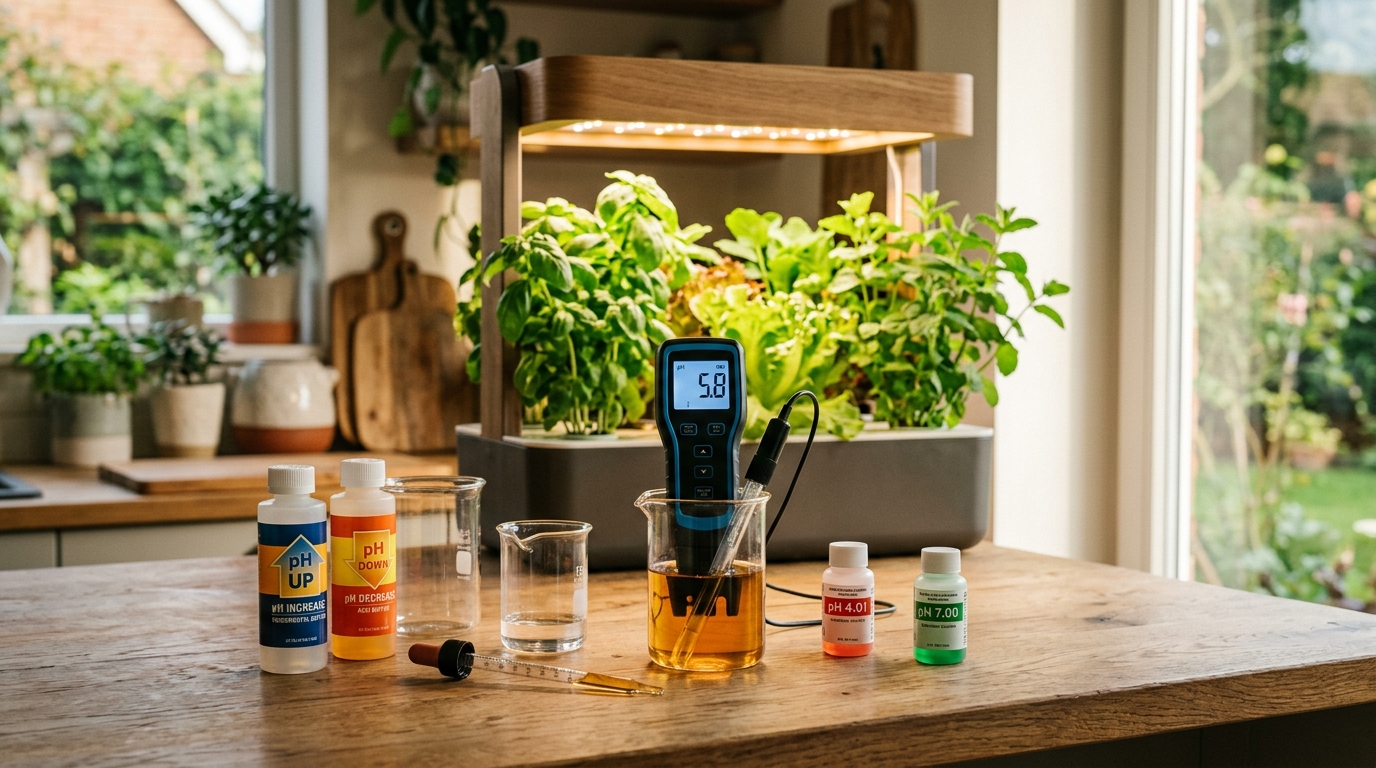
For hydroponics, target a pH between 5.5 and 6.5, with 5.8 to 6.2 being the sweet spot for most crops. Use a digital pH pen to test daily, and add pH Down (phosphoric acid) or pH Up (potassium hydroxide) in 1 ml increments per 5 gallons, wait 15 minutes, then retest before adjusting further.
Why does pH matter so much in hydroponics?
In soil growing, the biological activity of microbes and the buffering capacity of organic matter smooth out pH fluctuations naturally. In hydroponics, your roots sit directly in nutrient solution with no such buffer. The pH of that solution determines which nutrients are chemically available for root absorption — and the window is surprisingly narrow.
Each essential nutrient has a specific pH range at which it stays dissolved and accessible. Iron, manganese, and zinc become unavailable above pH 6.5. Calcium and magnesium become unavailable below pH 5.5. Phosphorus hits a narrow availability peak between 5.8 and 6.2. When pH drifts even half a point outside the target range, plants begin showing deficiency symptoms even when the nutrient is physically present in the solution at the correct concentration.
This is called nutrient lockout, and it is the single most common cause of poor yields and unhealthy plants in hydroponic systems that appear to be correctly maintained in every other way. A grower can add expensive nutrients at the correct ratios and still produce a deficient plant if pH is consistently off by one point.
pH and nutrient availability at a glance:
- pH 5.5 to 6.0: Optimal for iron, manganese, zinc, copper — the micronutrients
- pH 6.0 to 6.5: Optimal for calcium, magnesium, sulfur — the secondary macronutrients
- pH 5.8 to 6.2: The overlap zone where ALL major nutrient groups remain available simultaneously
Running between 5.8 and 6.2 keeps every nutrient accessible at the same time, which is why experienced growers treat this as a non-negotiable operating range.
What is the ideal pH for hydroponics?
The target pH depends slightly on what you are growing, but the differences are small enough that a universal target of 5.8 to 6.2 works reliably for the vast majority of hydroponic crops.
| Crop type | Optimal pH range |
|---|---|
| Leafy greens (lettuce, spinach, kale) | 5.5 to 6.5 |
| Herbs (basil, cilantro, mint) | 5.5 to 6.5 |
| Tomatoes, peppers, cucumbers | 5.8 to 6.3 |
| Strawberries | 5.5 to 6.0 |
| Cannabis | 5.5 to 6.5 |
In practice, aim for 5.8 to 6.2 for any crop. This range covers the overlap zone of maximum nutrient availability and is achievable with a single pH Down treatment in most municipal tap water, which typically starts around pH 7.0 to 7.5.
How to test pH in a hydroponic system
Test frequency:
- Daily for the first two weeks of a new grow
- Every 2 to 3 days once the system is stable
- Immediately after any reservoir top-off with fresh water
- Immediately after adding nutrients
Testing methods compared:
| Product | Best for | Rating | Notes | |
|---|---|---|---|---|
| Digital pH pen with ATC | Daily hydroponic pH management — the only accurate method for serious growing | ★★★★★ | Automatic temperature compensation adjusts readings for solution temperature, which matters because pH changes with temperature. Calibrate with buffer solution every 2 weeks. Accuracy within 0.01 pH. Required investment for any hydroponic grower. | Check price |
| pH liquid test kit (drops) | Backup verification or budget setups with fewer than 3 plants | ★★★★☆ | Cheaper than a digital meter but relies on color matching, which is subjective and inaccurate under grow lights with unusual color spectra. Acceptable as a backup but not reliable enough for daily management of a productive system. | Check price |
| pH test strips | Emergency spot checks only — not for regular hydroponic use | ★★★★☆ | Accuracy is typically only within 0.5 pH, which means a reading of 6.0 could be anywhere from 5.5 to 6.5. This range spans the entire acceptable window for hydroponics and provides no useful guidance for adjustment. | Check price |
Best for Any hydroponic system that requires reliable daily pH monitoring
Apera Instruments AI209 pH Pen
The AI209 reads to 0.01 pH precision with automatic temperature compensation, making it accurate across the temperature range typical of indoor hydroponic reservoirs. The replaceable probe means you buy a new probe every 12 to 18 months rather than an entirely new meter — far lower total cost of ownership than cheap all-in-one pens. Comes with two calibration buffer sachets and calibrates in under two minutes. One of the most consistently recommended meters across hydroponic forums.
★★★★★ 4.7 · 2,940 reviews
Check current price on Amazon→How to calibrate your pH pen:
Calibration is non-negotiable. An uncalibrated pH pen can read 0.5 to 1.0 pH off its actual value — large enough to cause significant crop damage if you are adjusting based on a bad reading.
- Remove the probe from its storage solution
- Rinse with distilled water and blot dry — do not rub
- Dip into pH 7.0 buffer solution, stir gently, and press calibrate
- Rinse with distilled water again
- Dip into pH 4.0 buffer solution for a two-point calibration (recommended for hydroponic use)
- Rinse with distilled water and return to storage solution
Recalibrate every 2 to 4 weeks with fresh buffer solutions. Store the probe tip submerged in dedicated pH pen storage solution — never in distilled water, which degrades the probe membrane.
How to adjust pH: step-by-step
Step 1: Identify the direction of adjustment needed
Test your nutrient solution and note the reading.
- Above 6.5: pH is too high — use pH Down (phosphoric acid) to lower it
- Below 5.5: pH is too low — use pH Up (potassium hydroxide) to raise it
- Between 5.5 and 6.5: acceptable — adjust only if outside the 5.8 to 6.2 target
Step 2: Calculate a conservative dose
Start with 1 ml of pH adjustment solution per 5 gallons of nutrient solution. This is the standard conservative starting dose. Less is always better — a single 1 ml addition to a 5-gallon DWC bucket will typically shift pH by 0.3 to 0.5 points in soft water, and more in soft water and less in hard water.
Step 3: Add the adjustment solution
- Pour pH Down or pH Up into a small cup with 100 ml of your nutrient solution and stir to dilute slightly — this helps it disperse evenly in the reservoir
- Pour the diluted dose into the reservoir while stirring or while your pump is running
- Never pour concentrated pH adjustment solution directly into the reservoir next to plant roots
Step 4: Wait and retest
Wait at least 15 minutes before retesting. This gives the adjustment solution time to fully distribute through the reservoir. Retesting immediately after adding gives artificially high or low readings from undistributed concentrate near the test point.
Step 5: Make incremental corrections
If the pH has not moved into the target range after 15 minutes, add another 1 ml dose and wait 15 minutes again. Repeat until you reach the target. Resist the temptation to add a large dose at once — overcorrection past your target in the opposite direction is common and requires adding the opposite adjustment solution, creating a cycle of pH chasing that stresses plants and wastes product.
Best for Complete pH management for any hydroponic system — includes both pH Up and pH Down
General Hydroponics pH Control Kit
The General Hydroponics pH Control Kit includes 8 oz bottles of both pH Up (potassium hydroxide) and pH Down (phosphoric acid) along with a small bottle of pH test indicator drops. Compatible with all nutrient lines including General Hydroponics Flora Series, Advanced Nutrients, and Botanicare. A reliable starting kit that lasts several months on a single 5-gallon DWC system at weekly reservoir changes.
★★★★★ 4.6 · 3,210 reviews
Check current price on Amazon→Best for Larger systems or growers who adjust pH downward frequently (common with alkaline tap water)
Botanicare pH Down Phosphoric Acid Solution
Municipal tap water in most regions runs pH 7.0 to 7.8, meaning pH Down is the primary adjustment you make at every reservoir fill. Buying a quart or gallon-size pH Down rather than the small kit bottles saves significantly over the cost of a growing season. Phosphoric acid also adds a small amount of phosphorus to the solution — not enough to affect nutrient ratios meaningfully, but worth knowing.
★★★★★ 4.5 · 876 reviews
Check current price on Amazon→How often should you check pH?
Week 1 to 2 of a new grow: Check pH every day. During this period, nutrient uptake rates, biological activity in the reservoir, and water chemistry interactions are all establishing their baseline patterns. Daily data lets you catch unusual drift early.
Weeks 3 onward with a stable system: Check every 2 to 3 days. A well-maintained system with a weekly reservoir change schedule typically holds pH within 0.3 points between checks.
After every top-off: Top-off water (fresh water added to replace evaporated volume) often has a different pH than your nutrient solution. Check pH after every significant top-off of more than 10% of reservoir volume.
After adding nutrients: Concentrated nutrient solutions alter pH when added to the reservoir. Always test pH after mixing a fresh nutrient solution before adding plants back.
Why does pH drift in hydroponics?
Understanding why pH drifts makes it easier to control. pH drift is not random — it follows predictable patterns tied to specific causes.
Upward pH drift (pH rising):
- Plants preferentially absorbing ammonium ions, which releases OH- into the solution and raises pH
- Biological activity from beneficial bacteria or beneficial fungi releasing alkaline byproducts
- CO2 outgassing from vigorous aeration, reducing carbonic acid in the solution
- Algae growth consuming CO2 and causing pH to spike during lights-on periods
Downward pH drift (pH falling):
- Plants absorbing nitrate ions, which draws H+ out of solution and lowers pH
- Decomposing organic matter releasing acidic compounds
- Root exudates — organic acids released naturally by plant roots — accumulating between reservoir changes
- Microbial activity producing lactic acid or other organic acids
Most growers experience predominant upward drift, especially with nutrient formulations that provide nitrogen primarily as nitrate rather than ammonium. Knowing your system tends to drift upward means you can perform smaller, more frequent pH Down adjustments rather than waiting for large corrections.
Common mistakes when adjusting hydroponic pH
Adjusting without calibrating: An uncalibrated pH pen is worse than no meter because it gives false confidence in an incorrect reading. Calibrate on schedule with fresh buffer solutions.
Adding concentrated solution directly to the reservoir: Highly concentrated pH adjustment solution in a small area of the reservoir can temporarily reach pH values extreme enough to damage root tissue on contact. Always dilute before adding.
Chasing a perfect point rather than a range: pH is measured to two decimal places, but plants care about a range. Trying to hit exactly 5.80 rather than anywhere in the 5.8 to 6.2 window leads to constant small corrections and unnecessary stress.
Using tap water for calibration rinses: Tap water contains chlorine and minerals that contaminate the probe membrane. Always use distilled water for calibration rinses.
Storing the probe dry: The glass membrane of a pH probe must stay moist. Storing dry — even briefly — degrades the probe and reduces accuracy. Keep the protective cap filled with storage solution between uses.
FAQ
Frequently asked questions
What pH should hydroponic nutrient solution be?
How do you lower pH in hydroponics?
How do you raise pH in hydroponics?
Can I use vinegar or baking soda to adjust hydroponic pH?
Why does my hydroponic pH keep rising?
How often should I calibrate my pH pen?
What happens if hydroponic pH is too high?
Bottom line
pH management is the highest-impact daily habit in hydroponic growing. Get a reliable pH pen with automatic temperature compensation, calibrate it on schedule, and test every 2 to 3 days once your system stabilizes. Add pH Down or pH Up in small incremental doses — 1 ml per 5 gallons — and wait 15 minutes between additions to avoid overcorrection. The target is 5.8 to 6.2, a range wide enough to be sustainable without constant micro-adjustments.
Most pH problems trace back to an uncalibrated meter giving false readings, not an actual chemistry problem. If something seems wrong with your plants despite correct pH readings, verify your meter against fresh buffer solution before adding any nutrients or adjusting anything else.
For more on building and running a hydroponic system, see the DIY hydroponics guide, how to prevent root rot in hydroponics, best hydroponic nutrients, and hydroponics vs soil comparison.