guides
What Is a Hydroponic System? 6 Types Explained
A hydroponic system grows plants in nutrient water without soil. Learn the 6 main types, costs, and which system fits beginners, herbs, or vegetables.
 Priya Anand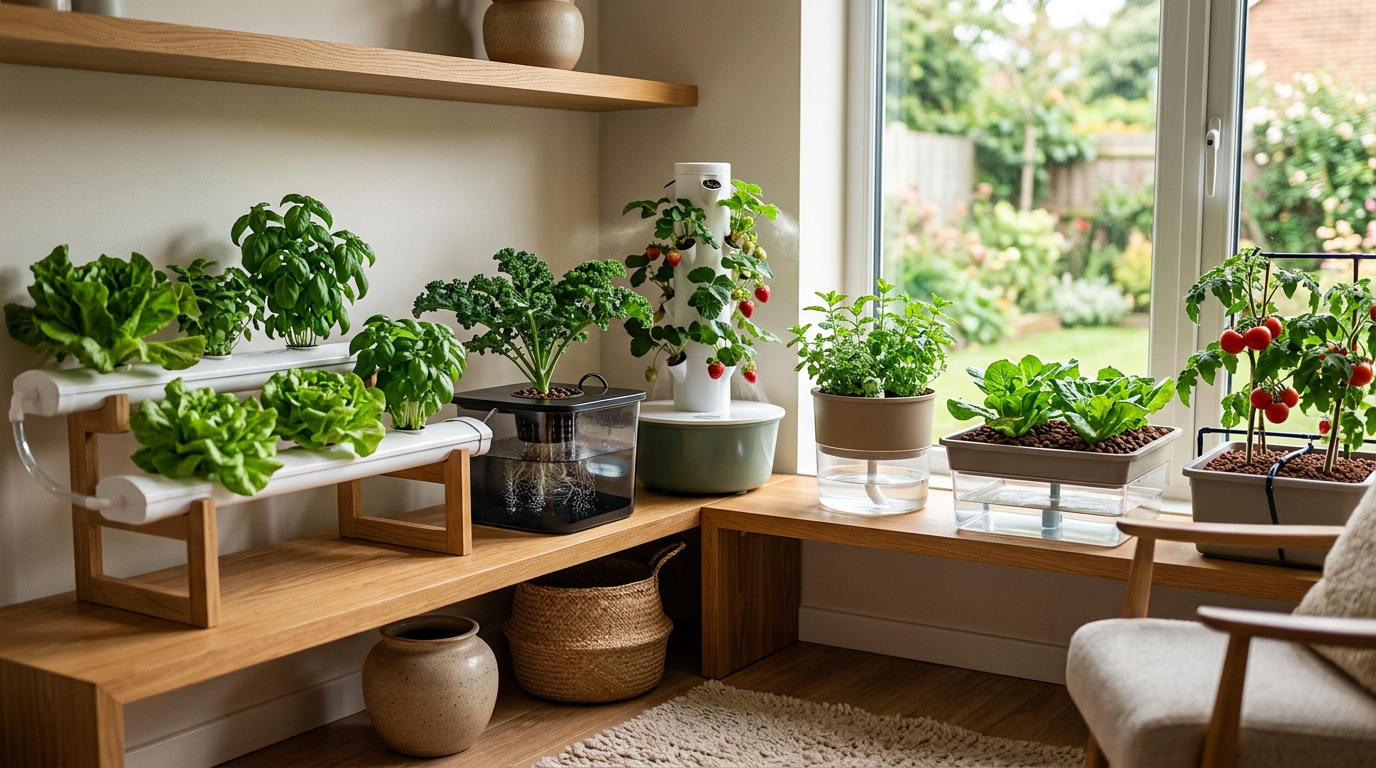
A hydroponic system grows plants in a nutrient-rich water solution instead of soil. Roots receive water, oxygen, and dissolved minerals directly, which lets plants grow 20–50% faster than in soil under identical light. For beginners, the Kratky method or a single-bucket Deep Water Culture setup are the most accessible starting points, each requiring under $50 in equipment.
How does a hydroponic system work?
Plants need six things to grow: water, oxygen at the root zone, light, carbon dioxide, and 17 mineral nutrients — including nitrogen, phosphorus, and potassium as the primary three. In soil, roots spend significant energy spreading through the substrate to locate and absorb these nutrients. In a hydroponic system, a nutrient solution delivers everything directly to the root zone.
Without the energy cost of soil navigation, plants redirect resources into leaf, stem, and fruit production. That is why hydroponically grown lettuce reaches harvest size in 25–35 days compared to 45–60 days in soil under the same light and temperature conditions.
The core components of any hydroponic system are:
- Reservoir: holds the nutrient solution between feeding cycles or continuously
- Growing medium: supports roots physically — clay pebbles, rockwool, coco coir, or perlite
- Nutrient solution: water plus dissolved macro and micronutrients in precise ratios
- pH management: keeping solution between 5.5 and 6.5 to prevent nutrient lockout
- Light: sufficient intensity and spectrum for the crop being grown
- Oxygen: delivered via air pump (DWC), passive air gap (Kratky), or root misting (aeroponics)
The specific way oxygen reaches roots and how nutrient solution is delivered determines which of the six hydroponic system types you are running. All six work — the right choice depends on your crop, budget, space, and how much active management you are willing to do.
The 6 main types of hydroponic systems
| Product | Best for | Rating | Notes | |
|---|---|---|---|---|
| Deep Water Culture (DWC) | Beginners growing leafy greens and herbs | ★★★★★ | Plant roots hang directly in aerated nutrient solution. An air pump and airstone keep dissolved oxygen high. Lowest-cost active system — a 5-gallon bucket DWC setup costs $30 to $50. Most forgiving for beginners because the large solution volume buffers pH and nutrient swings. | Check price |
| Kratky Method | Passive growing with zero electricity for the reservoir | ★★★★★ | A passive variation of DWC with no air pump. As the plant consumes solution, an air gap forms and provides oxygen to upper roots. No pump, no timer, no electricity for the reservoir. Ideal for herbs and leafy greens. Setup cost under $20 with mason jars. | Check price |
| Nutrient Film Technique (NFT) | High-plant-count setups for herbs and lettuce | ★★★★★ | A thin continuous stream of nutrient solution flows over roots in sloped channels. Roots access both solution and air simultaneously. Efficient nutrient use with low solution volume. Popular for commercial lettuce and strawberry production scaled down to home kits. | Check price |
| Drip System | Fruiting plants like tomatoes, peppers, and cucumbers | ★★★★★ | Nutrient solution drips onto growing medium through emitters on a timer. Excess solution drains back to the reservoir (recirculating) or runs to waste. The most common commercial hydroponic system. Flexible: works with soil, coco coir, or clay pebbles. | Check price |
| Ebb and Flow (Flood and Drain) | Versatile growing trays with multiple plant containers | ★★★★★ | A timer-controlled pump periodically floods the growing tray with nutrient solution, then drains it back to the reservoir. Wet and dry cycles oxygenate roots effectively. Higher complexity than DWC but supports a wide range of crops in different growing media. | Check price |
| Aeroponics | Maximum growth speed for advanced growers | ★★★★★ | Roots are suspended in air and misted with nutrient solution every 30 seconds to a few minutes. Maximum oxygen exposure drives the fastest plant growth of any system. Higher cost and maintenance — misting nozzles clog regularly. Best for experienced growers. | Check price |
Deep Water Culture (DWC)
DWC is the most widely recommended system for first-time hydroponic growers. Plant roots hang through net pots into a reservoir filled with nutrient solution. An air pump and airstone — the same equipment used in aquariums — continuously inject dissolved oxygen into the water, keeping it supersaturated so roots never suffocate.
Because roots have constant access to both nutrients and oxygen, DWC plants grow aggressively. Lettuce and basil started in a DWC bucket routinely reach harvest size in 3–4 weeks. A basic single-bucket DWC setup costs $30–50 in materials, and the principles transfer directly to larger multi-bucket systems as you scale.
Best for: loose-leaf lettuce, basil, cilantro, spinach, kale, arugula Key parameter: dissolved oxygen — keep it high with adequate airstone coverage and solution temperature below 72°F
The Kratky Method
Kratky is the simplest hydroponic system available. There is no pump, no timer, and no electricity required for the reservoir. Fill a dark container with nutrient solution, set net pots in the lid so roots hang into the solution, and let the plant consume the solution at its own pace. As the water level drops, an air gap forms between the surface and the net pot bottom — this gap provides oxygen to the upper root zone passively.
The trade-off is that Kratky requires manual top-off rather than automated delivery, and it suits short-cycle crops (under 6 weeks) better than long-cycle fruiting plants. For herbs and leafy greens, Kratky is unmatched in simplicity — a mason jar setup costs under $20 and requires almost no maintenance between checks.
See our full step-by-step setup guide: how to set up a Kratky system.
Nutrient Film Technique (NFT)
NFT pumps a continuous shallow stream of nutrient solution through sloped channels or PVC tubes. Roots lay along the channel bottom and receive solution from below while the upper root mass has access to open air above. The channels drain continuously back to a reservoir, which recirculates the solution.
NFT uses very little solution volume relative to the number of plants it supports, making it efficient for both space and nutrients. It is the dominant system for commercial indoor lettuce and herb production. Home NFT kits typically support 12–36 plants in compact food-grade channels.
Key risk: pump failure. Because NFT channels hold almost no solution, roots dry out within 1–2 hours if the pump stops. A backup pump or power monitoring system is worth the investment in any NFT setup.
Drip System
Drip systems are the most flexible hydroponic configuration. Emitters drip nutrient solution directly onto growing medium on a timer schedule, and excess solution either drains back to the reservoir (recirculating) or runs to waste (non-recirculating). Growing medium options are wide: coco coir, clay pebbles, rockwool, perlite, or even standard potting mix.
Drip systems excel with fruiting crops — tomatoes, peppers, cucumbers — that need precise control of feed frequency and volume as they progress through vegetative and fruiting stages. A drip system also makes the transition from outdoor soil growing feel familiar. For setup specifics, see the drip system for hydroponics guide.
Ebb and Flow (Flood and Drain)
Ebb and flow systems use a timer to flood a growing tray with nutrient solution pumped from a reservoir below. After a set flood period, the solution drains back down by gravity through a drain fitting. The alternating wet and dry cycle keeps the root zone oxygenated while delivering nutrients on a reliable schedule.
The system handles a wide variety of crops and growing media — individual pots of coco coir, rockwool slabs, or clay pebbles all work in an ebb and flow tray. The main limitation is complexity: a failed timer or blocked drain can waterlog roots within one missed cycle, making monitoring more important than in DWC or Kratky.
Aeroponics
Aeroponic systems suspend roots in a dark enclosed chamber and mist them with fine droplets of nutrient solution every 30 seconds to a few minutes. Roots have maximum oxygen exposure at all times — no growing medium, no submerged zones. This drives the fastest plant growth of any hydroponic system, outpacing DWC by 20–30% in speed in controlled comparisons.
The trade-off is technical maintenance. High-frequency misting nozzles clog regularly with mineral deposits, and a clogged nozzle that goes unnoticed can dry roots within minutes. Aeroponics is best suited to experienced growers comfortable with troubleshooting or to commercial operations with monitoring equipment in place.
How to choose the right hydroponic system
Match the system to your crop, skill level, and how much active management you want to take on:
New to hydroponics: Start with Kratky for herbs or a single-bucket DWC for lettuce. Both have low equipment costs, high tolerance for beginner mistakes, and clear feedback when something goes wrong.
Growing fruiting crops: A drip system gives you the control over feed timing and volume that tomatoes, peppers, and cucumbers need as they move through growth stages. Ebb and flow is a solid alternative if you prefer a tray-based layout.
Scaling up with many plants: NFT maximizes plant count per square foot and per liter of nutrient solution. It requires more investment in monitoring but runs very efficiently once dialed in.
Interested in maximum speed: DWC is a better starting point for advanced growers than aeroponics. Once comfortable with DWC management, aeroponics offers the next level of growth speed at the cost of higher maintenance.
Benefits of growing hydroponically
Faster growth. Plants grown hydroponically typically reach harvest 20–50% faster than soil-grown equivalents under the same light. The efficiency of direct nutrient delivery removes the growth bottleneck of soil foraging.
Water efficiency. Hydroponic systems use 70–90% less water than conventional soil growing. Recirculating systems return unused nutrient solution to the reservoir — waste is minimal compared to outdoor irrigation, where a large fraction of water evaporates or drains before roots can absorb it.
No weeding or soil-borne pests. Without soil, there are no weeds and no soil-borne pathogens. Indoor hydroponics can still encounter airborne pests like aphids or fungus gnats, but soil-specific problems including root-feeding insects, nematodes, and soil-borne fungi disappear entirely.
Year-round production. Because the system operates indoors in a climate-controlled space, outdoor season and day length have no effect. Lettuce, herbs, and cherry tomatoes grow continuously regardless of winter temperatures.
Space efficiency. Vertical configurations — stacked NFT channels, tower gardens — grow significantly more plants per square foot than flat soil containers. A 2-by-4 foot vertical NFT setup can hold 30–40 lettuce plants.
For a direct comparison of hydroponics versus growing in soil: hydroponics vs soil.
What can you grow in a hydroponic system?
Best crops for beginners:
- Loose-leaf lettuce: ready in 25–35 days in DWC or Kratky; the most forgiving hydroponic crop
- Basil, cilantro, parsley: fast-growing herbs that thrive in DWC, Kratky, and NFT
- Spinach, arugula, kale: leafy greens ready in 30–45 days with low nutrient demand
- Green onions and chives: extremely low-maintenance in any system
Intermediate crops:
- Cherry tomatoes: need a drip system or large DWC bucket plus trellising and hand pollination
- Peppers: similar requirements to tomatoes; 70–90 days from transplant to first harvest
- Cucumbers: fast-growing vines that need vertical support; perform well in drip systems
- Strawberries: excellent in NFT channels or vertical tower systems
Challenging to grow hydroponically:
- Root vegetables (carrots, potatoes, beets): require deep growing medium and are impractical in most home hydroponic systems
- Large perennial trees and shrubs: container volume requirements are prohibitive at home scale
For a complete list of what grows well indoors: what to grow indoors.
What does a hydroponic system cost?
Best for Single-plant DWC setup for beginners
General Hydroponics WaterFarm Complete Kit
An all-in-one DWC bucket kit from the most trusted name in home hydroponics. Includes the reservoir, aeration system, grow medium, and nutrients to start one large plant. Supports tomatoes, peppers, or a cluster of herbs. Straightforward setup with no custom parts to source.
★★★★★ 4.7 · 2,100 reviews
Check current price on Amazon→Best for Complete nutrient system for any hydroponic system type
General Hydroponics Flora Series Starter Kit
FloraGro, FloraBloom, and FloraMicro together cover every growth stage in DWC, Kratky, drip, NFT, or ebb and flow. The most widely used nutrient system for home hydroponic growers. The starter kit includes pH Up and pH Down so you have the full nutrient and pH management setup in one order.
★★★★★ 4.8 · 3,200 reviews
Check current price on Amazon→System cost ranges by type:
| System Type | Starter Setup Cost | Ongoing Monthly Cost |
|---|---|---|
| Kratky (mason jar) | $15–30 | $3–8 (nutrients only) |
| DWC (single bucket) | $30–60 | $5–12 |
| NFT (12-plant home kit) | $80–150 | $10–20 |
| Drip system | $100–250 | $15–30 |
| Ebb and flow | $120–300 | $15–30 |
| Aeroponics | $200–500+ | $20–50 |
Nutrients account for most of the ongoing cost — a good three-part nutrient system costs $20–40 and lasts 2–4 months for a small home setup. Electricity for lighting adds $10–30 per month depending on system scale and light wattage. For detailed product comparisons across commercial beginner kits, see best hydroponic systems and hydroponics system for beginners.
FAQ
Frequently asked questions
Do hydroponic plants taste different from soil-grown plants?
Is hydroponics difficult for beginners?
Can you use tap water for hydroponics?
How often do you change the nutrient solution?
What is the easiest hydroponic system to start with?
Do hydroponic systems need a lot of space?
Does hydroponics use a lot of electricity?
Bottom line
A hydroponic system replaces soil with a nutrient-rich water solution that delivers everything a plant needs directly to the root zone — resulting in faster growth, lower water consumption, and year-round indoor production regardless of outdoor season. The six main system types range from the completely passive Kratky mason jar (no pump, no electricity, under $20) to high-performance aeroponics (root misting every 30 seconds, maximum growth speed, higher maintenance).
For most beginners: start with a Kratky jar for herbs or a single-bucket DWC for lettuce. Get pH management right (target 5.8–6.0), use a proven three-part nutrient formula, and provide 14–16 hours of light per day. A working crop is achievable within 30 days of setup.
For more on getting started and going deeper: hydroponic system for beginners, how to start a hydroponic herb garden, best hydroponic nutrients, and pH adjustment guide for hydroponics.