guides
How to Grow Peppers Indoors: Complete Growing Guide
Grow jalapeños, bell peppers, and hot chiles indoors year-round with the right light, containers, and pollination tips.
 Priya Anand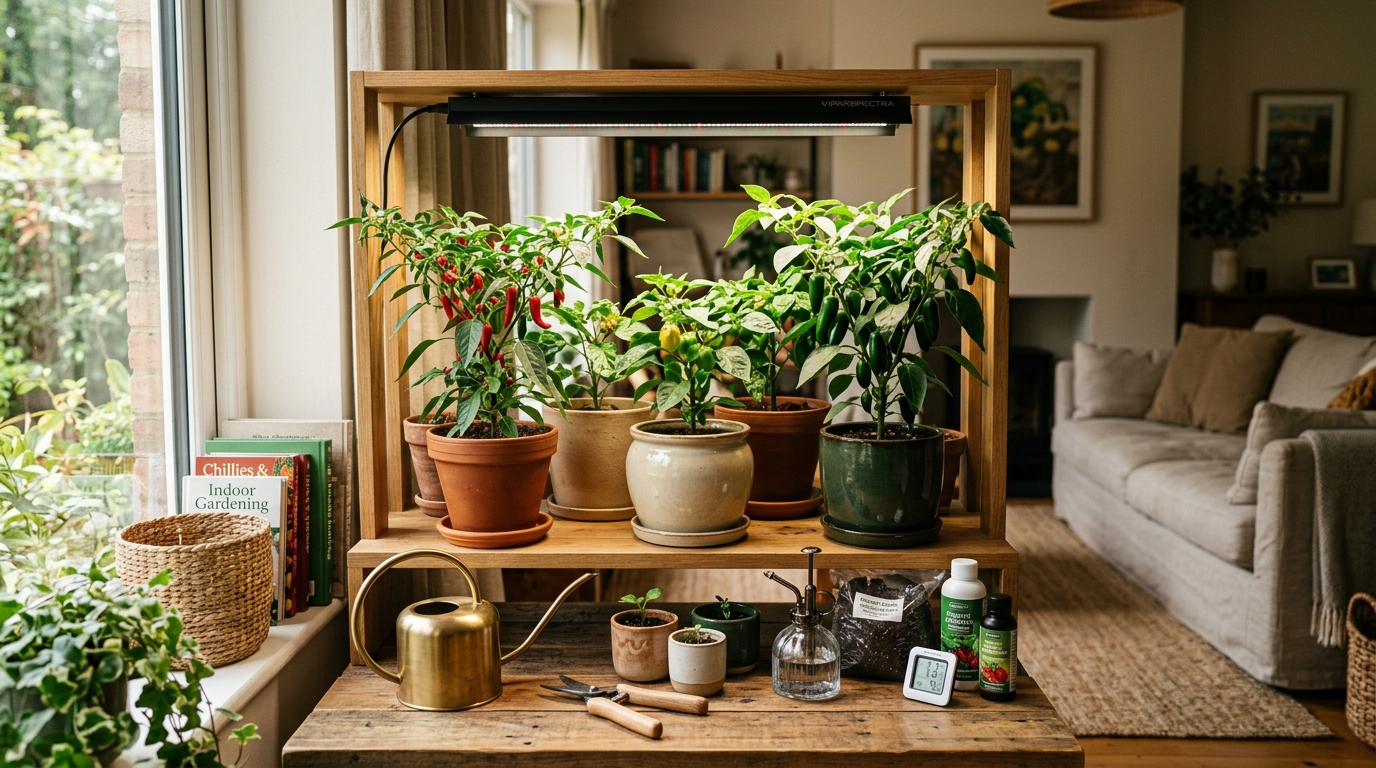
Growing peppers indoors is practical with a quality grow light running 14–16 hours a day, a 5-gallon container, and temperatures consistently above 65°F. Compact hot pepper varieties — jalapeños, cayenne, Thai chiles, and serranos — produce reliably in an indoor setting. Bell peppers can also succeed indoors but take longer to fruit and need larger containers and more patience.
Which peppers grow best indoors?
Pepper varieties vary enormously in size, heat, and growing requirements. Matching the variety to indoor conditions determines whether you get a productive plant or a frustrating experiment.
Best choices for indoor growing:
- Jalapeño — compact plants, productive, fruit in 70–80 days from transplant; the most reliable indoor pepper overall
- Cayenne — slim fruits on upright plants; handles drier air than most varieties; good for drying
- Serrano — slightly hotter than jalapeño with a similar growth habit; slightly smaller plant
- Thai chile (bird’s eye) — extremely compact; ornamental and edible; fruits prolifically even in tight spaces
- Lemon drop — a fruity Peruvian chile with bright yellow fruit on small plants; excellent indoors
- NuMex Twilight — ornamental variety with small upright fruits that ripen through purple, yellow, and red; outstanding indoor performer
Workable but more challenging:
- Bell peppers — large plants needing 5-gallon containers; slow to fruit (80–90 days from transplant); manageable with a strong grow light
- Poblano — moderate size; produces reliably but needs consistent warmth and strong light
- Banana pepper — longer fruits on larger plants; productive but benefits from staking indoors
Avoid for indoor beginners:
- Large sweet peppers bred for field production — these varieties need more space and light intensity than most indoor setups can deliver
- Ghost pepper and Carolina Reaper — long season (100+ days to fruit), large plants, and precise humidity requirements make these challenging without a dedicated grow room
Start with jalapeño or Thai chile. Both forgive minor temperature swings and light variations better than any other variety, and you will actually use the fruit.
What you need to grow peppers indoors
| Product | Best for | Rating | Notes | |
|---|---|---|---|---|
| Full-spectrum LED grow light (200–300W equivalent) | Providing 14–16 hours of light peppers need for fruiting | ★★★★★ | A grow light is not optional for indoor peppers. Position 6–12 inches above the canopy. Look for at least 2000 lumens per plant. A $40–80 panel covers 2–4 pepper plants easily. | Check price |
| 5-gallon fabric grow bag or hard pot | Root aeration and preventing root-bound plants | ★★★★★ | Fabric grow bags air-prune roots naturally, which produces a healthier root system. Jalapeños and most hot peppers do well in 3–5 gallon containers. Bell peppers need at least 5 gallons. | Check price |
| Premium vegetable or tomato potting mix | Nutrient-rich and well-draining growing medium | ★★★★★ | Avoid generic potting soil with high moisture retention. Fox Farm Ocean Forest or a tomato-specific mix with perlite already added performs well for peppers in containers. | Check price |
| Outlet timer for grow lights | Automating a consistent 14–16 hour light cycle | ★★★★★ | Consistent photoperiods improve flowering and fruit set. A $10–15 outlet timer handles this automatically. Manual switching leads to irregular schedules that slow production. | Check price |
| High-phosphorus liquid fertilizer | Promoting flowering and fruit set in container peppers | ★★★★★ | Switch from balanced nitrogen fertilizer to a bloom-focused formula (5-10-5 or 2-8-4 ratio) once plants begin flowering. High nitrogen after flowering produces foliage but delays fruit. | Check price |
Total setup for a two-plant indoor pepper operation runs $80–150 depending on grow light quality. The grow light is the biggest investment and also the most important one — everything else is secondary to adequate light.
Step 1: Start from seed or buy a transplant
Starting from seed gives access to unusual varieties not sold as transplants. Germination takes 10–21 days at soil temperatures of 80–85°F. Use a seedling heat mat under the seed tray — pepper seeds germinate poorly below 70°F and fail almost entirely below 60°F.
Seed-starting steps:
- Fill small cells or a seedling tray with moist seed-starting mix — not regular potting soil, which is too coarse for germination
- Plant seeds 1/4 inch deep, two seeds per cell
- Cover the tray with a clear dome and place on a heat mat set to 80–85°F
- Do not add grow light yet — seeds germinate in the dark; light is irrelevant until emergence
- Check daily; remove the dome and turn on the grow light the moment seedlings emerge
- Thin to one seedling per cell when the first set of true leaves appears
- Transplant to a 4-inch pot when the plant reaches 3–4 inches tall, then to the final container once roots fill that pot
A seedling heat mat for starting peppers from seed: view on Amazon.
Buying a transplant from a nursery or garden center shortens the timeline by 6–10 weeks. Look for compact, dark green plants with no yellowing or pest damage. Avoid plants that have already started to flower or fruit — they transplant poorly and often stall for weeks after repotting.
Step 2: Choose the right container
Container size directly affects how large the plant grows and how much fruit it produces. The single biggest container mistake with peppers is going too small.
Minimum container sizes:
- Jalapeño, serrano, Thai chile, cayenne: 3–5 gallons
- Bell pepper, poblano, banana pepper: 5 gallons minimum
- Larger specialty varieties: 7–10 gallons for maximum production
A pepper plant in a 1-gallon pot becomes root-bound within 6–8 weeks and stops producing flowers. Transplant up before roots emerge from drainage holes — do not wait until the plant shows visible stress.
Fabric grow bags vs. hard pots:
Fabric bags allow excess moisture to wick through the sides and air-prune roots at the tips, which stimulates root branching and produces a healthier system overall. The trade-off is that fabric bags dry out faster than plastic or terracotta — expect to water more frequently.
Hard plastic pots retain moisture longer and are easier to monitor. Either works well for peppers. Use a saucer under hard pots and empty it within 30 minutes of watering to prevent standing water at the root zone.
Always use containers with drainage holes. Peppers in containers without drainage will develop root rot within weeks regardless of careful watering.
Step 3: Provide enough light
Light is the most common reason indoor peppers fail to produce fruit. Peppers are native to tropical and subtropical climates with long, intense sun exposure. Replicating that indoors requires a dedicated grow light in most homes.
Why windows usually fall short:
Most windows deliver adequate light for leafy growth but not enough sustained intensity to drive flower and fruit production reliably. A south-facing window in summer provides 6–8 hours of light for jalapeños and small hot peppers during peak season. In winter, or in apartments with east or west-facing windows, the intensity drops well below what peppers need for fruiting.
Grow light requirements for peppers:
- Duration: 14–16 hours per day during active growth and fruiting
- Distance: 6–12 inches from the canopy for most panel lights; check the manufacturer recommendation for your specific fixture
- Intensity: at least 2000 lumens per plant; full-spectrum lights including red and blue wavelengths produce the best flower and fruit set
Good grow light options for indoor peppers:
- Mars Hydro TS 1000 — 150W LED panel covering 2–4 plants; one of the most consistently recommended fixtures for indoor vegetables: view on Amazon
- Spider Farmer SF-1000 — similar footprint to Mars Hydro, with LM301B diodes and good heat management: view on Amazon
- Barrina T5 LED Strip Lights — budget-friendly strip lights for a single plant on a shelf; cost around $30 for a 4-pack: view on Amazon
Run the grow light on a timer. A 16-hours-on / 8-hours-off schedule works well for most of the growing season. Consistent light cycles produce more even growth than manual switching.
Step 4: Maintain the right temperature and humidity
Peppers are tropical plants that thrive in warmth and suffer with cold.
Temperature ranges:
- Ideal daytime temperature: 70–85°F (21–29°C)
- Nighttime minimum: 60°F (15°C); below this, growth slows dramatically
- Fruit set threshold: stops below 60°F or above 95°F — flowers open and drop without producing fruit in either extreme
Most homes stay at 68–72°F year-round, which is workable for jalapeños and other compact varieties. The risk zones are near cold windows in winter — even a few inches from the glass can be 10–15°F colder than the room — and in rooms without air conditioning in a hot summer.
Humidity:
Peppers prefer 40–60% relative humidity. Below 30%, flower drop increases significantly. A small humidifier near the grow area helps in dry winter conditions. Avoid misting leaves directly, which promotes fungal issues without meaningfully raising root-zone humidity.
A small oscillating fan on low speed running during light hours strengthens stems by providing gentle mechanical resistance and improves airflow to reduce disease risk. This is a useful addition once plants are established.
Step 5: Water and fertilize for fruit production
Watering:
Push a finger 1–2 inches into the potting mix. Water thoroughly when the top 2 inches are dry — pour until water runs freely from drainage holes, then wait until the next check. In a 5-gallon container under grow lights in a warm room, this typically means watering every 2–4 days.
Signs of overwatering: yellowing lower leaves, mushy stem base, slow growth despite warm temperatures and strong light.
Signs of underwatering: daytime wilting even with soil at normal temperature, dry soil pulling away from pot edges, brown leaf tips.
Fertilizing by growth stage:
Pepper nutrition needs shift as the plant matures:
- Seedling stage (first 4–6 weeks): no supplemental fertilizer needed; seed-starting mix provides adequate early nutrition
- Vegetative stage (6 weeks to first flowers): balanced fertilizer at half strength every 7–10 days — a 10-10-10 or 5-5-5 builds the leafy framework that supports fruit later
- Flowering and fruiting stage: switch to a lower-nitrogen, higher-phosphorus formula such as 5-10-5; high nitrogen at this stage promotes foliage over fruit
Calcium and magnesium deficiencies are common in container peppers. If you see blossom end rot — dark, sunken spots on the fruit tip — calcium uptake is the issue. This is almost always caused by inconsistent watering rather than a soil deficiency. Even out the watering schedule before adding calcium supplements.
Step 6: Hand-pollinate to set fruit
This step separates indoor pepper growers who get fruit from those who get only flowers.
Outdoors, wind and insects transfer pollen between pepper flowers. Indoors, there is no wind and no pollinators. Without intervention, flowers will open and drop without producing fruit — a common frustration among first-time indoor pepper growers.
Hand-pollination technique:
- Wait until flowers are fully open — small yellow pollen-covered stamens should be visible inside the petals
- Use a small electric toothbrush on low against the flower stem, or gently shake the stem to simulate wind vibration; this releases pollen onto the pistil within the same flower (peppers are self-fertile)
- Alternatively, use a clean cotton swab or small paintbrush to collect pollen from the stamen of one flower and transfer it to the pistil of another open flower
- Pollinate during the warmest part of the light cycle — midday works well
- Repeat every day that new flowers are open
You should see the base of successfully pollinated flowers begin to swell within 3–5 days. If flowers keep dropping, check temperature (should be 65–85°F when flowers are open), humidity (above 40%), and ensure nitrogen fertilizer has been reduced now that the plant is in flower.
Troubleshooting common indoor pepper problems
Flowers dropping without fruit — the most common indoor pepper problem. Check temperature (should be 65–85°F when flowers are open), humidity above 40%, and confirm hand-pollination is happening daily. Also verify nitrogen fertilizer has been reduced since flowering began.
Yellow leaves on lower half of plant — most often overwatering or nitrogen deficiency. Check drainage and watering frequency first. If drainage is good and watering is correct, apply half-strength balanced fertilizer and monitor for improvement.
Blossom end rot (dark, sunken spot on fruit tip) — inconsistent watering causes calcium absorption failure. The soil contains calcium; the plant cannot pull it up when water stress fluctuates. Even out the watering schedule rather than adding calcium supplements.
Slow growth with good light — soil temperature may be low. Peppers grow slowly when roots are cold even if air temperature is adequate. Move plants off cold floors; elevate containers away from concrete or tile.
Pale leaves and thin stems — insufficient light intensity despite adequate duration. Move the grow light closer to the canopy, or upgrade to a higher-output panel.
Aphids or spider mites — common on indoor peppers, especially in dry conditions. Check the undersides of leaves weekly. Treat with insecticidal soap spray or neem oil solution at first sign. For visible aphid clusters, blast them off with a gentle stream of water before spraying: insecticidal soap on Amazon.
FAQ
Frequently asked questions
Can peppers grow indoors year-round?
How long do peppers take to produce fruit indoors?
Can I grow peppers indoors without a grow light?
Why are my indoor pepper flowers dropping off?
What is the easiest pepper to grow indoors?
Do indoor peppers need to be pollinated by hand?
Bottom line
Growing peppers indoors rewards growers who invest in the right setup from the start. A quality grow light running 14–16 hours a day and a properly sized container solve 80% of indoor pepper problems before they start. Choose compact varieties like jalapeño or Thai chile, keep temperatures above 65°F, and hand-pollinate every open flower. With those fundamentals in place, a single indoor pepper plant produces enough fruit for regular kitchen use throughout the year.
Start small — one or two jalapeño plants in 3–5 gallon containers under a mid-range LED panel. Once you understand the rhythm of watering, feeding, and pollination, scaling to more plants or experimenting with specialty varieties becomes straightforward.
For grow light options: best grow lights and best grow light bulbs. For container and setup help: how to set up a grow tent and indoor gardening setup guide. For a similar fruiting crop: how to grow cherry tomatoes indoors.