guides
How to Grow Cherry Tomatoes Indoors
Grow cherry tomatoes indoors year-round with the right grow light, container size, and compact variety. Step-by-step guide from seed to harvest.
 Priya Anand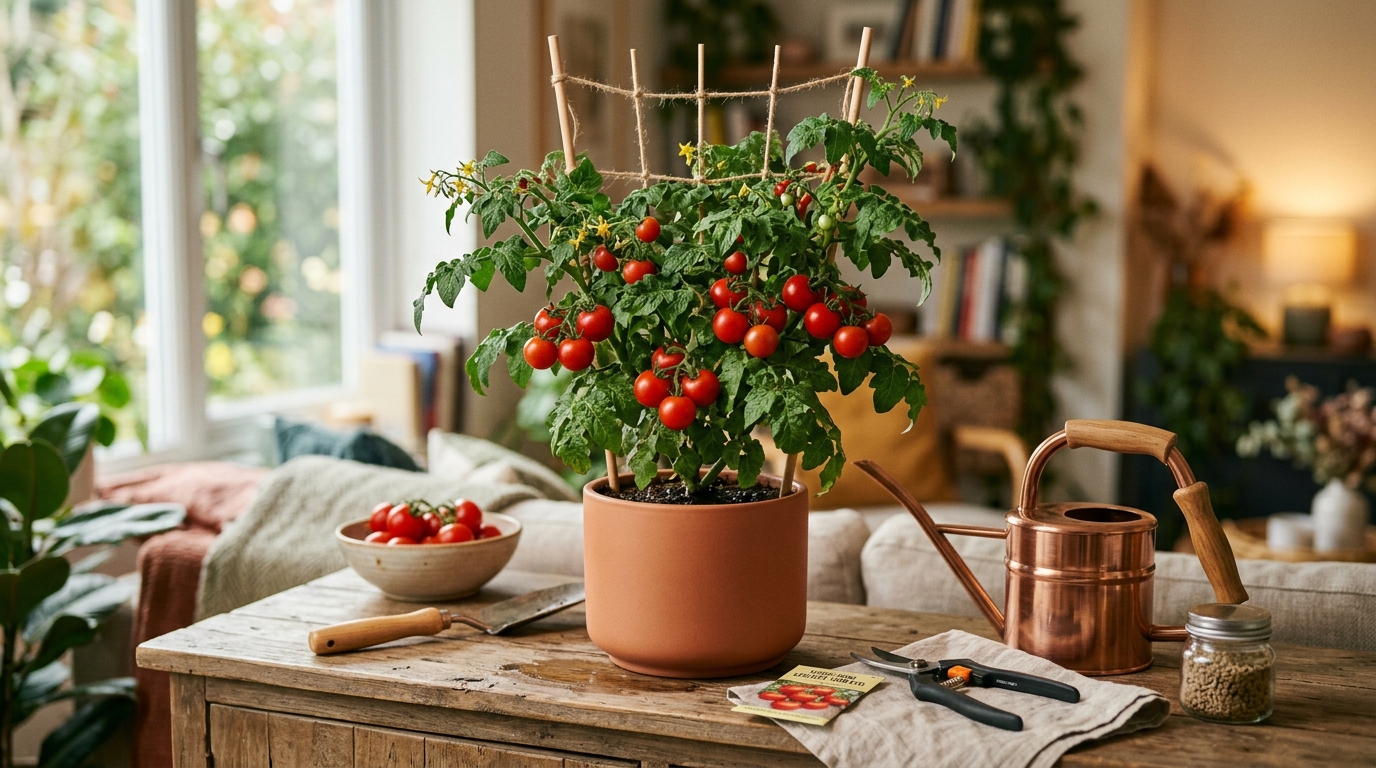
Cherry tomatoes grow successfully indoors using a compact variety like Tiny Tim or Tumbling Tom, a minimum 5-gallon container with drainage holes, and a high-output full-spectrum LED grow light running 14–16 hours daily. Started from transplant, plants reach first harvest in 50–70 days with continuous production for several months.
Indoor tomatoes are more demanding than indoor herbs or leafy greens — they need more light, more space, more fertilizer, and active pollination — but the reward is proportionally larger: vine-ripened cherry tomatoes in January from a plant sitting under a grow light in your kitchen or spare bedroom. Tiny Tim, Red Robin, and Tumbling Tom are the three varieties most reliably suited to indoor container growing, staying compact enough to manage without a grow tent. Larger indeterminate varieties can also succeed indoors but require a full-size grow tent and significant vertical space.
Can cherry tomatoes really grow indoors?
Cherry tomatoes grow indoors — the key is matching the variety and setup to what the plant actually needs. Standard outdoor tomato varieties planted in a small pot near a window will disappoint: they stretch toward light, produce few flowers, and carry heavy fruit that strains thin stems. The indoor approach that works consistently uses a compact variety bred for container growing, a container large enough to support vigorous root growth, and grow lighting powerful enough to substitute for the 8–12 hours of direct summer sun that tomatoes need at peak production.
The practical threshold is this: if your setup can sustain herbs and leafy greens well, it is about halfway to what tomatoes need for fruit. Tomatoes require roughly twice the light intensity of leafy greens and significantly higher nutrition. The payoff is harvesting fresh, genuinely flavorful tomatoes in any season — a meaningful upgrade over grocery store produce, especially in winter.
What you need to get started
| Product | Best for | Rating | Notes | |
|---|---|---|---|---|
| High-output full-spectrum LED grow light (200-400W equivalent panel) | Providing the intense light indoor tomatoes need to set fruit | ★★★★★ | Tomatoes need far more light than herbs. Use a panel-style LED covering a 2x2 foot area, hung 12-18 inches above the canopy. Run 14-16 hours daily with an outlet timer. | Check price |
| 5-gallon fabric grow bag or pot with drainage holes | The minimum container size for productive indoor cherry tomatoes | ★★★★★ | Fabric bags allow air pruning of roots and prevent overwatering better than solid pots. 5 gallons is the practical minimum; 7-10 gallons produces heavier yields. | Check price |
| Premium potting mix with perlite (no moisture-control formula) | Well-draining growing medium that supports vigorous root development | ★★★★★ | Mix standard potting soil 3:1 with perlite for improved drainage and aeration. Avoid moisture-control potting mixes — tomatoes need consistent wet-dry cycles. | Check price |
| Calcium-fortified tomato fertilizer (liquid or water-soluble) | Preventing blossom end rot and supporting fruit development | ★★★★★ | Use a tomato-specific formula with added calcium and magnesium. Feed every 7-10 days once flowering begins. Calcium deficiency is the leading cause of indoor tomato failure. | Check price |
| Compact tomato cage or bamboo stakes (18-24 inch) | Supporting stems and keeping plants upright under heavy fruit load | ★★★★★ | Even compact varieties need some support once fruit develops. A small cage or two bamboo stakes and soft plant ties work well for Tiny Tim and Tumbling Tom. | Check price |
| Outlet timer for grow lights | Running a consistent 14-16 hour photoperiod automatically | ★★★★★ | Consistent light schedules matter more for fruiting plants than for herbs. A basic mechanical timer costs under $15 and eliminates the need to remember to switch lights on and off. | Check price |
Step 1: Choose the right variety
Variety selection is the most important decision for indoor tomato success. Most common tomato varieties are bred for outdoor gardens — they grow 4–6 feet tall, need pollinators flying between plants, and require months of outdoor sun to produce well. Indoor growing requires a different category of variety.
Best compact varieties for indoor growing:
Tiny Tim — the classic indoor tomato. Stays under 18 inches tall, requires minimal or no staking, and produces small, sweet 1-inch red tomatoes in large clusters. Performs well under a standard LED grow light without a full grow tent setup. First harvest approximately 60 days from transplant.
Tumbling Tom (Red or Yellow) — slightly larger than Tiny Tim at 18–24 inches, with a trailing or cascading growth habit that suits hanging baskets and shelf-edge container placement. Produces prolific clusters of cherry-size fruit over an extended season.
Red Robin — a true dwarf variety reaching only 8–12 inches, specifically developed for windowsill and container gardening. Produces small but intensely flavored red fruits. The most space-efficient option for limited indoor growing areas.
Sweet Million and SuperSweet 100 — indeterminate varieties that work in a grow tent with a high-output light and significant vertical support reaching 4 feet or more. Better yields than dwarf types but require considerably more management and space.
Avoid standard slicing tomato varieties (Beefsteak, Early Girl, most heirloom types) for most indoor setups — the plant size, light requirements, and fruit weight are all substantially higher than what a compact indoor setup can support.
Step 2: Match the light to what tomatoes need
Light is the most common reason indoor tomatoes fail to set fruit. Tomatoes need approximately 8 hours of full direct outdoor sun to produce at peak. Indoors, that means either a true south-facing window with unobstructed summer sun, or a dedicated high-output grow light running 14–16 hours per day.
Window-only growing: Only attempt this with a south-facing window receiving actual direct sun — not bright indirect light — for 6 or more hours daily from spring through summer. In winter, even a perfect south window falls significantly short in most northern climates. East- and west-facing windows do not provide enough light intensity for fruit production in most situations.
Grow light requirements for tomatoes:
Cherry tomatoes need substantially more light than most herb and seedling grow lights provide. Aim for:
- Full-spectrum LED panel rated 200–400W equivalent or higher
- Positioned 12–18 inches above the tomato canopy
- Running 14–16 hours per day on an outlet timer
- Covering a footprint of at least 2×2 feet
Budget panel LEDs in the $40–80 range (Spider Farmer SF-1000, AC Infinity IONBOARD S22, or MARS HYDRO TS 1000) provide adequate output for one or two compact tomato plants and cost far less than traditional HPS or MH fixtures while running cooler and consuming less electricity.
Signs of insufficient light in tomatoes:
- Flowers develop but drop before setting fruit
- Fruit stays green much longer than expected
- Stems grow long and thin with large gaps between leaf nodes
- Flowering is sparse despite otherwise healthy-looking plants
Best for powering one to two compact indoor tomato plants through the full growing cycle
Spider Farmer SF-1000 LED Grow Light
The Spider Farmer SF-1000 is a 100W quantum board LED delivering full-spectrum light optimized for flowering and fruiting crops, covering a 2x2 foot vegetative canopy. It uses Samsung LM301B diodes rated for high efficiency and long life, with no fan noise — important for home setups. At 14-16 inches above compact cherry tomato plants, it delivers the intensity needed for consistent fruit set, visibly outperforming strip-style lights and grow bulbs for fruiting crops. Real users consistently report successful tomato and pepper harvests indoors at this output level, with the panel paying for itself quickly compared to larger HID setups.
★★★★★ 4.7 · 14,200 reviews
Check current price on Amazon→Step 3: Set up the container and soil
Container size:
Use a 5-gallon container as the absolute minimum for cherry tomatoes. Tomato roots are aggressive and need volume to support vigorous top growth and fruit production. Under-potted tomatoes produce smaller plants, fewer flowers, smaller fruit, and exhaust soil nutrients faster.
A 7–10 gallon container produces noticeably higher yields for the same variety. If space allows, choose 7 gallons or larger for your primary growing container.
Fabric grow bags are particularly well-suited for indoor tomatoes because:
- Air pruning at the bag walls encourages dense, fibrous root development rather than root circling
- The breathable fabric prevents waterlogging and allows excess heat to escape
- They are lightweight and easy to reposition under a grow light
- They dry out more evenly than solid plastic pots, reducing overwatering risk
Soil preparation:
Standard potting mix retains more moisture than tomatoes prefer for healthy root function. Mix 3 parts quality potting mix with 1 part perlite for improved drainage and aeration. Avoid potting mixes labeled “moisture control” — these are designed to stay wet longer, which is the opposite of what tomato roots need.
Fill the container to within 1 inch of the top. After transplanting, water thoroughly until water runs from the bottom, then allow the top 2 inches to dry before the next watering.
Best for growing compact cherry tomato varieties indoors with excellent drainage and root health
VIVOSUN 5-Gallon Fabric Grow Bags
VIVOSUN fabric grow bags are made from 300g nonwoven breathable fabric with reinforced handles, available in 5, 7, and 10-gallon sizes. The breathable material allows air pruning at the root tips, which prevents root circling and produces a denser root network that supports heavier fruit loads. The side handles make repositioning under a grow light easy — useful when rotating plants for even light exposure. They fold flat for storage between grows, and the fabric dries faster than plastic after watering, reducing the risk of overwatering for growers still calibrating their schedule.
★★★★★ 4.8 · 28,600 reviews
Check current price on Amazon→Step 4: Plant and germinate
Starting from seed:
Fill seed cells or 3-inch pots with seed-starting mix. Plant 2–3 seeds per cell at a depth of 0.25 inch. Maintain soil temperature at 70–80°F for germination — use a seedling heat mat if your indoor temperature falls below 68°F. Seeds germinate in 5–10 days.
Once seedlings reach 3–4 inches with their first set of true leaves, thin to the strongest seedling per cell and grow under a light positioned 4–6 inches above the seedling canopy.
Transplanting to the final container:
Move seedlings to their 5-gallon final container when they reach 6–8 inches tall and have 4–6 sets of true leaves. Plant deeply — tomatoes develop roots along their buried stems, so burying the lower 2–3 inches of stem at transplant produces a stronger, more drought-resistant root system.
Water in after transplanting, keep the light 12–18 inches above the canopy, and maintain temperatures of 65–80°F. New growth appears within 5–7 days of successful establishment.
Buying a transplant:
Starting from a healthy nursery transplant cuts 4–6 weeks off the time to first harvest. Choose a compact, stocky transplant with dark green leaves and no flowers or fruit already formed — plants flowering in tiny nursery pots have already experienced stress and may transition poorly to a new container.
Step 5: Water and fertilize correctly
Watering:
Tomatoes in containers need consistent moisture — not saturated, not dry. Check soil by pressing your finger 2 inches into the mix. Water when it feels dry at that depth, watering thoroughly until water drains freely from the bottom.
Under a grow light in warm conditions, a 5-gallon fabric bag typically needs water every 2–3 days at peak growth. As the plant canopy grows larger and fruit develops, water needs increase — large indoor plants can need daily watering in warm conditions. Monitor by feel rather than schedule.
Inconsistent watering causes blossom drop and blossom end rot. Brown, leathery patches on the bottom of developing fruit signal calcium uptake disruption from uneven soil moisture. Consistent watering corrects this; it is rarely a true deficiency in newly refreshed potting mix.
Fertilizing:
Tomatoes are heavy feeders, especially once flowering begins. A three-stage approach works well in containers:
- Weeks 1–4 after transplant: Use a balanced fertilizer (5-5-5 or 10-10-10) at half strength every 10–14 days to support vegetative growth.
- First flower to fruit set: Switch to a tomato-specific formula higher in phosphorus and calcium. Feed every 7–10 days.
- Active fruiting: Continue the tomato formula. Watch for deficiency signs — yellowing lower leaves indicate nitrogen need; brown leaf edges indicate potassium need; blossom end rot indicates calcium uptake disruption.
Best for feeding indoor cherry tomatoes from flowering through harvest for maximum fruit set
Jack's Classic Tomato Feed Fertilizer
Jack's Classic Tomato Feed uses a 12-15-30 NPK ratio with added calcium, magnesium, and micronutrients formulated for fruiting performance in container tomatoes. The high potassium content supports fruit development and flavor, while added calcium directly addresses blossom end rot — the most common indoor tomato nutrition problem. It dissolves fully in water with no residue, making it ideal for container use. At the recommended feeding interval of every 7-10 days during fruiting, a single canister treats a small indoor tomato garden through a full growing season.
★★★★★ 4.8 · 9,400 reviews
Check current price on Amazon→Step 6: Pollinate, prune, and support
Indoor pollination:
Outdoor tomatoes are pollinated by bees and wind. Indoors, no natural pollinators are present and air movement is minimal. Without intervention, flowers develop and drop before setting fruit — the most common cause of indoor tomato frustration.
Pollinate by hand using one of two methods:
- Stem shaking — gently shake each flowering stem for 5–10 seconds once per day, mid-day when flowers are fully open. This mimics the vibration that bees create when visiting flowers.
- Soft paintbrush or electric toothbrush — touch the vibrating surface or brush tip gently to the center of each open flower. A battery-powered toothbrush head used briefly at each flower is the most efficient method when plants are large.
Do this daily when flowers are open. The base of the flower swells into a small green fruit within 3–5 days of successful pollination.
Pruning and pinching suckers:
For compact varieties like Tiny Tim and Red Robin, minimal pruning is needed — these determinate or semi-determinate varieties self-manage reasonably well. For Tumbling Tom and any indeterminate varieties:
- Remove suckers (new shoots growing in the V between the main stem and a branch) from the lower third of the plant
- Remove any yellowing or diseased lower leaves as they develop
- Keep the plant to 2–3 main stems to concentrate energy into fruit production rather than excessive vegetative growth
Supporting stems:
Even compact varieties benefit from light support once fruit clusters develop. Use bamboo stakes and soft plant ties to prevent heavy fruit-laden branches from snapping. For Tumbling Tom in a hanging basket, no staking is needed — the trailing growth habit manages weight naturally.
Step 7: Harvest and troubleshoot common problems
When and how to harvest:
Cherry tomatoes are ready to harvest when:
- The fruit has turned fully to its mature color (red, yellow, or orange depending on variety)
- It yields slightly to gentle thumb pressure
- It releases from the vine with light twisting and no force required
Harvest slightly before full color for longer shelf life; leave on the vine 2–3 extra days after full color for maximum sugar concentration. Indoor cherry tomatoes stored at room temperature — not refrigerated — retain the best flavor for 3–5 days after harvest.
Troubleshooting common problems:
Flowers dropping without fruit — almost always a pollination failure. Begin daily hand pollination immediately. Also verify that temperatures stay between 60–85°F; extremes outside this range cause flower drop regardless of pollination effort.
Blossom end rot (dark, leathery patch on the bottom of fruit) — disrupted calcium uptake from uneven watering. Maintain consistent soil moisture and feed with a calcium-fortified tomato fertilizer. Remove affected fruit — it will not recover — and new fruit will set normally once watering is consistent.
Leaves curling upward — heat and light stress. If the grow light is closer than 12 inches, raise it 3–4 inches. If room temperature is above 85°F, improve air circulation with a small fan.
Yellowing lower leaves — normal if limited to the lowest 2–3 leaves on a mature plant; fertilize if yellowing spreads upward. Also check soil moisture — both overwatering and underwatering cause lower leaf yellowing in tomatoes.
Fruit staying green despite healthy-looking plant — usually insufficient light intensity. Increase grow light output, reduce the hanging distance, or extend photoperiod to 16 hours. Also confirm temperatures are above 65°F; fruit ripening stalls below that threshold.
Aphids or whiteflies on leaf undersides — knock off with a strong spray of water. Apply diluted neem oil to leaf undersides weekly as an effective organic preventive: view on Amazon.
FAQ
Frequently asked questions
What is the best cherry tomato variety to grow indoors?
Can cherry tomatoes grow indoors without a grow light?
How long does it take to grow cherry tomatoes indoors?
Why are my indoor tomato flowers falling off without making fruit?
What size pot do I need for indoor cherry tomatoes?
Do indoor tomatoes need fertilizer?
How do I prevent blossom end rot on indoor tomatoes?
Bottom line
Growing cherry tomatoes indoors is genuinely rewarding but requires more investment than herbs or leafy greens. The non-negotiables are a compact variety suited to containers — Tiny Tim or Tumbling Tom are the most reliable starting points — a minimum 5-gallon container, a high-output full-spectrum grow light running 14–16 hours daily, and daily hand pollination once flowers appear.
Get those four elements right and indoor cherry tomatoes produce continuous harvests for 4–6 months, delivering fresh vine-ripened fruit in any season. The biggest mistake most beginners make is under-lighting: herb-scale grow bulbs and weak LED strips do not provide the intensity tomatoes need for fruit set. A proper panel-style LED grow light from the start makes the difference between a plant that flowers and drops, and one that loads up with fruit.
For more indoor vegetable and growing guides: how to grow herbs indoors for a comparison of what herbs succeed alongside a tomato setup, best grow lights for LED panel recommendations suited to fruiting crops, how to fertilize indoor plants for a deeper dive on feeding schedules, and how to set up a grow tent if you want to scale up to larger indeterminate varieties.