roundups
Best Ebb and Flow Hydroponic Systems for Home Growing
Top flood and drain hydroponic kits for tomatoes, peppers, and herbs. Expert picks from budget starter trays to complete large-scale systems.
 Priya Anand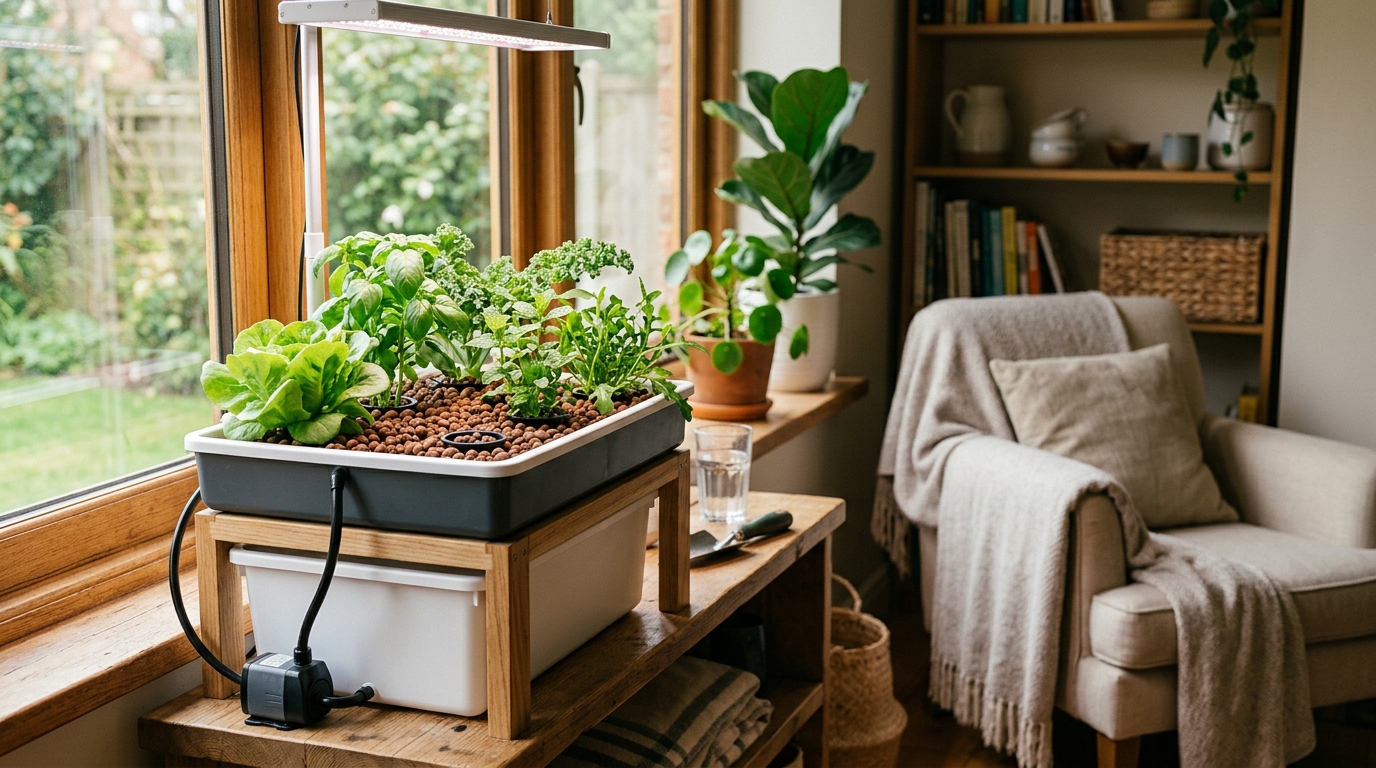
The best ebb and flow hydroponic system for most home growers is the Active Aqua Grow Flow Ebb & Gro, which handles large fruiting plants like tomatoes, peppers, and cucumbers in a modular bucket layout for $150–250. For beginners who prefer a flood tray approach, a Bootstrap Farmer 3x3 tray kit at $80–120 offers more media flexibility and easier access. Ebb and flow — also called flood and drain — is the clear top choice when you need to grow crops too large for NFT channels or too numerous for individual DWC buckets.
How ebb and flow hydroponics works
Ebb and flow works on a simple timer-driven cycle. A submersible pump in a reservoir periodically floods a grow tray or series of containers with nutrient solution, then the solution drains back to the reservoir by gravity when the pump stops. Roots alternate between a wet period — delivering nutrients — and a dry period that provides oxygen. The cycle repeats 2 to 6 times per day.
A complete ebb and flow system has four core components:
- Grow tray or containers — either a wide flood table (2x2, 3x3, 4x4, or 4x8 feet) holding multiple small pots, or modular buckets each housing one large plant
- Reservoir — a sealed tank positioned below the grow tray; 17 to 35 gallons is typical for home systems
- Submersible pump with timer — pushes solution from the reservoir on a schedule; 2–6 flood cycles per day is standard
- Fill and drain fittings — one fitting floods the tray, one acts as an overflow return; the overflow fitting sets the maximum flood depth
The flood depth determines how much of the grow medium gets saturated during each cycle. For most setups, 1–2 inches of flood depth is enough to saturate the root zone without waterlogging the upper medium. Hydroton clay pebbles are the standard medium for ebb and flow because they absorb moisture during flooding and dry out quickly between cycles, giving roots alternating access to nutrients and oxygen.
Unlike NFT, where roots are continuously exposed to flowing solution, ebb and flow gives roots a defined wet period followed by a complete dry period. That dry period is what allows the large, oxygen-demanding root systems of tomatoes and peppers to thrive — the same root mass would deplete dissolved oxygen in a shared DWC reservoir faster than aeration could replenish it.
Quick comparison
| Product | Best for | Rating | Notes | |
|---|---|---|---|---|
| Active Aqua Grow Flow Ebb & Gro System | best overall ebb and flow for fruiting plants | ★★★★★ | $150-250. Modular buckets. 4- or 8-site. Pump and fittings included. | Check price |
| Bootstrap Farmer 3x3 Flood Tray Kit | best flood tray for beginners with media flexibility | ★★★★★ | $80-130. Heavy-duty food-grade tray. Works with any grow medium. Tent-compatible. | Check price |
| VIVOSUN Ebb and Flow Hydroponic Kit | best complete budget kit under $100 | ★★★★☆ | $70-100. Complete kit with pump, timer, and fittings. Good for first-time growers. | Check price |
| Current Culture H2O Shift Ebb & Flow Module | best premium modular ebb and flow system | ★★★★★ | $300-500. Commercial-grade. Large root zone volume per site. Modular expansion. | Check price |
| 4x4 Flood Table Kit with 17-Gallon Reservoir | best large-format tray for 12-16 plant grows | ★★★★☆ | $120-200. Wide grow surface. Clone tray compatible. Heavy-duty 1-inch fittings. | Check price |
The picks
Best for most growers: Active Aqua Grow Flow Ebb & Gro
Best for home growers who want to grow large fruiting plants like tomatoes, peppers, or cucumbers in a compact, professional-grade setup
Active Aqua Grow Flow Ebb and Gro Hydroponic System
Active Aqua's Grow Flow Ebb & Gro is the most-recommended modular ebb and flow system for US home growers. Each site uses a 17-gallon outer bucket housing a 13-gallon inner bucket filled with hydroton — the inner bucket floods and drains while the outer bucket buffers against overwatering when flood timing is slightly off. A central controller reservoir (27- or 55-gallon) serves 4 or 8 plant sites through a single pump and manifold. The modular design lets you start with 4 sites and expand to 8 later without replacing the reservoir or pump. Active Aqua builds all components to commercial standards: pumps are rated for 24/7 operation and thick-walled buckets resist cracking after years of repeated flooding. At \$150–250 for a 4-site system, this is the clear best-value choice for large-plant ebb and flow growing.
★★★★★ 4.6 · 1,400 reviews
Check current price on Amazon→Pros
- Modular design expands from 4 to 8 sites without replacing the reservoir
- Outer/inner bucket design buffers against overwatering
- Commercial-grade pump rated for continuous 24/7 operation
- Large per-site root zone volume suits tomatoes and peppers
Cons
- Buckets take up significant vertical height compared to flat tray systems
- Reservoir requires topping up every 3-5 days with large plants at peak growth
- 4-site configuration limits plant count compared to flat tray systems holding 12-16 pots
Best flood tray: Bootstrap Farmer 3x3 Tray Kit
Best for beginners and intermediate growers who want a flexible flood tray for herbs, clones, or a mixed crop lineup
Bootstrap Farmer 3x3 Ebb and Flow Flood Tray Kit
Bootstrap Farmer makes the most durable flood tray for home hydroponic use. Their 3x3 food-grade polyethylene trays are 2 inches deep and reinforced at the base — unlike most import trays that flex and bow under a full load of wet grow medium. The 3x3 footprint fits inside a standard 3x3 grow tent with room for air circulation. You can fill the tray with hydroton for 9 to 12 individual plant sites, or use it as a propagation tray for 72 to 100 seedling rockwool cubes. The tray ships without a reservoir, pump, or timer — a deliberate tradeoff allowing full configuration flexibility. Pair it with a 17-gallon reservoir and a 400 GPH submersible pump for a solid starter system under \$130 total.
★★★★★ 4.5 · 870 reviews
Check current price on Amazon→Pros
- Food-grade polyethylene resists bowing under heavy wet loads
- Fits standard 3x3 grow tents without modification
- Works with any grow medium — hydroton, coco, perlite, or rockwool
- Doubles as a propagation tray for seedlings and clones
Cons
- Does not include reservoir, pump, timer, or fittings — must be sourced separately
- Requires a frame or bench to elevate above the reservoir for drainage
- No included documentation for first-time ebb and flow setup
Best budget kit: VIVOSUN Ebb and Flow System
Best for budget-conscious first-time growers who want a complete plug-and-play ebb and flow kit under \$100
VIVOSUN Complete Ebb and Flow Hydroponic Grow System
VIVOSUN's ebb and flow kit is the most accessible entry into flood-and-drain hydroponics. The complete kit ships with the grow tray, reservoir, submersible pump, mechanical timer, fill fitting, drain fitting, and tubing — everything needed without additional purchases. Tray dimensions are typically 24x24 inches, sized for 6 to 9 plants in 3-gallon containers or up to 36 seedling blocks. The mechanical timer handles 2 to 6 flood cycles per day reliably. VIVOSUN's tray material is thinner than premium alternatives, so the tray needs a completely flat surface to prevent stress cracks over time — a wooden board or grow tent floor works. Plan to replace the pump after 12 to 18 months of daily operation. For testing ebb and flow for the first time, VIVOSUN provides the complete tool set at a price that makes experimentation practical.
★★★★☆ 4.2 · 3,200 reviews
Check current price on Amazon→Pros
- Complete kit includes tray, reservoir, pump, timer, and fittings
- Lowest total cost for a working ebb and flow system
- Large Amazon presence means fast shipping and straightforward returns
- Straightforward setup documentation for first-time growers
Cons
- Tray material is thinner than premium options and requires flat surface support
- Pump is rated for 12-18 months of continuous use rather than multi-year service
- Basic mechanical timer does not support multiple cycles within a single hour
Best premium system: Current Culture H2O Shift Ebb & Flow
Best for serious home growers who want professional-grade ebb and flow infrastructure built for multi-year use and maximum yield
Current Culture H2O Shift Ebb and Flow Hydroponic Module
Current Culture H2O builds the premium end of the ebb and flow market with the same engineering used in commercial vegetable and herb operations across North America. The Shift system uses thick-walled containers with oversized fill and drain fittings, a commercial-grade pump, and a digital timer that supports cycle-count programming rather than simple interval timing. The large per-site root zone volume — typically 8 to 13 gallons per plant site — allows tomatoes and peppers to develop the full root mass their genetics support without the root binding that limits smaller containers. Current Culture also sells replacement parts for every component and provides phone technical support, which consumer brands do not offer. At \$300–500 for a multi-site system, the investment makes sense when the goal is maximum yield from high-value fruiting crops over multiple growing seasons.
★★★★★ 4.7 · 520 reviews
Check current price on Amazon→Pros
- Commercial-grade build quality designed for multi-year continuous operation
- Large root zone volume per site maximizes yield from fruiting plants
- Digital timer supports precise cycle programming beyond simple intervals
- Phone support and manufacturer replacement parts available
Cons
- Significantly higher cost than consumer-grade systems
- More capacity than needed for casual herb or lettuce growing
- Larger physical footprint per plant site than compact bucket or tray systems
Best large-format tray: 4x4 Flood Table with Reservoir
Best for growers who want to run 12-16 plants in 3-gallon containers or use the full table surface for clone propagation and seedling starts
4x4 Ebb and Flow Flood Table Kit with 17-Gallon Reservoir
A 4x4 flood table is the standard large-format ebb and flow configuration for home growers who want to maximize plant count in a single grow tent. A 4x4 table fits 12 to 16 plants in 3-gallon containers, or a full 100-site seedling tray during propagation before transitioning to full-grown plants. The 17-gallon reservoir sits beneath the table on the tent floor; the table is elevated at the correct height for gravity drain. Heavy-duty 1-inch fill and drain fittings are standard for 4x4 tables — the larger diameter handles the faster fill and drain rates when flooding 16 square feet of growing surface. When comparing kits in this category, verify that table side walls are at least 3 inches tall; shallower walls do not provide enough flood depth for containers at the tray perimeter.
★★★★☆ 4.4 · 1,100 reviews
Check current price on Amazon→Pros
- Large surface fits 12-16 plants in 3-gallon containers or a full clone tray
- Pairs perfectly with a 4x4 grow tent footprint
- Heavy-duty 1-inch fittings handle fast fill rates for large flood volumes
- Versatile for propagation, vegetative, and flowering stages
Cons
- Requires an elevated frame or stand to position correctly above the reservoir
- More difficult to relocate once set up and loaded
- 17-gallon reservoir requires topping up every 2-4 days with 16 large plants at peak growth
What to skip
Cheap flood trays with thin bases. A tray that bows or flexes under load creates uneven flood depth — one corner floods to 2 inches while the opposite corner barely gets wet. Uneven flooding is the most common cause of inconsistent yields in ebb and flow systems. Verify that any tray you buy specifies base thickness (minimum 1/4 inch for a 3x3) or reinforced construction before purchasing.
Translucent or white reservoir tanks. Light-permeable reservoirs allow algae to establish in the nutrient solution and root zone. Algae competes with plant roots for nutrients and oxygen, and algae mats can clog drain fittings after a few weeks of growth. Only use black, opaque reservoir tanks — or wrap any existing transparent tank in black poly sheeting before your first fill.
Mechanical timers with only 1-hour resolution. Most ebb and flow systems need 4 to 6 flood cycles per day spaced every 3 to 4 hours during lights-on. A 15-minute increment mechanical timer handles this correctly. Avoid timers with only 1-hour increments — they cannot provide enough flood frequency for systems running more than 2 cycles per day, which leads to medium drying out and wilting between cycles.
Ebb and flow vs NFT vs DWC: which should you choose?
Choose ebb and flow when your primary crops are large fruiting plants — tomatoes, peppers, cucumbers, squash, or large cannabis plants. These plants develop extensive root systems that outgrow NFT channels within 4 to 6 weeks and consume dissolved oxygen faster than DWC air pumps can replenish it in shared reservoirs. Ebb and flow handles the root volume and oxygen demands that other methods struggle with.
Choose NFT when you want to maximize leafy green plant count per square foot. A 4-channel NFT kit grows 32 to 48 lettuce or herb plants in a 4x4 footprint — a density no ebb and flow table matches. NFT is also simpler to harvest: pull net cups without disturbing the growing medium.
Choose DWC when you want to grow individual large plants with maximum simplicity and minimum timer complexity. A 5-gallon DWC bucket with an air stone has fewer moving parts than any ebb and flow setup, and a single-plant DWC bucket is the most forgiving starting point for learning hydroponic principles before scaling up.
How to set up an ebb and flow system
Setting up a 3x3 flood tray ebb and flow system takes 2 to 3 hours, plus one full day of test runs before transplanting plants into it.
-
Position the tray above the reservoir. The tray must sit at least 6 to 8 inches above the reservoir lid so nutrient solution drains completely by gravity. An inverted plastic storage bin, a custom frame, or grow tent shelf brackets all work as a platform.
-
Install fill and drain fittings. Thread the fill fitting into the smaller tray hole (typically 1/2-inch) connected to the pump output line. Thread the overflow fitting into the larger hole — the height of this fitting above the tray floor sets the maximum flood depth. Most setups use a 1-inch drain fitting set at 1 to 2 inches above the tray floor.
-
Run a water test. Fill the reservoir with plain pH-adjusted water. Run a test flood cycle: the tray should fill to the overflow fitting height and drain completely within 10 to 20 minutes after the pump stops. Check all fittings for leaks and confirm that water drains without pooling in any corner.
-
Set flood frequency. A 15-minute flood cycle run 4 times per day during lights-on is the standard starting point for crops in hydroton. Increase to 5 to 6 cycles per day when plants are large and actively transpiring in warm conditions. Reduce to 2 to 3 cycles for seedlings and in grow rooms below 68°F.
-
Add nutrients and adjust pH and EC. Mix nutrients per your chosen schedule. Target pH 5.8–6.2 for most crops, and EC 1.4–2.0 for seedlings transitioning to vegetative growth. Tomatoes and peppers at peak fruiting prefer EC 2.0–3.0. Use a calibrated EC/TDS meter — not guesswork.
-
Transplant and monitor daily for the first week. Place plants in their grow medium in the tray or containers. Run 5 to 6 flood cycles per day for the first 5 to 7 days to help roots establish contact with the medium, then step back to your normal frequency. Change the full reservoir every 10 to 14 days to prevent salt accumulation.
FAQ
Frequently asked questions
What is an ebb and flow hydroponic system?
What plants grow best in an ebb and flow system?
How often should I flood an ebb and flow system?
What grow medium works best for ebb and flow?
How large should the reservoir be for an ebb and flow system?
How is ebb and flow different from drip hydroponics?
Bottom line
The best ebb and flow system for most home growers is the Active Aqua Grow Flow Ebb & Gro — commercial-grade build quality, modular expansion, and the root zone volume large fruiting plants need. Choose the Bootstrap Farmer 3x3 flood tray when you want media flexibility and compatibility with a standard grow tent. Pick VIVOSUN for a complete kit at the lowest cost for a first-time ebb and flow setup. Step up to Current Culture H2O for serious multi-season production of high-value crops.
To get the most from your system, dial in your nutrient solution with the best hydroponic nutrients guide, keep pH in range with the pH adjustment guide for hydroponics, and track EC accurately with a calibrated EC/TDS meter. Still comparing system types? The best hydroponic systems guide puts ebb and flow side by side with NFT, DWC, and aeroponics, and the drip system for hydroponics guide covers the closest alternative for large-plant growing.