roundups
Best Carbon Filters for Grow Tents 2026 (Tested Picks)
The best carbon filters for grow tents: AC Infinity, Phresh, Vivosun, and more. Sized by fan CFM, carbon quality, and filter life to eliminate odors.
 Priya Anand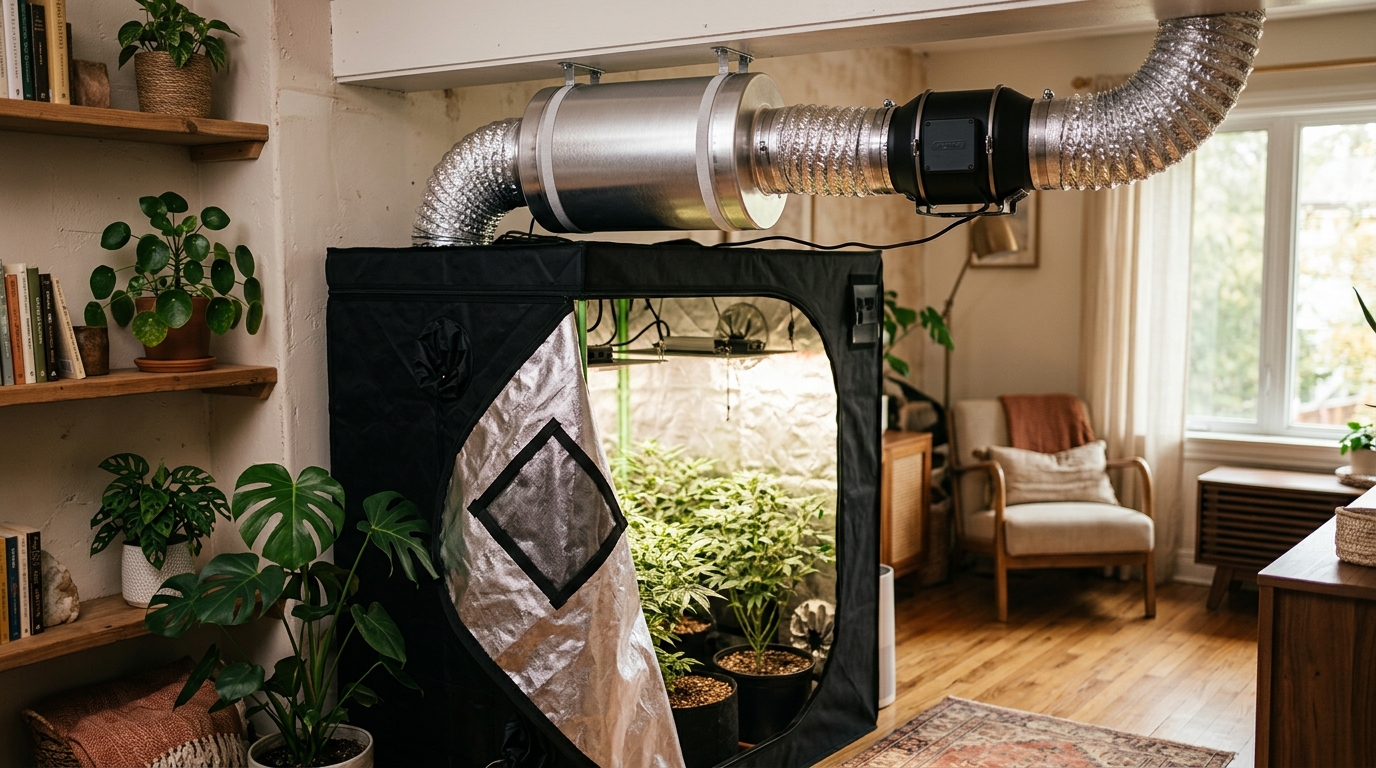
The best carbon filter for most grow tents is the AC Infinity Charcoal Carbon Filter (6-inch), which pairs perfectly with their Cloudline fan ecosystem and lasts 12-18 months under continuous use. For the longest-lasting filter with less frequent replacement, the Phresh Filter is the premium pick. Both outperform budget filters that clog within 3-6 months and fail to neutralize odors at the source.
Why a carbon filter is non-negotiable for serious grow tents
A grow tent without carbon filtration exhausts every volatile compound your plants produce directly into the surrounding room. For aromatic crops — herbs, fruiting plants, anything that flowers — this means a persistent, concentrated smell. A carbon filter mounted on the exhaust fan scrubs the air before it leaves the tent, capturing volatile organic compounds in the activated carbon bed before they reach your living space.
The filter does nothing without airflow. It must be paired with an inline fan that pulls tent air through it. The path is: plants grow in the tent interior, air is drawn into the carbon filter by the fan, the fan exhausts cleaned air through ducting and out the exhaust port. The fan does the moving; the carbon does the scrubbing. Without the fan pulling air through, the carbon bed is essentially inert.
Carbon quality determines both effectiveness and longevity. The industry benchmark is RC-48 or RC-412 Australian virgin activated carbon — processed from Australian coal with a surface area of 1200-1500 square meters per gram. This high surface area is what gives activated carbon its scrubbing capacity. Budget filters use lower-grade carbon with lower surface area; they work initially but lose effectiveness within 3-6 months instead of 12-18.
Sizing: match the filter to the fan, not the tent
Most growers make the mistake of sizing by tent dimensions. The correct approach is sizing by fan CFM (cubic feet per minute). Your carbon filter must be rated to handle at least as much airflow as the fan produces:
- 4-inch fan (100-200 CFM): pair with a 4-inch carbon filter rated 200 CFM or higher
- 6-inch fan (350-450 CFM): pair with a 6-inch carbon filter rated 400 CFM or higher
- 8-inch fan (700-800 CFM): pair with an 8-inch carbon filter rated 750 CFM or higher
Undersizing causes odor breakthrough — air moves through the carbon faster than the carbon can scrub it. It also exhausts the carbon prematurely because the material works harder per cubic foot of air. Oversizing is fine; a 6-inch filter rated at 600 CFM on a fan producing 400 CFM will outlast that fan’s operational life.
The tent volume informs your fan requirement, not the filter. A 4x4x7-foot tent (112 cubic feet) needs at least 112 CFM to exchange air once per minute; most growers target 2-3 exchanges per minute. A 6-inch Cloudline fan at 400 CFM handles a 4x4 tent with room to spare.
Quick comparison
| Product | Best for | Rating | Notes | |
|---|---|---|---|---|
| AC Infinity Charcoal Carbon Filter 6" | best overall; AC Infinity fan ecosystem | ★★★★★ | $40-60. RC-412 Australian carbon. 12-18 month life. | Check price |
| Phresh Filter 6x16" | best premium; longest life, densest carbon bed | ★★★★★ | $80-110. RC-48 Australian carbon. 18-36 month life. | Check price |
| Vivosun Carbon Filter 6" | best budget; reliable odor control for the price | ★★★★★ | $25-40. Australian activated carbon. 10-12 month life. | Check price |
| AC Infinity Charcoal Carbon Filter 4" | best for small tents: 2x2 and 2x4 | ★★★★★ | $30-45. Same RC-412 quality, sized for 4-inch fans. | Check price |
| Phresh Filter 8x24" | best for large tents: 5x5 and 4x8 | ★★★★★ | $120-160. RC-48 carbon. Handles 750 CFM or more. | Check price |
| iPower Carbon Filter 6" | best ultrabudget for occasional or low-odor use | ★★★★☆ | $20-30. Generic activated carbon. 6-8 month life. | Check price |
The picks
Best overall: AC Infinity Charcoal Carbon Filter 6-inch
Best for most home growers; anyone already running AC Infinity Cloudline fans
AC Infinity Charcoal Carbon Filter 6-inch
The AC Infinity carbon filter uses RC-412 Australian virgin activated carbon — the same grade as premium competitors at a mid-range price of 40-60 dollars for the 6-inch size. The flanges are precision-sized to connect directly to Cloudline T6 and S6 fans without adapter rings. Carbon bed depth is 46mm, above average for this price tier. Real-world life expectancy is 12-18 months under continuous use in a 4x4 tent. Two pre-filter sleeves are included and help block large particulates before they reach the carbon, meaningfully extending replacement intervals. For growers already in the AC Infinity ecosystem, this is the obvious pairing — no adapter hardware, no compatibility guessing.
★★★★★ 4.8 · 3,200 reviews
Check current price on Amazon→Pros
- RC-412 Australian virgin carbon — same grade as premium brands at lower cost
- Direct flange fit for Cloudline fans; no reducer rings or adapters needed
- 46mm carbon bed depth; above average for this price range
- Two pre-filter sleeves included; extend carbon life significantly
- Consistent 12-18 month life across thousands of real-world reviews
Cons
- Shorter life than Phresh Filter; more frequent replacement for year-round heavy grows
- Not available in as many CFM ratings as Phresh Filter lineup
- Pre-filter sleeves need washing or replacement every 3-4 months
Best premium: Phresh Filter 6x16-inch
Best for year-round growers; anyone wanting maximum odor elimination and minimum replacement frequency
Phresh Filter 6x16-inch
Phresh is the filter brand that professional and commercial growers rely on when odor control cannot be compromised. The 6x16 model uses RC-48 Australian activated carbon with 1500 square meters per gram surface area — industry-leading density. Carbon bed depth is 51mm, the deepest available in the 6-inch category. Life expectancy is 18-36 months under normal conditions; high-intensity continuous grows report 18-24 months. At 80-110 dollars, the math works in its favor: one Phresh Filter replaces two to three budget filters costing 30 dollars each. Construction is solid steel with an integrated pre-filter mesh baked into the housing body — no loose sleeves falling off when mounting. For anyone growing anything with strong aromatics and wanting to replace the filter as infrequently as possible, this is the right investment.
★★★★★ 4.7 · 1,800 reviews
Check current price on Amazon→Pros
- RC-48 carbon at 1500 m2/g surface area — highest available in consumer filters
- 51mm carbon bed; the deepest in the 6-inch category
- 18-24 month real-world life under continuous heavy use
- Steel body construction resists denting and deformation when mounting
- Integrated pre-filter mesh — no loose sleeves to manage or replace
Cons
- 80-110 dollars is 2x the cost of AC Infinity; not justified for casual or seasonal growing
- Heavier than plastic-body filters; flange and hanging hardware must support the added weight
- Replacement cost approaches the price of a new unit
Best budget: Vivosun Carbon Filter 6-inch
Best for budget growers; seasonal growing; lower-odor plants like herbs and vegetables
Vivosun Carbon Filter 6-inch
Vivosun occupies the same position in carbon filters as it does in grow tents: the brand that reliably works for 70 percent of growers at 50-60 percent of the price. The 6-inch model uses Australian activated carbon (not RC-48 grade, but meaningfully above generic non-Australian sources) in a 38mm bed. Standard flanges fit most 6-inch fans universally. Life is 10-12 months under continuous use — shorter than AC Infinity or Phresh, but a rational trade-off at 25-40 dollars. For growers running one or two cycles per year, or growing lower-odor plants like tomatoes, basil, or leafy greens, the Vivosun is a sound choice. For year-round continuous grows with high-odor crops, annual replacement costs start to close the gap versus mid-tier filters.
★★★★★ 4.5 · 9,400 reviews
Check current price on Amazon→Pros
- 25-40 dollars — roughly half the cost of AC Infinity, one-third of Phresh
- Australian activated carbon; above generic non-Australian quality
- Universal 6-inch flanges fit most inline fans without adapters
- Pre-filter sleeve included; helps extend life for low-odor grows
- Ideal for seasonal growers who run 1-2 cycles per year
Cons
- 38mm carbon bed — thinner than AC Infinity (46mm) and Phresh (51mm)
- 10-12 month life; year-round growers replace it annually
- Fan ecosystem integration absent; may need reducer rings for some fan brands
Best for small tents: AC Infinity Charcoal Carbon Filter 4-inch
Best for 2x2 and 2x4 grow tents; herb gardens; propagation and seedling tents
AC Infinity Charcoal Carbon Filter 4-inch
For tents smaller than 3x3, a 4-inch inline fan and matching 4-inch carbon filter is the correctly sized combination. The AC Infinity 4-inch carbon filter uses the same RC-412 Australian activated carbon as the 6-inch model — quality does not drop at the smaller size. At 30-45 dollars, it fits appropriately for the smaller tent budgets it serves. Flanges connect directly to AC Infinity Cloudline S4 and T4 fans without adapters. For herb growers running a 2x4 closet tent, or anyone maintaining a seedling propagation tent year-round, this is the right pick — no oversized filters requiring reducer rings, no undersized filters choking on the airflow.
★★★★★ 4.7 · 1,400 reviews
Check current price on Amazon→Pros
- Same RC-412 Australian carbon quality as the larger 6-inch AC Infinity filter
- Properly sized for 4-inch fans — direct connection, no reducer rings
- 30-45 dollars; appropriate pricing for small tent setups
- Direct fit for Cloudline S4 and T4 fans
Cons
- Too small for tents larger than 3x3 — air volume exceeds filter scrubbing capacity
- Less total carbon surface area means slightly shorter life than the 6-inch version
What to skip
Unbranded Amazon filters under 20 dollars. These use off-grade activated carbon — low surface area, inconsistent processing. They reduce odors for the first 4-8 weeks, then breakthrough happens and nothing changes when you run the fan. You end up replacing 3-4 times per year, which costs more than a single AC Infinity or Vivosun filter.
Filters with a carbon bed thinner than 30mm. Bed depth is the primary predictor of lifespan and scrubbing thoroughness. Anything under 30mm is designed for light-duty or short-term use. Most budget filters hide this spec — if it is not listed, assume it is thin.
A filter sized smaller than your fan. A 4-inch carbon filter on a 6-inch fan means air moves through faster than the carbon can capture volatile compounds. Odor passes straight through. The diameter and CFM rating must match or exceed the fan output.
Generic activated charcoal bags or mesh pouches sold as tent odor absorbers. These work passively in enclosed spaces — a drawer, a closet shelf — but do essentially nothing when exhausted air from a running fan blows past them. Passive deodorizers cannot compete with the airflow rates inside a running exhaust system.
Plastic-body filters with stapled pre-filter seams. The pre-filter sleeve on cheap plastic filters often separates from the housing when mounted vertically (the standard orientation inside a tent). Look for filters where the pre-filter attaches securely or is integrated into the housing.
Maintenance: extending filter life and knowing when to replace
Activated carbon is a consumable — it cannot be washed, recharged, or regenerated at home. Once the carbon bed is saturated with volatile compounds, it stops scrubbing effectively and must be replaced. The pre-filter sleeve, however, is reusable: remove it, wash it in warm water, let it dry fully, and reinstall. Clean pre-filters meaningfully extend carbon life by blocking the large particulates that would otherwise clog the carbon bed directly.
Signs the filter needs replacement:
- Odors are detectable in the exhaust airflow, even when the fan runs at full speed
- Airflow through the exhaust system has noticeably decreased despite a clean fan
- The filter has been running continuously for 15 months or more
Practices that extend life:
- Keep tent humidity below 65-70 percent. High humidity saturates carbon faster than odor compounds do
- Run the fan at lower speed settings during vegetative or seedling stages when odor load is lower
- Wash the pre-filter every 6-8 weeks; do not wait for it to visibly clog
- Store replacement filters sealed in their original packaging until needed — activated carbon absorbs compounds from ambient air, so an unsealed filter sitting on a shelf pre-ages
FAQ
Frequently asked questions
How do I size a carbon filter for my grow tent?
Should the carbon filter go inside or outside the tent?
How long does a carbon filter last?
Can I recharge or reuse a carbon filter?
Does a carbon filter work for herbs and vegetables, or only cannabis?
Do I need a carbon filter if I am growing in a tent inside a garage?
What is RC-48 carbon and why does it matter?
Bottom line
Best overall: AC Infinity Charcoal Carbon Filter 6-inch — RC-412 Australian carbon, direct-fit for Cloudline fans, 12-18 month life at an honest price. Best premium: Phresh Filter 6x16 — the densest carbon bed and longest life available; worth it for year-round continuous grows. Best budget: Vivosun Carbon Filter 6-inch — reliable Australian carbon at half the cost, right for seasonal and lower-odor applications.
Skip any filter under 20 dollars, any filter undersized for your fan, and any passive odor pouch sold as a grow tent solution.
For the full grow tent setup: best grow tents, fan selection for grow tents, grow tent ventilation guide, how to set up a grow tent step by step.