roundups
Best Humidifiers for Plant Rooms 2026
Best whole-room humidifiers for a dedicated plant room. High-capacity picks for tropical collections, indoor jungles, and sunroom conversions.
 Priya Anand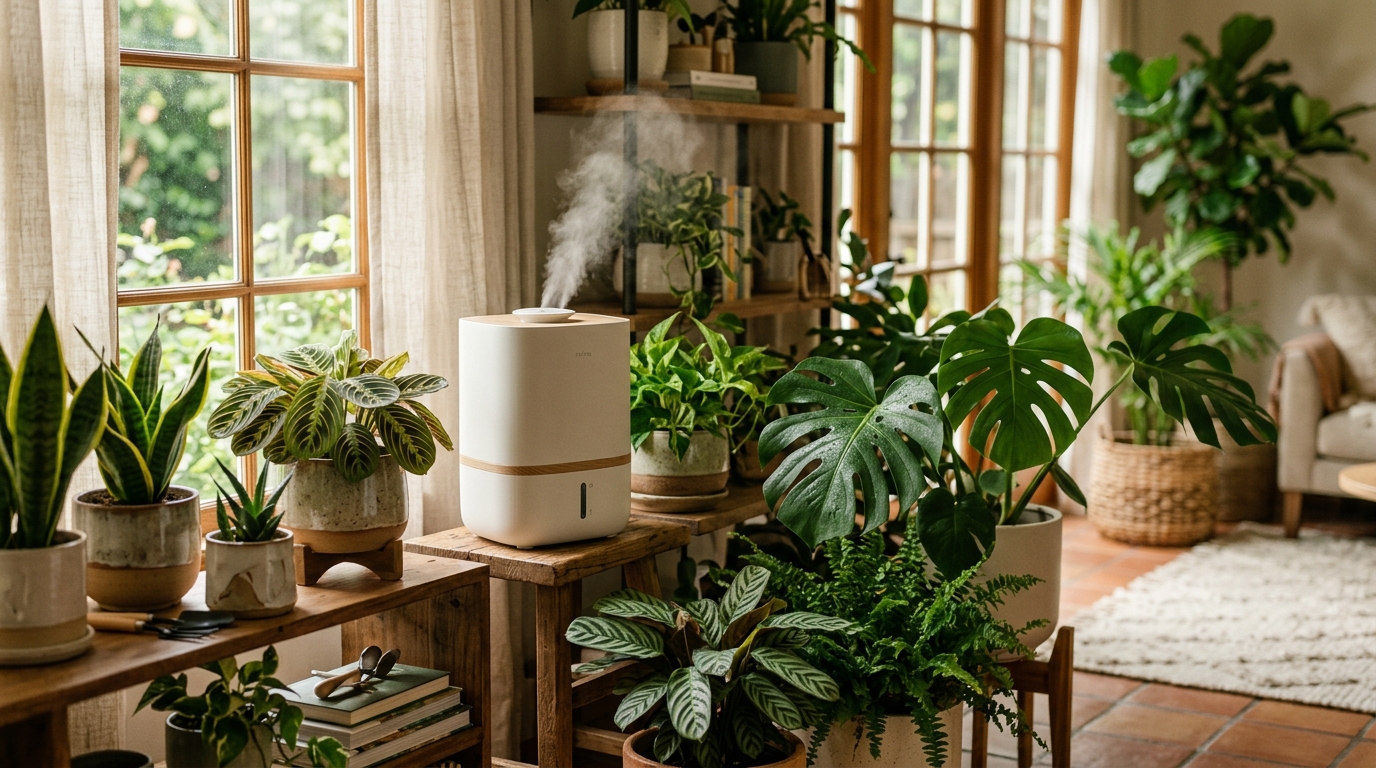
The LEVOIT LV600HH is the best humidifier for most dedicated plant rooms — its 6-liter tank, built-in humidity sensor with auto-mode, and warm or cool mist setting hold 55–80% RH in rooms up to 500 square feet with one refill per day or less. For large converted sunrooms or spaces with 100+ plants, the AIRCARE MA1201 evaporative console covers up to 1,000 square feet without producing white mineral dust that settles on foliage and clogs stomata.
Why a dedicated plant room needs a high-capacity humidifier
Most bedrooms and living rooms run at 30–50% relative humidity in winter and 40–60% in summer. Tropical houseplants — Monsteras, Calatheas, Ferns, Orchids, Bromeliads, Anthuriums — evolved in environments with 65–90% RH year-round. Growing them in a typical room at 40% humidity means they survive rather than thrive: leaf edges brown, new growth is stunted, and spider mite populations expand aggressively in dry air.
A dedicated plant room concentrates the humidity challenge because you are maintaining elevated RH across an entire space with plants on multiple shelves and racks, not just a single display cabinet. A 10x12-foot plant room holds roughly 960 cubic feet of air. A standard bedroom humidifier with a 1-liter tank raises humidity quickly but requires refilling every 3–5 hours at high output. A 6-liter tank at medium output runs 20–30 hours — the difference between refilling daily and refilling every 2–3 days.
The second challenge is white mineral dust. Ultrasonic humidifiers use vibrating plates to atomize any water source, including tap water. Dissolved calcium and magnesium in tap water become airborne particles that deposit on plant leaves, soil surfaces, and grow lights. In a room with 40 plants, white dust accumulates visibly within 3–7 days of tap water use. The fix is distilled water — about $1 per gallon at most grocery stores — which eliminates white dust entirely. Evaporative humidifiers sidestep this problem by passing air through a wet wick filter; minerals stay in the filter rather than becoming airborne.
What humidity level does a plant room need?
| Plant Type | Target RH | Notes |
|---|---|---|
| Monsteras, Pothos, Philodendrons | 55–70% | These adapt to lower RH; higher humidity accelerates growth and leaf size |
| Orchids (Phalaenopsis) | 55–70% | Good air circulation prevents rot at higher RH |
| Ferns and mosses | 70–85% | Brown frond edges are the first sign of insufficient humidity |
| Calatheas and Marantas | 65–80% | Very sensitive to low humidity; leaf curling indicates dryness |
| Bromeliads and Tillandsia | 55–70% | Mist twice weekly if ambient room humidity stays below 50% |
| High-humidity aroids (Alocasia, Colocasia) | 70–85% | Consistent high RH maximizes fenestration and leaf size |
Most mixed tropical plant rooms perform well targeting 60–70% RH — high enough for demanding species without the mold risk that accompanies 80%+ in spaces with imperfect airflow.
Quick comparison
| Product | Best for | Rating | Notes | |
|---|---|---|---|---|
| LEVOIT LV600HH | Best overall for plant rooms up to 500 sq ft | ★★★★★ | $70-90. 6L tank, 36-hour runtime on auto-mode. Warm and cool mist. Built-in humidity sensor. Covers up to 753 sq ft. | Check price |
| AIRCARE MA1201 | Best for large plant rooms with no white dust | ★★★★☆ | $100-140. Evaporative console. No white dust. Covers up to 1000 sq ft. No distilled water needed. Replaceable wick filter. | Check price |
| LEVOIT OasisMist 600S | Best smart pick with app control and scheduling | ★★★★★ | $80-100. 6L tank, Wi-Fi app, voice control. Built-in sensor with auto-mode. Covers up to 505 sq ft. | Check price |
| Pure Enrichment MistAire XL | Best budget pick for small plant rooms under 300 sq ft | ★★★★☆ | $35-50. 1.5L tank, two output levels, 360-degree nozzle. Auto-shutoff when empty. Quiet at under 28 dB. | Check price |
The picks
Best overall: LEVOIT LV600HH
Best for plant rooms up to 500 square feet needing consistent humidity with minimal daily maintenance
LEVOIT LV600HH Ultrasonic Humidifier
The LEVOIT LV600HH is the most practical high-capacity humidifier for a dedicated plant room because it combines a large 6-liter tank with a built-in humidity sensor that reads the room and adjusts output automatically. Most basic humidifiers run at a fixed output setting — they cannot tell whether the room is at 45% or 75% RH. The LV600HH reads ambient humidity continuously and reduces mist output as RH rises, preventing the over-humidification that encourages mold on walls, soil surfaces, and dense foliage. On low auto-mode with the humidistat set to 65%, the 6-liter tank runs 30–36 hours before requiring a refill — one refill per day or every other day, not every 3–5 hours. This matters enormously in a plant room where the humidifier runs constantly and constant attention is impractical. The warm mist setting adds a low-wattage heating element that kills bacteria in the water before dispersing mist — useful in plant rooms where high humidity and organic matter create conditions for airborne bacteria. Cool mist mode reduces electricity draw and is the correct setting for rooms with grow lights already raising ambient temperature. Use distilled or filtered water to prevent white mineral dust from accumulating on foliage, grow light panels, and pots. The LV600HH is not a smart humidifier with app control, but the built-in humidistat and included remote cover the core use case: set your target humidity, turn it on, and the unit maintains it without further adjustment. For plant room owners who want remote monitoring and scheduling, the OasisMist 600S is the logical step up.
★★★★★ 4.6 · 15,200 reviews
Check current price on Amazon→Pros
- 6-liter tank provides 30-36 hours of runtime on auto-mode, dramatically reducing refilling versus 1-2 liter budget humidifiers in daily plant room use
- Built-in humidity sensor with auto-mode adjusts output to maintain target RH and prevents over-humidification that causes mold in dense plant collections
- Warm mist setting kills waterborne bacteria before dispersing mist, beneficial in high-organic-material plant room environments
- Sleep mode reduces fan noise to under 36 dB and dims the LED panel for overnight operation without disrupting a bedroom plant room
- Wide-opening top fill design allows easy refilling and complete interior cleaning without disassembly
Cons
- Requires distilled or RO water — tap water in ultrasonic mode deposits white mineral dust on plant leaves and grow light panels within days
- No Wi-Fi or app connectivity; the included remote is useful but Bluetooth or smart home integration requires the OasisMist 600S instead
- Built-in sensor reads air near the unit base, not at mid-shelf plant height — accurate for open rooms but may lag in spaces with distinct humidity stratification
- Warm mist element adds 50-75 watts of heat; in small grow-lit rooms with 600W+ of lighting already running, warm mode may raise temperature above the optimal plant range
Best for large plant rooms: AIRCARE MA1201
Best for large converted sunrooms, greenhouse rooms, and plant spaces over 500 square feet where white dust from ultrasonic units is a problem
AIRCARE MA1201 Whole-House Evaporative Humidifier
The AIRCARE MA1201 is the correct answer for plant rooms where white mineral dust from ultrasonic humidifiers is unacceptable — rooms with many plants, open trays of soil, and grow lights that attract and show dust accumulation. Evaporative humidifiers work by blowing room air through a water-saturated wick filter; water evaporates naturally into the airstream and minerals stay behind in the wick rather than becoming airborne. The result is invisible humidity with zero white dust, regardless of tap water mineral content — no distilled water required. The MA1201 is a pedestal console that sits on the floor and covers up to 1,000 square feet at maximum output, making it the right scale for a converted sunroom, basement plant room, or large spare bedroom turned indoor jungle. The evaporative mechanism is also inherently self-limiting: as room humidity rises, the evaporation rate naturally decreases — an evaporative humidifier physically cannot push a room above the ambient dewpoint, making it nearly impossible to cause condensation on walls or windows from over-humidification. The limitation is that output depends on ambient temperature and current room humidity. In rooms with grow lights raising ambient temperatures to 75–85°F, evaporation rates improve and the MA1201 maintains target humidity efficiently. Wick filters last 1–2 months before calcium deposits reduce airflow; replacement filters cost $10–15 each. Runtime on the full 3.6-gallon reservoir is 8–14 hours at medium output depending on room conditions.
★★★★☆ 4.3 · 5,400 reviews
Check current price on Amazon→Pros
- Evaporative mechanism produces zero white mineral dust regardless of water quality — no distilled water needed, no deposits on plant leaves
- Self-limiting output naturally prevents over-humidification; evaporation slows as room RH rises, making condensation on walls nearly impossible
- Console floor design with a 3.6-gallon reservoir provides 8-14 hours of runtime and covers up to 1000 square feet
- Quiet fan-based operation is less disruptive in ambient-light plant rooms than the piezoelectric vibration hum of ultrasonic units
- Three fan speeds allow low-output maintenance mode for rooms already at target RH and high output for rapid humidity recovery after door openings
Cons
- Wick filter requires replacement every 1-2 months at $10-15 per filter; ongoing consumable cost is higher than ultrasonic units that only need water
- Output depends on ambient conditions — evaporation rate drops in already-humid rooms, making the MA1201 less effective at pushing RH above 65% in warm summer months
- Large console footprint (roughly 12x12 inches at the base) takes meaningful floor space in dense plant rooms where floor area is occupied by large-container specimens
- No built-in humidity sensor on base models; add a standalone hygrometer or upgrade to the AIRCARE EP9800 for an integrated humidistat and auto-shutoff
Best smart humidifier: LEVOIT OasisMist 600S
Best for plant rooms where you want scheduled humidity cycles, voice control, and remote monitoring without physically entering the room
LEVOIT OasisMist 600S Smart Humidifier
The LEVOIT OasisMist 600S is the LV600HH with full smart home integration added — 6-liter tank, built-in humidity sensor, and auto-mode are functionally identical, but the OasisMist adds Wi-Fi control via the VeSync app, voice commands through Alexa and Google Home, and scheduling that allows different humidity targets for day and night cycles. For a dedicated plant room where you are not present throughout the day, the ability to check current humidity remotely and adjust output without entering the room is a meaningful convenience. Plants in a sealed or lightly ventilated room drift significantly from target humidity during a door-closed afternoon; the app shows the current reading and allows one-tap adjustment. The scheduling feature enables a smart plant room setup: run at 70% target humidity during daylight hours when plants are actively transpiring and photosynthesizing, then drop to 60% at night to reduce mold risk from cool, still, stagnant air. This day-night cycling is how serious tropical plant collectors manage humidity without continuously elevated overnight RH that invites gray mold on new growth. At $80–100 versus $70–90 for the LV600HH, the added cost is justified primarily by the remote monitoring and scheduled cycling rather than the core humidification performance, which is equivalent between the two units.
★★★★★ 4.5 · 9,600 reviews
Check current price on Amazon→Pros
- Wi-Fi app shows live room humidity readings remotely — check conditions in a closed plant room without opening the door and disrupting the humidity environment
- Scheduling allows different day and night RH targets; lower overnight settings reduce mold risk from cool stagnant air without sacrificing daytime plant humidity needs
- Voice control via Alexa and Google Home allows hands-free output adjustments when both hands are occupied during plant care sessions
- 6-liter tank with integrated humidity sensor matches the LV600HH core performance at only $10-20 more for full smart integration
Cons
- Requires distilled or RO water for white-dust-free operation; the smart features do not eliminate the ultrasonic mineral deposit problem
- Wi-Fi setup requires a 2.4 GHz network; routers broadcasting 5 GHz only require a temporary band configuration change during initial pairing
- App-dependent scheduling reverts to manual mode during Wi-Fi outages; the built-in auto-mode continues operating but scheduled night cycles stop
- Premium price over the LV600HH is not justified if you do not need remote monitoring or scheduling — the base unit performs identically at lower cost
Best budget pick: Pure Enrichment MistAire XL
Best for small plant rooms or plant alcoves under 300 square feet where budget is the primary constraint
Pure Enrichment MistAire XL Ultrasonic Humidifier
The Pure Enrichment MistAire XL is the correct entry-level option for a small dedicated plant room — a 10x10-foot guest bedroom converted to plant growing, a wide plant shelf alcove, or a plant corner in a larger room. The 1.5-liter tank is smaller than the LEVOIT units, but at under $40 it allows a beginner plant room setup without the $70–90 commitment of a high-capacity humidifier. The MistAire XL produces mist on two output levels with a 360-degree adjustable nozzle for directing mist upward toward plants on shelves or into an enclosed area. Auto-shutoff when the tank empties protects the ultrasonic plate. Runtime on the high mist setting is approximately 4–6 hours per tank fill — in a small room this is adequate for a morning and evening refill cycle. The limitation compared to the LEVOIT units is the absence of a built-in humidity sensor; the MistAire XL runs at its selected output level regardless of actual room humidity. Pairing it with an Inkbird IHC-200 humidity controller ($35–50) adds automated on/off control and covers the missing sensor functionality — though the combined cost approaches the LEVOIT LV600HH price point, which has the sensor built in. The MistAire XL makes the most sense for a small plant space where you are home regularly to monitor conditions and refill the tank, or as a supplemental unit alongside a primary humidifier in a larger room.
★★★★☆ 4.4 · 6,300 reviews
Check current price on Amazon→Pros
- Under $40 entry price makes it the lowest-cost option for a first plant room humidifier without committing to a high-capacity unit
- 360-degree adjustable mist nozzle directs output toward plants on high shelves, grow racks, or wall-mounted planters
- Auto-shutoff when empty protects the ultrasonic plate from dry-running damage that permanently degrades mist output over time
- Quiet operation under 28 dB is appropriate for plant rooms in bedrooms or offices where ambient noise is a concern
Cons
- No built-in humidity sensor; runs at a fixed output level regardless of actual room RH — add an Inkbird IHC-200 controller for automated regulation
- 1.5-liter tank requires refilling every 4-6 hours at high output; not practical as the primary humidifier for plant rooms you cannot attend several times per day
- White mineral dust from tap water accumulates on foliage rapidly; distilled water is mandatory and adds a recurring cost
- Coverage area is optimistic in a plant-dense room with heavy transpiration — expect effective coverage closer to 150-200 sq ft than the rated maximum
Do you need a separate humidity controller?
If your humidifier has a built-in humidity sensor and auto-mode — the LEVOIT LV600HH and OasisMist 600S both have this — you do not need a separate controller. Set your target humidity and the unit maintains it automatically.
If your humidifier runs at a fixed output setting (the MistAire XL or the AIRCARE MA1201 base model), an Inkbird IHC-200 Wi-Fi Humidity Controller ($35–50) is a worthwhile addition. It plugs inline between the humidifier and the wall outlet, reads a probe inside the room, and cycles the humidifier on when RH drops below your set minimum and off when it reaches your maximum. This prevents two main failure modes: a room that dries out overnight because a fixed-output unit ran empty, and a room that climbs to 90%+ RH and grows mold on walls, soil, and foliage.
The combined cost of a MistAire XL plus Inkbird controller is $70–90, which approaches the LEVOIT LV600HH price with its integrated sensor. For most plant rooms, the LEVOIT with the built-in sensor is the cleaner and more convenient solution.
What to skip
Humidifiers under 4 liters for a primary plant room unit — a 1-liter or 2-liter tank may be marketed as covering 250–400 square feet, but in a plant room running consistent high humidity with lights on for 12–16 hours daily, these units require 4–8 refills per day at comparable output. Constant refilling means the humidifier regularly runs dry and the room drops to ambient humidity for hours before you notice. For any serious plant room, a 4-liter minimum — and ideally 6 liters — is the practical floor.
Warm mist humidifiers in grow-lit plant rooms — warm mist units use a heating element to boil water before dispersing steam, adding meaningful heat output (50–150 watts depending on model). In a plant room where grow lights already raise ambient temperature, a warm mist humidifier risks pushing the room above 85°F during peak light hours — temperatures at which most tropical houseplants experience heat stress regardless of humidity. Use cool mist ultrasonic or evaporative designs in grow-lit plant rooms.
Generic ultrasonic units without auto-shutoff — lower-cost ultrasonic units without auto-shutoff sensors will run dry and continue running, burning out the ultrasonic plate. In a room you leave unattended for hours at a time, a dry-running unit is a real failure mode and an avoidable one. Every humidifier on this list includes auto-shutoff; do not compromise on this feature.
FAQ
Frequently asked questions
What is the best humidity level for a plant room?
How big of a humidifier do I need for a plant room?
Why is white dust appearing on my plant leaves from the humidifier?
Should I run a humidifier in a plant room with grow lights?
Can I use tap water in a plant room humidifier?
How often should I clean a humidifier in a plant room?
Bottom line
For most dedicated plant rooms, the LEVOIT LV600HH ($70–90) is the single best choice — 6-liter tank, built-in humidity sensor with auto-mode, and 36-hour runtime cover everything most plant rooms need without over-engineering the setup. Step up to the OasisMist 600S ($80–100) if you want remote monitoring and day/night scheduling via the app. If your plant room is large or you cannot use distilled water consistently, the AIRCARE MA1201 ($100–140) eliminates white dust entirely and covers up to 1,000 square feet with zero mineral deposits on foliage. The Pure Enrichment MistAire XL ($35–50) works for small plant spaces but requires regular refilling and a separate humidity controller to match the automation of the LEVOIT units.
For related reading: best plant humidifiers for a broader range of plant humidity options including smaller personal units, how to control humidity for plants for a complete guide to measuring and managing moisture levels, humidifier for plant cabinet for smaller enclosed display setups with different humidity requirements, and common indoor plant problems since low humidity is one of the leading causes of houseplant stress and leaf damage.