guides
How to Grow Strawberries Indoors: Complete Guide
Grow strawberries indoors year-round with the right pot, light, and variety. Step-by-step guide for windowsill and grow-light setups.
 Priya Anand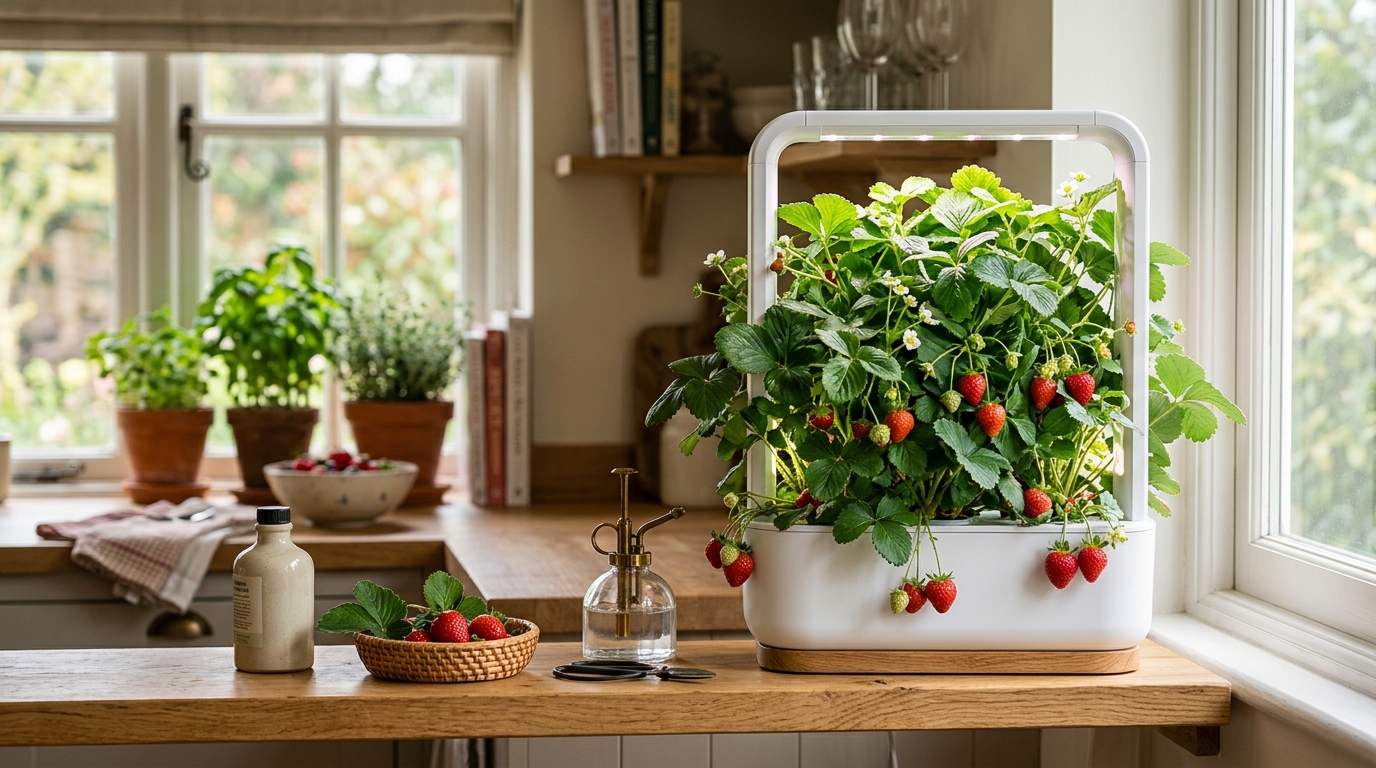
Growing strawberries indoors works best with a day-neutral variety like Albion or Seascape in a 6–8 inch pot under a full-spectrum grow light running 14–16 hours per day. Expect first fruits 8–12 weeks after planting, with continuous harvests through most of the year once the plants are established and you hand-pollinate the flowers.
Indoor strawberries require more active management than a typical houseplant — they need strong light, consistent feeding, and manual pollination — but the payoff is fresh fruit from a kitchen counter or balcony shelf regardless of the season outside. This guide covers every step from choosing the right variety to harvesting the first ripe berry, along with solutions to the most common problems that cause indoor strawberry plants to flower but never fruit.
Which strawberry variety grows best indoors?
Choosing the right variety is the single most critical decision for indoor strawberry growing. Most commercial strawberry varieties are June-bearing types bred for outdoor production — they require extended cold periods (vernalization) and respond to day length to trigger flowering, conditions that are impossible to replicate indoors without specialized equipment.
Day-neutral varieties are the correct choice for indoor growing. They flower and fruit based on temperature rather than day length, producing continuously through spring, summer, and fall outdoors — and year-round indoors under grow lights. The best options:
- Albion — Large berries, firm flesh, excellent flavor. The most widely available day-neutral variety and the most reliable for indoor production. Produces heavy crops with consistent quality.
- Seascape — Medium to large berries, slightly softer than Albion, outstanding flavor. Very productive indoors. More heat-tolerant than most varieties, making it well-suited to warm indoor environments.
- Tristar — Smaller berries with intense, almost wild-strawberry flavor. More compact growth habit than Albion or Seascape, well-suited to smaller pots and limited shelf space.
- Evie-2 — Everbearing type with good day-neutral characteristics. Compact, disease-resistant, produces well in containers. Less commonly available but worth seeking out.
What to avoid: Any variety labeled June-bearing, short-day, or bred specifically for outdoor production. These require cold vernalization periods and specific day lengths to initiate flowering — growing them indoors without mimicking those conditions produces plants with vigorous foliage but no flowers and no fruit.
Buy dormant bare-root plants or potted nursery starts rather than seeds. Seeds are slow — strawberries from seed take 4–6 months to reach fruiting size — and may not produce fruit that reliably matches the parent variety. Starting from established plants gets you to first fruit in 8–12 weeks.
What you need to get started
| Product | Best for | Rating | Notes | |
|---|---|---|---|---|
| Full-spectrum LED grow light | The most reliable light source for indoor strawberry fruiting | ★★★★★ | Run 14-16 hours daily. Position 4-6 inches above the canopy. A strip or bar light works better than single bulbs for even canopy coverage across multiple pots. | Check price |
| Day-neutral strawberry plants | Starting your indoor strawberry grow | ★★★★★ | Albion and Seascape are the most reliable. Buy 4-6 plants to ensure continuous harvests as different plants fruit at different times. | Check price |
| 6-8 inch pots with drainage holes | One plant per pot for adequate root space | ★★★★★ | Terracotta dries out faster than plastic, which helps prevent crown rot. Self-watering pots work well when they have an air gap above the reservoir. | Check price |
| Fast-draining potting mix with perlite | Fast-draining root environment that prevents rot | ★★★★★ | Mix standard potting soil 2:1 with perlite, or use a cactus and herb blend. Strawberry roots cannot tolerate wet, compacted soil. | Check price |
| Tomato and fruit fertilizer (high potassium) | Feeding during flowering and fruiting for best yield | ★★★★★ | Look for an NPK ratio with more potassium than nitrogen, such as 5-10-10 or 4-6-8. Use a balanced formula during vegetative growth, then switch once buds appear. | Check price |
| Small soft paintbrush for pollination | Hand-pollinating flowers since there are no bees indoors | ★★★★★ | A flat or fan brush size 0-2 works well. One brush handles an entire collection of plants. Gently touch the center of each open flower daily. | Check price |
| Outlet timer for grow lights | Automating a consistent 14-16 hour light schedule | ★★★★★ | A basic digital timer costs $10-15 and eliminates the need to manually switch lights on and off each day. | Check price |
Step 1: Set up the right light
Light is the most critical factor for indoor strawberry fruiting. Plants that receive insufficient light grow and flower but produce poor fruit set or no fruit at all.
What strawberries actually need:
Strawberries in outdoor production receive 8–10 hours of direct sunlight. A south-facing window in the northern hemisphere provides 4–6 hours of direct sun in summer, dropping dramatically in fall and winter. While some fruiting is possible on a perfect south-facing windowsill during peak summer, a dedicated grow light produces significantly better and more consistent results year-round.
Grow light setup for strawberries:
Use a full-spectrum LED grow light that covers the range from 400nm (blue) to 700nm (red). White-spectrum LEDs labeled “full spectrum” or “sunlight spectrum” work well. Avoid blurple (blue-purple) grow lights — they function but produce leggier growth in strawberries compared to white-spectrum options.
A quality LED bar or strip light positioned 4–6 inches above the plant canopy delivers the right intensity for most consumer grow lights in the 20–50W range. Run the light for 14–16 hours per day on an outlet timer. This photoperiod triggers day-neutral varieties to flower and fruit continuously without seasonal variation. Do not exceed 18 hours — plants benefit from a dark rest period.
Best for even canopy coverage across multiple strawberry pots
Barrina T5 LED Grow Light Strips
Barrina T5 strip lights are among the most popular low-cost options for small indoor fruit gardens. Mounted 4-6 inches above a row of pots on a wire shelf, a set of 2-4 strips covers 3-6 strawberry plants with even light distribution across the entire canopy. The full-spectrum white light supports both vegetative growth and fruit development without the eye fatigue of purple blurple lights. At around $30 for a 4-pack with power adapters and mounting hardware, they are excellent value for small indoor grows.
★★★★★ 4.5 · 28,000 reviews
Check current price on Amazon→Step 2: Choose the right container and soil
Container size and type:
Use one 6–8 inch pot per plant. Strawberry roots are shallow but spread horizontally — a 6-inch diameter pot gives adequate root volume for a single plant without the excess soil that stays wet between waterings and leads to rot.
- Terracotta — Best choice for most growers. The porous material wicks moisture and dries faster than plastic, preventing the crown rot that is the most common cause of indoor strawberry failure.
- Plastic — Works well if watering is carefully managed. Retains moisture longer, which reduces watering frequency but increases the risk of overwatering.
- Self-watering pots — Effective when the design includes an air gap between the reservoir and the soil. If soil sits directly in water, crown rot is likely.
A strawberry tower planter or hanging basket allows you to grow multiple plants vertically in a compact footprint — useful when growing 4–6 plants under a single grow light. Ensure each planting pocket has adequate drainage.
Soil:
Standard potting mix holds too much moisture for strawberries. Use one of these approaches:
- Mix standard potting soil 2:1 with perlite (2 parts soil, 1 part perlite)
- Use a cactus and herb potting mix straight from the bag
- Use a berry-specific potting mix if available
Avoid potting mixes labeled “moisture control” — these are engineered to stay wet longer, the opposite of what strawberries need.
Plant at the correct depth: the crown (where leaves emerge from the root ball) must sit precisely at soil level, not buried below it. A buried crown rots within days; a crown elevated too far above soil dries out and the plant declines.
Step 3: Plant and establish your plants
- Fill the pot to within 1 inch of the rim with your prepared soil mix
- Make a small mound of soil in the center of the pot
- Drape the roots over the mound so they spread downward and outward
- Fill in around the roots until the crown sits precisely at soil level
- Water gently to settle the soil without washing the crown
- Position immediately under the grow light
For bare-root plants that have been stored cold or shipped: soak the roots in room-temperature water for 30–60 minutes before planting. Trim any dead or damaged roots back to healthy tissue. Do not trim healthy white roots.
Remove early flowers for the first 3–4 weeks. This redirects energy from fruit production into root establishment. Plants that fruit immediately after transplant often decline faster than plants that spend the first month building strong root systems. A short delay produces higher long-term yields.
Step 4: Water and fertilize correctly
Watering:
Check soil moisture by pressing your finger 1 inch into the mix. Water when the top inch feels dry; water until it drains freely from drainage holes. In a terracotta pot under a grow light running 14–16 hours per day, strawberries typically need watering every 2–3 days in warm temperatures.
Never allow strawberries to sit in standing water — empty saucers within 30 minutes of watering. Persistent moisture at the crown triggers gray mold (Botrytis) and root rot, both of which are common and often fatal for indoor plants.
Fertilizing by stage:
Nutritional needs shift as the plant moves from establishment to fruiting:
- Establishment (weeks 1–4): Balanced fertilizer at half strength every 2 weeks. A 10-10-10 or 5-5-5 NPK ratio supports root and leaf development.
- Active vegetative growth: Continue balanced feeding every 2 weeks.
- Once flower buds appear: Switch to a low-nitrogen, high-potassium formula. Excess nitrogen at this stage promotes leafy growth at the expense of fruit. Use a tomato or fruit fertilizer with higher potassium than nitrogen — 4-6-8 or 5-10-10 at the labeled rate.
- During fruiting: Continue high-potassium feeding every 2 weeks throughout the fruiting period.
Best for feeding indoor strawberries during flowering and fruiting
Jack's Classic Tomato Feed 12-15-30
Jack Classic Tomato Feed at 12-15-30 NPK is a water-soluble fertilizer that delivers high potassium alongside calcium and magnesium — the combination that supports fruit quality in container plants. Dissolve in water at 1 teaspoon per gallon and apply every 10-14 days once flower buds appear. The lower nitrogen ratio prevents the leafy overgrowth that reduces fruiting in containers. One bag treats a small indoor strawberry collection for an entire growing season at half-dose rates.
★★★★★ 4.7 · 14,500 reviews
Check current price on Amazon→Step 5: Hand-pollinate your flowers
This is the step most beginners miss, and it is the most common reason indoor strawberries flower but never fruit.
Outdoor strawberries are pollinated by bees and other insects visiting each flower. Indoor plants have no natural pollinators. Without pollination, flowers develop fully and fall off without setting fruit regardless of how healthy the plant is otherwise.
How to hand-pollinate strawberries:
- Use a small soft-bristled artist paintbrush (size 0–2) or a cotton swab
- Check plants daily once flowering begins — flowers are receptive for about 3 days after opening
- Gently touch the brush to the center of each open flower, making a small circular motion to transfer pollen from stamens to pistils
- Move the brush from flower to flower, spreading pollen across the plant and between nearby plants
- Repeat daily during the active flowering period
Alternative pollination methods:
- Shake each pot gently when flowers are fully open — the vibration mimics bee activity and transfers pollen within each flower
- Hold a battery-powered electric toothbrush against the base of a flowering stem for a few seconds — this replicates the sonic vibration bees use and is highly effective for strawberries and tomatoes alike
A flower that has been successfully pollinated closes and its base begins to swell within 3–7 days. An unpollinated flower simply dries up and drops. Once you see the base swelling and turning green, fruiting is underway. Strawberries typically ripen 4–6 weeks after successful pollination.
Step 6: Harvest and maintain your plants
Harvesting:
Strawberries are ready when fully red with no white or green shoulder at the stem end, and slightly soft to the touch. Indoor strawberries tend to be smaller than commercial berries but often more intensely flavored due to slower development under controlled light.
Pick by gripping the stem just above the berry and bending it to snap cleanly. Leaving a short piece of stem attached extends shelf life in the refrigerator.
Remove any rotting or overripe fruit immediately — gray mold spreads rapidly among fruit in still indoor air.
Managing runners:
Strawberry plants send out long horizontal stems called runners that terminate in small plantlets. Indoors, you can root them by pinning the plantlet end into a small pot of moist soil adjacent to the parent. Sever the runner once the plantlet develops its own roots (typically 3–4 weeks).
Alternatively, remove all runners to keep the parent plant channeling energy into fruit rather than vegetative reproduction. Both strategies work — remove runners for maximum fruit yield, allow rooting to expand your plant collection for free.
When to replace plants:
Indoor strawberry plants decline in productivity after 2–3 years. The most efficient renewal strategy is to root runners from your best-producing plants and replace older parents with healthy offspring each season. This maintains variety characteristics while keeping plants in peak production without buying new starts each year.
Troubleshooting common indoor strawberry problems
Flowers drop without fruiting — Almost always a pollination failure. Increase hand-pollination to once daily for all open flowers. Also check that temperatures are not above 85°F — heat stress prevents fruit set even with successful pollination.
Fruit develops but stays small and pale — Insufficient light or low potassium. Move plants closer to the grow light and switch to a high-potassium fertilizer formula during fruiting.
Gray fuzzy mold on berries or leaves — Botrytis, caused by high humidity and poor air circulation. Remove affected tissue immediately. Increase air circulation with a small fan near the plants. Reduce watering frequency and avoid wetting foliage.
Crown rot — plant collapses at the base — Usually fatal once advanced. Caused by the crown being buried below soil level or exposed to persistent moisture. Prevention is the only cure: plant at the correct depth and never let the crown sit in wet conditions. Remove affected plants before rot spreads.
Yellowing leaves — Uniform yellowing from old to new leaves indicates nitrogen deficiency; resume balanced feeding. Yellow tissue between green veins (interveinal chlorosis) on new leaves indicates iron deficiency — add chelated iron to the feeding solution.
Runners but no flowers — Insufficient light or a light schedule that is too short. Ensure 14–16 hours of light daily. Also common when plants are overfed with nitrogen — reduce nitrogen and increase potassium to shift the plant toward reproductive growth.
FAQ
Frequently asked questions
How long does it take to grow strawberries indoors?
Do indoor strawberries need to be pollinated?
What is the best strawberry variety to grow indoors?
How many strawberries can one indoor plant produce?
Can I grow strawberries indoors without a grow light?
Do indoor strawberries taste the same as outdoor ones?
Bottom line
Growing strawberries indoors successfully comes down to four essentials: a day-neutral variety like Albion or Seascape, a full-spectrum grow light running 14–16 hours per day, correct crown depth when planting, and daily hand-pollination once flowers appear. Get those four right and a collection of 4–6 plants produces fresh fruit through most of the year.
Start with potted nursery starts rather than seeds to reach first harvest in 8–12 weeks. Remove early flowers for the first 3–4 weeks post-planting to build root systems that support higher long-term yields. Once flowering begins, switch to a high-potassium fertilizer and make daily pollination a short routine — it takes 30 seconds per session and is the single step that most determines whether your indoor strawberries flower only or actually fruit.
For more indoor growing guides: how to grow herbs indoors for kitchen herbs to grow alongside your strawberries, best grow lights for light recommendations that suit both herbs and fruiting plants, how to water indoor plants for dialing in moisture balance that prevents crown rot, and how to fertilize indoor plants for the complete feeding schedule from establishment through fruiting.