guides
How to Grow Radishes Indoors: Step-by-Step Guide
Grow radishes indoors from seed to harvest in 25-30 days. Best varieties, containers, and grow light setup for year-round crisp radishes.
 Priya Anand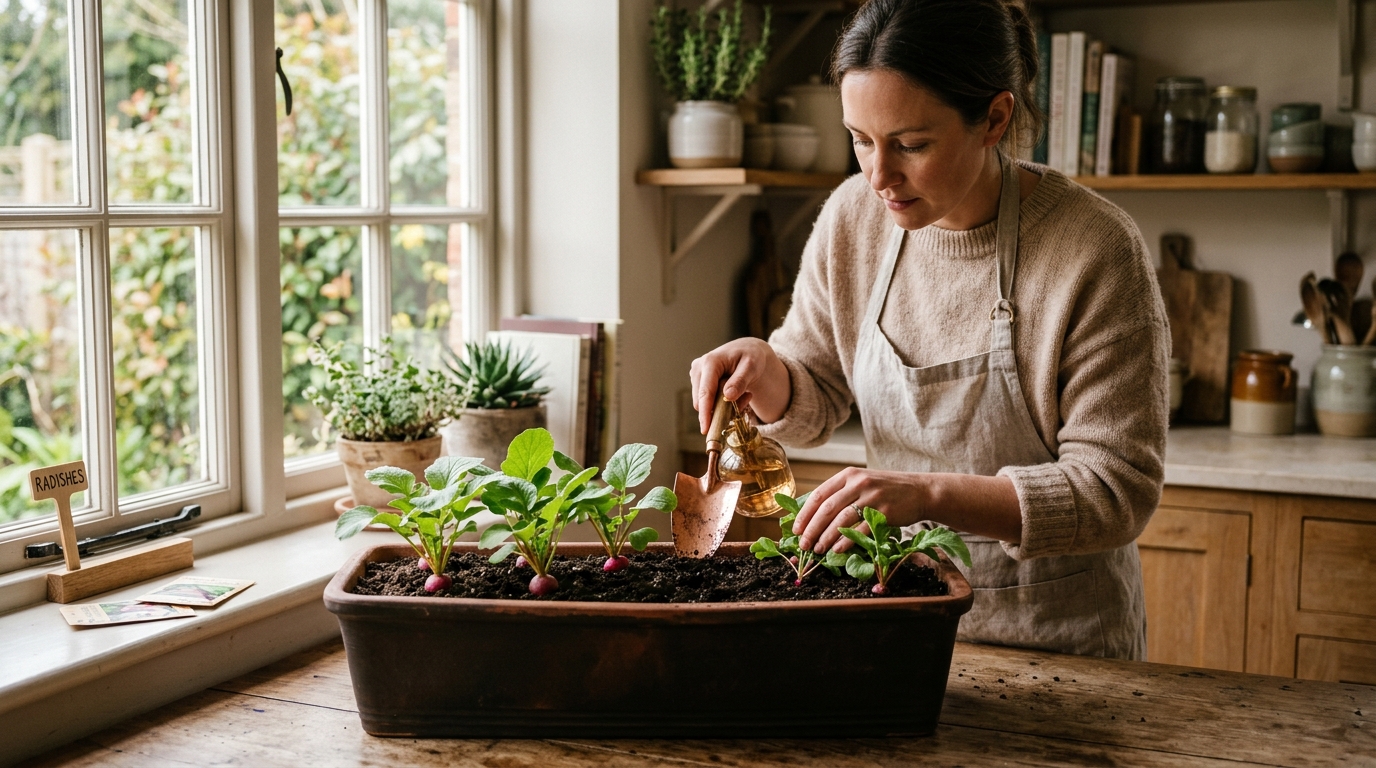
Radishes are the fastest food crop you can grow indoors: Cherry Belle and French Breakfast varieties go from seed to harvest in 25-30 days with no special skills required. Direct sow seeds in a 6-inch-deep container filled with loose potting mix, give them 6 or more hours of sun or a grow light running 14-16 hours daily, and water consistently to keep the soil evenly moist throughout.
Radishes are the ideal beginner indoor crop precisely because the feedback loop is so short. In less than a month you know whether your setup works — there is no waiting for fruit to set or flowers to open. The main requirement is a container at least 6 inches deep (8 inches for longer varieties like French Breakfast), loose well-draining soil that lets roots expand without resistance, and enough light to drive steady growth. A countertop container on a sunny south-facing windowsill or a simple clip-on grow light is all the infrastructure most setups need. Succession sow a new container every 2 weeks and you have a continuous supply of fresh radishes from the same small footprint all year.
Why radishes are one of the best indoor vegetables
Most indoor vegetable crops demand patience. Tomatoes take 60-80 days. Peppers take 70-90 days. Even fast lettuce requires 40-50 days from seed. Radishes are different: the fastest varieties produce a harvestable root in 25 days under good conditions. That speed has practical benefits beyond impatience.
Immediate setup feedback. If your grow light is positioned wrong, your soil is too compacted, or your container is too shallow, radishes tell you within three weeks. With tomatoes, you might not discover a setup problem until three months in. Radishes are the best diagnostic crop for a new indoor growing setup.
No pollination required. Unlike fruiting crops such as tomatoes, cucumbers, and peppers, radishes are grown entirely for their root. There is no flowering stage to manage, no hand-pollination needed, and no risk of unpollinated flowers dropping off. The plant either makes a root or it does not, and the reasons are simple to diagnose.
Minimal space. A 12-inch diameter container 6-8 inches deep holds 9-12 radish plants — enough for a meaningful harvest from a surface area about the size of a dinner plate. Round varieties grow in containers as shallow as 6 inches, making them suitable for countertop planters, window boxes, and shallow trays that cannot support deeper-rooted vegetables.
Cool-season performance. Radishes are cool-season crops that actively prefer temperatures between 50-70°F. A cool windowsill in winter that is too cold for herbs or tomatoes — where indoor temperatures might drop to 55-60°F at night — is close to ideal for radishes. They are one of the few crops that perform better in conditions that most other plants find challenging.
What you need to grow radishes indoors
| Product | Best for | Rating | Notes | |
|---|---|---|---|---|
| Round radish seeds (Cherry Belle or Easter Egg) | Quick round radishes for shallow containers 6 inches deep | ★★★★★ | Cherry Belle matures in 22-25 days and fits in any 6-inch-deep container. Easter Egg mix produces red, pink, white, and purple radishes from one sowing and matures in 25 days. Both handle cool indoor temperatures well. | Check price |
| Oblong radish seeds (French Breakfast or White Icicle) | Longer radish varieties with mild flavor for deeper containers | ★★★★★ | French Breakfast is an oblong 2-3 inch variety with a mild, slightly sweet flavor, ready in 25-28 days. Requires a container at least 8 inches deep. White Icicle produces slim 4-5 inch white roots in 28-30 days. | Check price |
| Window box or 6-inch-deep container | Growing multiple radishes in a row on a windowsill or countertop | ★★★★★ | A 24-inch window box holds two to three rows of radishes and provides enough volume for good root development. Ensure drainage holes are present — standing water causes root rot within days in a shallow container. | Check price |
| Loose vegetable potting mix | Providing the loose, well-draining medium radish roots need to expand | ★★★★★ | Compact or heavy soil is the primary cause of stunted, forked radishes. Use a light, perlite-amended vegetable mix or a dedicated raised-bed mix that breaks apart easily when squeezed. Never use garden soil in containers. | Check price |
| Full-spectrum LED grow light | Supplementing windows or growing radishes without a south-facing window | ★★★★★ | Radishes need the equivalent of 6+ hours of direct sun. A 20-40 watt LED panel or strip light running 14-16 hours provides adequate light intensity. Position 6-10 inches above the container top for radishes. | Check price |
| Outlet timer | Automating consistent 14-16 hour light cycles without manual switching | ★★★★★ | Consistent light cycles matter more than intensity for radishes. A simple mechanical outlet timer set to 14-16 hours on eliminates variation and lets radishes grow steadily without daily attention to the light schedule. | Check price |
Step 1: Choose the right radish variety
Variety selection determines your container depth requirements and how quickly you harvest. The wrong variety for a shallow container produces leaves without a developed root — the most common indoor radish failure.
Round varieties (best for most indoor setups):
- Cherry Belle — the standard round red radish, 22-25 days to harvest, fits in any container 6 inches deep or more. Mild, crisp, and reliable under variable indoor light conditions. This is the best starting choice for anyone growing radishes indoors for the first time.
- Easter Egg — a mix that produces red, pink, white, and purple round radishes from a single sowing. 25 days to harvest, same container depth requirements as Cherry Belle. The visual variety makes it a popular choice; performance matches Cherry Belle closely.
- Champion — a slightly larger round variety at 1-1.5 inches diameter, 25-28 days to harvest, tolerates slightly warmer temperatures than Cherry Belle before becoming pithy. A good second variety once you have Cherry Belle dialed in.
Oblong varieties (require 8-10 inch depth):
- French Breakfast — a mild, elongated red-and-white radish, 2-3 inches long, 25-28 days to harvest. Slightly milder and less sharp than Cherry Belle. Requires a container at least 8 inches deep and consistent moisture — it cracks if moisture is inconsistent.
- White Icicle — a slim, all-white variety, 4-5 inches long, 28-30 days to harvest. Milder than most red radishes with a slightly sweet finish. Requires the deepest container of the common indoor varieties — 10 inches minimum.
Varieties to avoid indoors: Daikon radishes grow 8-18 inches long and require containers 12-18 inches deep that are impractical for most indoor setups. Watermelon radish and Black Spanish radish both take 60+ days to harvest and perform poorly under the lower light conditions typical of indoor growing.
Step 2: Direct sow seeds correctly
Radishes cannot be transplanted. Their taproots are the edible portion, and disturbing the root during the seedling stage causes forking, stunting, or complete failure to develop a usable root. Always direct sow radish seeds into their final growing container — never start in seed trays and transplant later.
Sowing method:
Fill the container to within 1 inch of the rim with loose, pre-moistened potting mix. Press your finger about 0.5 inches into the soil to make a hole, drop one seed per hole, and cover lightly. Space holes 1 inch apart in a grid pattern — this is closer than the final spacing because some seeds will not germinate, and you will thin to final spacing once seedlings emerge.
Best for direct sowing round radishes in containers 6 inches or deeper for a 22-25 day harvest
Burpee Cherry Belle Radish Seeds
Cherry Belle is the benchmark indoor radish variety: round, bright red, and ready in 22-25 days under consistent conditions. A single packet contains enough seeds for multiple succession sowings through an entire growing season. The germination rate on quality radish seed is high — you will see sprouts in 4-7 days at 65-70 degrees Fahrenheit, with virtually every seed producing a seedling. Cherry Belle is the most forgiving variety for variable indoor light and temperature conditions, meaning it produces a good root even if your setup is not perfectly optimized. Start here before experimenting with French Breakfast or Easter Egg mixes.
★★★★★ 4.8 · 12,400 reviews
Check current price on Amazon→Germination:
Radish seeds germinate in 4-7 days at 60-70°F. Unlike many vegetable seeds, they do not require a heat mat — room temperature is adequate. Keep the surface of the potting mix consistently moist (not soaked) during germination. Covering the container with a clear plastic wrap or a humidity dome for the first 4-5 days speeds germination by maintaining moisture around the seeds.
Thinning — the most critical step:
Once seedlings reach 1 inch tall (about 7-10 days after germination), thin to 2-3 inches between plants. This step is not optional. Overcrowded radishes push against each other underground and produce large leafy tops with no root development — exactly the outcome most beginners are frustrated to find at harvest time.
To thin without disturbing neighbors, use scissors to snip overcrowded seedlings at soil level rather than pulling them. Pulling can disturb nearby seedlings whose roots are already developing.
Step 3: Set up the right container and soil
Container requirements:
The container depth determines which varieties you can grow:
- Round varieties (Cherry Belle, Easter Egg): 6-8 inches deep minimum
- Oblong varieties (French Breakfast): 8-10 inches deep minimum
- Long varieties (White Icicle): 10-12 inches deep minimum
Width matters for yield: a 12-inch-square container holds 12-16 Cherry Belle radishes at 2.5-inch spacing. A standard 24-inch window box holds 24-32 plants depending on row arrangement.
Every container must have drainage holes. Radishes in standing water develop root rot in days. If using a window box without drainage, drill 3-4 holes in the bottom before filling with soil.
Soil preparation:
Loose, uncompacted soil is the single most important factor for indoor radish success. Compact soil physically blocks root expansion, producing forked or stunted roots regardless of light, water, or temperature.
Do not use garden soil in containers — it compacts severely indoors, forming a dense plug that radish roots cannot penetrate. Use a quality vegetable or raised-bed potting mix that breaks apart easily when squeezed. Mixing in 15-20% perlite by volume improves drainage and prevents compaction as the mix settles over repeated watering.
Best for filling indoor radish containers with a loose, well-draining mix that allows root expansion
Miracle-Gro Raised Bed Soil Mix
Raised bed formulations are lighter and more porous than standard potting mixes, which makes them significantly better for root vegetables in containers. The open texture allows radish roots to push outward and downward without resistance, producing round, well-formed roots rather than forked or stunted ones. This mix breaks apart easily when squeezed — a good sign that the particle structure will maintain drainage even after repeated watering. Mix in a handful of perlite per container to further improve aeration. The built-in fertilizer provides adequate nutrition for one full 30-day radish cycle without additional feeding.
★★★★★ 4.7 · 31,000 reviews
Check current price on Amazon→Step 4: Provide the right light
Radishes need the equivalent of 6 or more hours of direct sun per day. This sounds modest, but the reality indoors is that most windows do not provide it for most of the year — particularly at northern latitudes in winter.
Window growing:
A south-facing window is the best choice. In summer at latitudes below 40°N, a south-facing window provides adequate light for radishes. An east or west-facing window works for Cherry Belle — the most light-tolerant indoor variety — but produces slower growth and less well-formed roots.
In winter (November through February) at most northern latitudes, even a south-facing window provides 3-4 hours of usable sun at low intensity. Radishes grown in window light only during this period often develop excellent leaf tops with thin or absent roots — the classic light-deficiency symptom.
Grow light setup for radishes:
A simple LED strip or panel light running 14-16 hours daily provides more than enough light for radishes. Unlike fruiting crops, radishes do not need high-intensity grow lights. A 20-40 watt LED strip positioned 6-10 inches above the container surface is sufficient for a standard window box or 12-inch container.
Good grow light options for radishes:
- Barrina T5 LED strip lights — clamp or mount under a shelf directly above the container, about $30-40 for a 4-pack: view on Amazon
- Clip-on LED grow light — attaches to a shelf edge and adjusts directly over a single container: view on Amazon
- Spider Farmer SF-300 panel — covers a 12x12 inch area at 24 watts, ideal for one container of radishes: view on Amazon
Signs of insufficient light:
- Tall, thin, pale green stems reaching toward the window (etiolation)
- Large, lush leaf tops at harvest time with no visible root development
- Germination is normal but growth stalls after the first 2 weeks
Step 5: Water and temperature
Watering radishes:
Consistent, even moisture is more important for radishes than for most indoor crops. Inconsistent watering — alternating between dry and soaked — causes radishes to crack or develop a pithy, spongy interior. The root adds volume during moist periods and the outer skin cracks when the soil dries and then rewets rapidly.
Check moisture by pressing a finger into the top inch of soil. Water when it feels just slightly dry to the touch, before it becomes genuinely dry. For a 6-inch-deep container, this typically means watering every 2-3 days in warm conditions and every 3-4 days in cooler conditions. Small, shallow containers dry out faster than large ones — check daily.
Water gently to avoid disturbing the developing roots. A watering can with a rose head or a squeeze bottle directed at the soil surface works better than pouring water directly from a jug.
Temperature requirements:
Radishes grow best at 50-70°F. They are one of the most cold-tolerant indoor crops — they continue growing at 45°F, albeit more slowly. Above 75°F, growth accelerates briefly before the plant begins to bolt (send up a flower stalk), and roots become woody and pithy before reaching full size.
Indoor environments above 75°F in summer are the most common cause of disappointing radish results. In warm months, move containers to the coolest room in the house, or supplement with a small fan to increase airflow and reduce the ambient temperature around the plants.
Step 6: Harvest at the right moment
Radishes go from good to bad quickly once they reach maturity. Unlike kale or lettuce, which you can leave in the container for weeks past peak harvest, radishes left in the ground beyond their prime become pithy, hot, and cracked.
When to harvest:
Check round varieties 20-22 days after germination by gently brushing aside soil at the base of the stem. The root should be visible and round, approximately the size of a marble or small grape. Harvest when the root reaches 0.75-1 inch in diameter — do not wait until it is the largest possible size, as roots continue to grow and quickly become overripe.
Pull radishes by gripping the stem at soil level and twisting gently while pulling upward. In loose soil, they release easily. Firmer soil may require loosening around the root with a chopstick or pencil before pulling.
Succession sowing for continuous harvest:
A single sowing of 12 radishes is consumed in one or two meals. For a continuous supply, start a new container every 14 days. Three containers at staggered stages (just sown, two weeks old, three weeks old) provide a rolling harvest that keeps radishes available at all times from a minimal growing footprint.
Troubleshooting indoor radish problems
Leafy tops, no root development — the most common indoor radish failure, caused by insufficient light, overcrowding, or compacted soil. Increase light intensity or duration, thin seedlings to 2-3 inch spacing, and switch to a lighter, more porous potting mix for the next sowing.
Forked or misshapen roots — caused by compacted or rocky soil, recent transplanting (radishes must be direct sown), or obstructions in the potting mix. Use a fresh batch of light, perlite-amended potting mix with no clumps or debris.
Cracked roots at harvest — caused by inconsistent watering (the most common cause) or delaying harvest past the peak window. Water more consistently and harvest as soon as roots reach the correct size rather than waiting.
Pithy or spongy texture — roots left in the ground too long, or grown in temperatures above 75°F. Harvest at the first sign of maturity and keep temperatures cool. Once pithiness develops it cannot be reversed — compost those roots and adjust your harvest timing.
Bolting (flower stalk emerging) — temperatures too high (above 75°F), or the plant was left in the ground beyond its harvest window. Bolted radishes produce no usable root. Pull them and compost. Adjust to cooler conditions for the next sowing.
Slow or failed germination — potting mix was too dry during the germination window, or soil temperature was below 50°F. Radish seeds need consistent surface moisture for the first 4-7 days. Cover the container with clear plastic wrap to maintain humidity until sprouts emerge.
FAQ
Frequently asked questions
How long does it take to grow radishes indoors?
Can radishes grow indoors without a grow light?
What is the minimum container depth for indoor radishes?
Why are my indoor radishes all leaves and no roots?
Can I grow radishes indoors year-round?
How many radishes can I grow in one container?
Do indoor radishes need fertilizer?
Bottom line
Radishes are the most beginner-accessible indoor food crop because the feedback loop is so short. In under 30 days from sowing, you know whether your setup works — and if it does not, you can adjust and try again the following month without losing a full growing season. The key requirements are a container at least 6 inches deep filled with loose potting mix, consistent moisture, cool temperatures, and enough light to drive steady growth.
Cherry Belle is the best variety to start with: the fastest to mature, the most forgiving of imperfect indoor conditions, and widely available. Direct sow at 1-inch spacing, thin to 2-3 inches once seedlings emerge, keep the soil consistently moist, and harvest at the first sign that roots have reached marble size. Start a new container every 14 days and you have fresh radishes in rotation year-round from a minimal growing footprint.
For more indoor food growing: how to start seeds indoors for sowing techniques that apply to all indoor vegetables, best indoor seed starting lights for choosing a grow light that works for radishes and beyond, best grow lights for a full comparison of grow light types for food crops, and how to water indoor plants for dialing in the consistent moisture schedule that radishes need to form crack-free roots.