guides
How to Grow Green Onions Indoors
Grow green onions indoors year-round in water or soil. Covers regrowing from scraps, container setup, light needs, and harvest tips.
 Priya Anand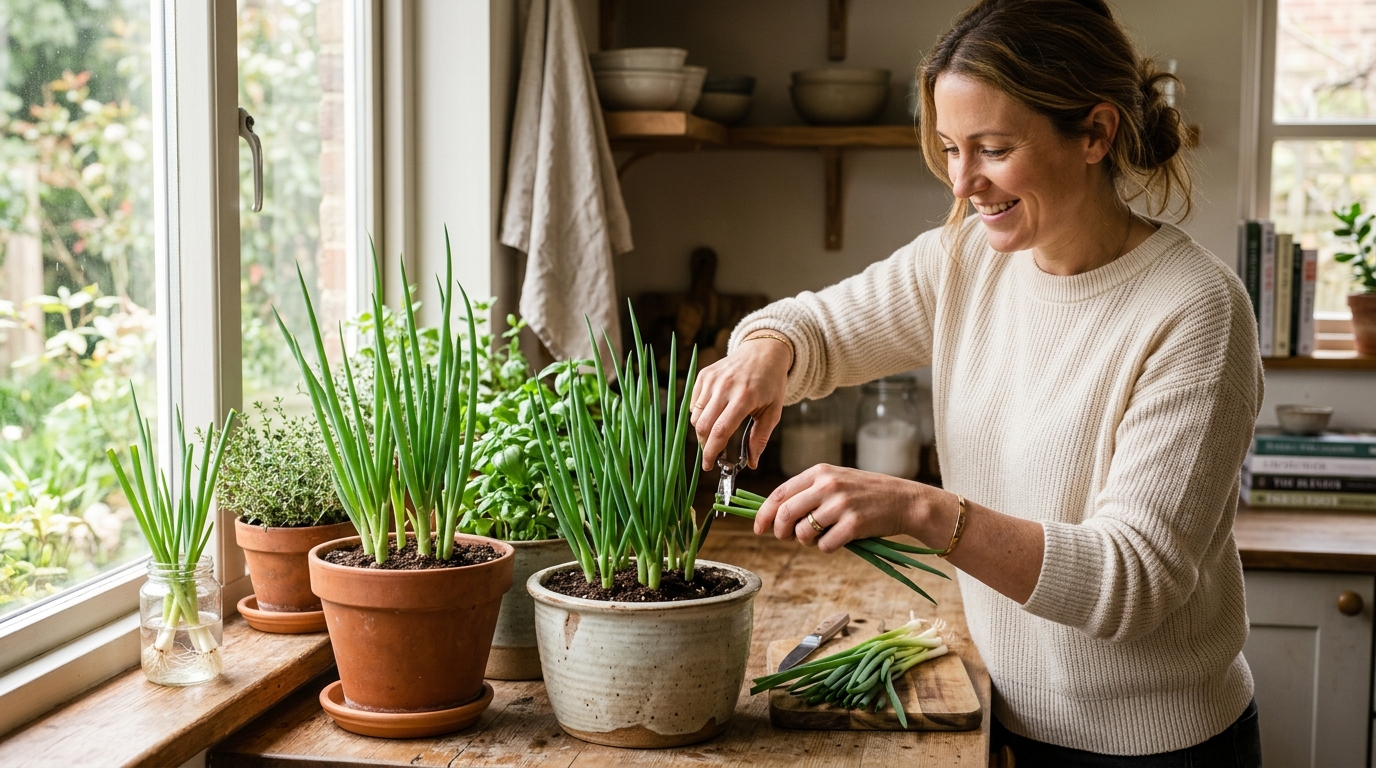
Growing green onions indoors is the fastest way to grow food at home. Place grocery store scallion roots in a glass of water near a sunny window, and you will see new growth in 24 hours — harvestable greens in 7–10 days. For a year-round supply in soil, expect 3–4 weeks to establish transplants or 60–90 days from seed, with continuous cutting after that.
Why green onions are the ideal indoor crop
Green onions — also called scallions, spring onions, or bunching onions — are one of the most practical vegetables to grow indoors for three reasons: they need minimal space, they tolerate imperfect light conditions better than most edibles, and they produce a usable harvest faster than almost any other food crop.
A 6-inch pot holds 15–20 plants, and you never have to harvest all at once. Cut what you need, leave the rest. New growth emerges from the cut base within a few days, giving you repeated harvests from the same set of plants. No replanting, no waiting for fruit to ripen — you simply cut and the plant regrows.
Green onions also handle a wider range of indoor conditions than most other edibles. They tolerate lower light levels than tomatoes or peppers, handle cooler indoor temperatures (60–75°F is ideal but they survive dips into the 50s), and are far more drought-tolerant than lettuce or spinach.
The one thing they genuinely need is adequate light. Without it, green onions grow tall and weak with little flavor. A basic full-spectrum grow light running 12–14 hours per day solves this completely and costs $25–40.
What you need
The supplies depend on your chosen method. For water regrowing, you need almost nothing. For soil growing, here is what makes a real difference:
| Product | Best for | Rating | Notes | |
|---|---|---|---|---|
| Clear glass jar or short vase | Water regrowing from grocery store scraps | ★★★★★ | Any jar with a mouth wide enough to hold a bunch of scallions upright works. Mason jars and repurposed pasta sauce jars both do the job well. | Check price |
| 6-inch deep pot with drainage holes | Soil growing for long-term continuous harvests | ★★★★★ | Depth matters more than diameter for green onions. A 6-inch deep pot allows roots to develop fully. One pot holds 15-20 plants comfortably. | Check price |
| Fast-draining potting mix amended with perlite | Soil growing and seed starting | ★★★★★ | Use 2 parts standard potting mix to 1 part perlite. Drains faster and prevents the compaction that causes root rot in containers. | Check price |
| Full-spectrum LED grow light (T5 or strip-style) | Supplementing weak window light and winter growing | ★★★★★ | Run 12-14 hours per day on a timer. Position 4-6 inches above plant tops. A $25-40 strip light handles 2-4 pots easily. | Check price |
| Bunching onion seeds (Evergreen Hardy White or Tokyo Long White) | Starting a continuous indoor supply from seed | ★★★★★ | Non-bulbing bunching varieties are best for containers. Sow densely — 20-30 seeds per 6-inch pot — and thin as they grow for early cuttings. | Check price |
Three ways to grow green onions indoors
Method 1: Regrow from grocery store scraps (fastest)
This is where most people start. Buy a bunch of green onions from the store, use the green tops in your cooking, and save the white root ends — about 1–2 inches of the base with roots attached.
Place the root ends upright in a glass with about 1 inch of water — enough to cover the roots but not the cut tops. Set the glass near a sunny window (south or east-facing works well). Change the water every 1–2 days to prevent bacterial growth.
New green tops appear within 24–48 hours. By day 7–10, the new growth is 4–6 inches long and ready to cut. The roots can regrow 2–4 times before quality noticeably declines. When growth slows or roots begin to look slimy, start fresh with new grocery store roots.
Limitation to know: Water-grown green onions are lighter in flavor than soil-grown ones because the plant has no nutrients beyond what was stored in the original root. For cooking purposes they work well; for maximum flavor, switch to soil growing.
Method 2: Grow in soil (best long-term results)
Soil growing produces green onions with better flavor, thicker stems, and a longer productive life. You can start from transplants, sets, or seeds.
Starting from transplants: Purchase started green onion plants from a garden center in spring. These typically come as small clusters of seedlings that can be separated and planted individually. They establish in 2–3 weeks and produce harvestable growth within 4–6 weeks.
Starting from sets: Small dried onion bulbs available at most garden centers in early spring. Plant 1 inch deep and 1 inch apart. Sets establish faster than seeds but are less widely available for bunching varieties.
Starting from seed: The least expensive option with the widest variety selection. Takes 60–90 days from seed to first harvest, but once established the plants are highly productive. Sow seeds about 1/2 inch deep and 1 inch apart directly into your container. Thin to 1-inch spacing when seedlings reach 3–4 inches, using the thinnings in cooking.
Method 3: Move water-grown plants to soil
A practical middle approach: start with the water regrowing method to get established roots, then transplant the strongest starts into soil after 2–3 weeks. The plants transition easily and benefit from soil nutrients immediately.
Step 1: Set up your container
Depth matters more than width for green onions. Their roots need at least 6 inches of vertical growing space. Shallow window boxes and decorative saucers produce weak plants when used with soil.
Good container options:
- Standard 6-inch round pots — hold 15–20 plants each; terracotta or plastic both work
- Window boxes at least 6 inches deep — hold more plants per container; good for larger harvests
- Repurposed plastic takeout containers — free and functional; puncture the bottom for drainage
Whatever container you choose, drainage holes are essential. Waterlogged soil causes root rot and kills green onion plants quickly. If a decorative pot has no drainage, use it as an outer sleeve with a plain draining pot inside.
Fill the container to within half an inch of the rim with well-draining potting mix. If your mix feels dense, blend in perlite at a 2:1 ratio (2 parts mix to 1 part perlite) to improve drainage and prevent compaction over time.
Step 2: Provide the right light
Light is the variable that separates productive, flavorful green onions from pale, spindly disappointments. Green onions need 6–8 hours of bright light daily.
Best natural light options:
- South-facing window — ideal year-round in the northern hemisphere; provides bright light through the longest part of the day
- East or west-facing window — acceptable; green onions tolerate somewhat less light than many other edibles
- North-facing window — not enough light for productive growth; a grow light is essential
Signs your plants need more light:
- Tops grow very tall and thin, leaning toward the window
- Color is pale green or yellowish rather than deep green
- Growth is slow even in warm temperatures
- Flavor is bland or absent when you harvest
A basic full-spectrum LED strip light or T5 fixture resolves all of these issues. Position it 4–6 inches above the plant tops and run it on a timer for 12–14 hours per day. Green onions grown entirely under artificial light produce results comparable to a good south-facing window.
Budget-friendly grow light options:
- Barrina T5 LED Grow Lights — about $30 for a 4-pack; mounts easily under a shelf or cabinet
- GE Grow Light LED Bulb — screws into any standard lamp socket; ideal for 1–2 small pots
- Clip-on LED Grow Light — clamps to any surface; flexible neck positions it over small pots easily
Step 3: Water correctly
Green onions need consistent moisture but not waterlogged conditions. The common failure is one of two things: letting soil dry out completely between waterings, or keeping it constantly wet.
The correct approach: Push your finger 1 inch into the soil. If it is dry at that depth, water thoroughly until water runs freely from the drainage holes. If still moist, wait another day or two. In warm weather with strong light, this typically means watering every 2–3 days. In winter or under artificial light only, every 4–5 days is more typical.
Water temperature: Green onions prefer water at room temperature. Cold tap water can shock roots in winter. Let water sit in a jug for an hour before using it if your tap water runs very cold.
For water-grown regrows: Change the water every 1–2 days to prevent bacterial buildup. Rinse the roots gently when you refresh the water. If you see brown, slimy roots, trim them off with scissors and start with a clean jar and fresh water.
Step 4: Feed for maximum production
Green onions grown in containers deplete potting mix nutrients within 4–6 weeks. After that, they benefit from regular fertilizing to maintain strong growth and good flavor.
Use a balanced liquid fertilizer — a 10-10-10 or 5-5-5 formula diluted to half the label-recommended strength — every 2–3 weeks during active growth from spring through early fall. Reduce feeding to once a month or stop entirely in winter when growth naturally slows.
Signs that plants need feeding:
- Pale or yellowish new growth during the active season
- Noticeably slower growth after the first 4–6 weeks
- Thin stems that lack the girth of earlier harvests
Avoid fertilizers very high in phosphorus (the middle number in NPK). These favor root and flower development over the leaf and stem growth you want. A nitrogen-forward or balanced formula keeps green tops growing densely.
Step 5: Harvest for continuous regrowth
Harvesting technique determines how many productive cuts you get from each planting. Done correctly, a single batch of green onions produces 4–6 harvests before quality declines.
How to harvest:
- Select the outer stalks or the tallest plants in the container.
- Use clean scissors or a sharp knife.
- Cut the stalk to 1–2 inches above the soil line (or above the root base in water-grown plants).
- Leave the base and root system fully intact.
- New growth emerges from the cut base within a few days.
- Repeat harvest when plants reach 6–8 inches tall again, typically every 3–4 weeks.
Never pull the entire plant out of the soil. Leaving the root system undisturbed is what allows regrowth. If you want to harvest everything from a pot, replant or start a fresh batch immediately.
Succession planting for a continuous supply: Start a new pot of seeds or a fresh batch of water-regrows every 3–4 weeks. This way, at least one container is always at peak harvest stage while others are earlier in their cycle.
When to replace: After 3–6 harvests, green onion plants lose vigor. Stems become thinner and flavor weakens. At that point, start fresh with new seeds, transplants, or grocery store root scraps.
Troubleshooting common problems
Yellow or pale tops — nearly always a light issue. Move to a brighter window or add a grow light running 12–14 hours per day. Occasional yellowing of the outermost leaf is normal; systemic yellowing throughout the plant points to insufficient light.
Slimy or rotting base — root rot from overwatering or poor drainage. Reduce watering frequency, verify drainage holes are functioning, and consider repotting into fresh soil with added perlite. Trim any slimy roots before replanting.
Very slow growth — usually light or temperature. Green onions grow fastest between 65–75°F with 8+ hours of bright light. Growth slows significantly in rooms below 60°F or with poor light.
Thin, floppy stems — combination of insufficient light and possibly too much nitrogen. Improve light first. If growth remains weak after improving light, switch to a balanced fertilizer instead of a nitrogen-heavy formula.
Fungus gnats in the soil — result of consistently moist topsoil. Allow the top inch to dry completely between waterings. Set yellow sticky traps near containers to catch adults while you correct the watering schedule.
Plants bolting or sending up flower stalks — caused by extended warm temperatures above 80°F or very long days in summer. Cut flower stalks immediately and harvest all the tops; once a plant has bolted, flavor turns sharp. Start a fresh pot if the whole container has bolted.
FAQ
Frequently asked questions
How long does it take to grow green onions indoors?
Can I grow green onions indoors without sunlight?
What is the best variety of green onion to grow indoors?
How many times can I regrow green onions from the same roots?
Do green onions need fertilizer when grown indoors?
What temperature do green onions need indoors?
Bottom line
Green onions are the most beginner-friendly indoor edible for good reason: they work with whatever you have. A glass of water and a windowsill is enough to get fresh scallions within a week. A 6-inch pot with well-draining soil and a grow light turns that quick experiment into a continuous indoor supply lasting for months.
Start with the water regrowing method to see how rewarding and immediate it is, then set up a soil container to improve flavor and extend the harvest. Succession plant every 3–4 weeks and you will rarely be without fresh green onions on hand.
For more indoor food growing projects: how to grow herbs indoors, how to start seeds indoors, best grow light bulbs, and best potting soil.