guides
How to Grow Cilantro Indoors: Complete Growing Guide
Grow cilantro indoors year-round with succession sowing, the right pot depth, and cool temperatures. Step-by-step guide for fresh coriander leaves at home.
 Priya Anand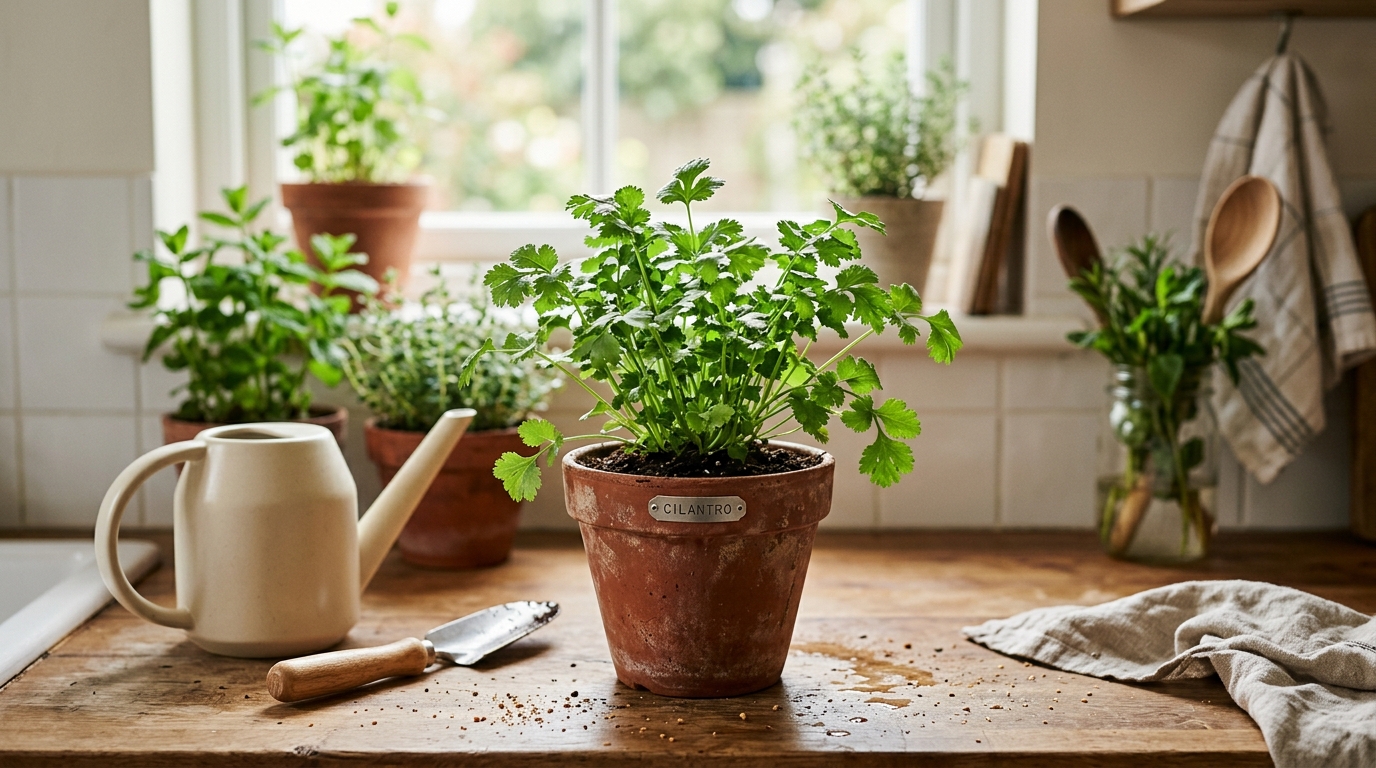
Cilantro grows best indoors in a deep pot (at least 8 inches) in a bright south- or east-facing window or under a grow light running 12–14 hours per day, kept between 60–75°F. The real secret is succession sowing a few seeds every 2–3 weeks, because individual plants bolt (go to seed) within 6–8 weeks — a constant conveyor of young plants beats trying to extend a single plant indefinitely.
Cilantro is one of the fastest herbs you can grow indoors: seeds germinate in 7–10 days and leaves are ready to harvest in just 3–4 weeks. It is also one of the most frequently wasted herbs — grocery store bunches cost $2–4, go limp within days, and often arrive partially wilted. A windowsill pot keeps a continuous fresh supply within arm’s reach of your cutting board for salsa, curries, tacos, and pho. The challenge is understanding that cilantro is a cool-season annual that dislikes heat and tends to flower quickly — once you work with that biology rather than against it, it becomes a reliable, low-maintenance herb.
Is growing cilantro indoors worth it?
Cilantro is one of the few herbs where indoor growing delivers an obviously better product than store-bought. The problem with grocery store cilantro is not quality at the farm but transport and storage: cilantro is one of the most ethylene-sensitive herbs, meaning it goes from vibrant to wilted faster than almost anything else in the produce aisle. Cut cilantro in water lasts 1–2 weeks in the refrigerator; a healthy pot of living cilantro on your counter supplies fresh leaves on demand.
The economics favor the home grower clearly. A packet of cilantro seeds — 200 to 500 seeds — costs $3–5 and provides a full growing season of succession sowings. A single bunch at the grocery store costs $2–4. Within 4–6 weeks of your first sowing you are harvesting, and the seed packet continues to pay dividends for months.
What you need to grow cilantro indoors
| Product | Best for | Rating | Notes | |
|---|---|---|---|---|
| Deep pot 8-10 inch with drainage holes | Preventing taproot restriction that causes premature bolting | ★★★★★ | Depth matters more than diameter for cilantro. A 4-inch pot stunts the taproot and triggers early flowering. A standard 8-inch nursery pot or a window box at least 8 inches deep works well. | Check price |
| Slow-bolt cilantro seeds | Getting the longest possible harvest window from each sowing | ★★★★★ | Varieties: Leisure, Calypso, or Santo. These bolt 2-3 weeks later than standard varieties under warm indoor conditions. Avoid generic unlabeled seed packets. | Check price |
| Well-draining potting mix | Preventing waterlogged roots that cause stem rot in cilantro | ★★★★★ | Standard potting mix mixed with 20-30% perlite is ideal. Cilantro tolerates brief dry spells better than soggy roots. | Check price |
| Full-spectrum LED grow light | Growing cilantro without a south-facing window or in winter | ★★★★★ | Run 12-14 hours daily. Position 6-8 inches above the canopy. Cilantro needs less light intensity than basil, so a basic strip or clip-on light works well. | Check price |
| Spray bottle for misting seedlings | Watering freshly sown seeds without washing them to the pot edge | ★★★★★ | Essential for the germination stage. Direct watering from a can or tap dislodges tiny seeds. Once seedlings are 2 inches tall, switch to normal watering. | Check price |
| Outlet timer for grow lights | Automating a consistent 12-14 hour light schedule | ★★★★★ | A $10-15 basic timer keeps the photoperiod consistent. Irregular light schedules stress cilantro and accelerate bolting. | Check price |
Step 1: Choose the right cilantro variety
Variety selection matters more for cilantro than for almost any other culinary herb because the bolt rate — how quickly the plant flowers and stops producing leaves — varies enormously between types.
Best indoor varieties:
- Leisure — the standard recommendation for indoor growing. Bolts 2–3 weeks later than generic seed packets and maintains compact, dark green leaf growth under typical home light levels.
- Calypso — very slow to bolt, with leaf production that continues even under mild heat stress. An excellent choice for apartments or rooms that warm above 72°F in summer.
- Santo — the most widely available slow-bolt variety. Often found at home improvement stores alongside other herb seeds. Reliable germination and good flavor.
- Delfino — finely cut, ferny leaves with a milder flavor. Lower bolt resistance than Leisure or Calypso but beautiful in containers and grows compactly in limited space.
Avoid planting “coriander” seeds sold specifically for spice use — many of these are heat-treated to prevent germination. Stick with seeds labeled for herb or vegetable growing.
Step 2: Sow seeds correctly
Cilantro has a taproot that is disturbed by transplanting. Unlike most herbs, it performs significantly better when sown directly into its final container rather than started in a seed tray and moved later.
Preparing seeds:
Cilantro seeds are technically a dried fruit containing two seeds. Lightly crushing the outer husk between your fingers before planting improves germination rates by allowing water to reach the inner seeds faster. Place the seeds in a folded paper towel, apply gentle pressure, and roll them slightly. You should feel a slight give in the husk without destroying the seed inside.
Sowing:
Fill your pot to within 0.5 inch of the rim. Scatter seeds across the surface at roughly 1 seed per square inch — slightly denser than you think you need, as not all will germinate. Press seeds gently into the surface so they have soil contact, then cover with a thin layer (0.25 inch) of potting mix. Mist thoroughly with a spray bottle until the surface is evenly moist.
Do not bury seeds deeper than 0.25 inch. Deep sowing delays germination and results in weak, etiolated seedlings that struggle from the start.
Germination conditions:
Keep the soil consistently moist (not wet) and maintain temperatures of 65–75°F during germination. Seeds typically sprout within 7–10 days. Cooler temperatures (60–65°F) extend germination to 14 days but produce stronger seedlings once they emerge. Temperatures above 80°F at the soil surface dramatically reduce germination rates and should be avoided.
Cover the pot loosely with plastic wrap or a clear plastic bag during the germination phase to maintain humidity, removing it as soon as the first green shoots emerge.
Best for indoor cilantro growing where heat and limited light accelerate bolting
Botanical Interests Leisure Cilantro Seeds
Leisure is the gold standard slow-bolt cilantro variety for indoor container growing. It produces dense, dark green aromatic leaves 2-3 weeks longer than generic seed packets before initiating flowering — that extra time dramatically improves your harvest to effort ratio in a home setup. The seeds have high germination rates (80-90%) and the plants stay compact enough for 8-10 inch windowsill pots without sprawling. One packet provides enough seeds for 3-4 succession sowings, giving continuous harvests for a full season.
★★★★★ 4.7 · 5,200 reviews
Check current price on Amazon→Step 3: Provide the right light conditions
Cilantro needs less light intensity than basil but is more sensitive to day length. Long days (more than 14 hours of light) accelerate bolting, which creates a useful management tool: keeping your indoor light on for exactly 12–14 hours mimics the day length of spring and early summer — when cilantro naturally thrives outdoors — and slows the transition to flowering.
Window placement:
A bright east-facing window providing 4–6 hours of direct morning sun is often ideal for cilantro — enough light for good leaf production without the intense afternoon heat of a south-facing exposure that speeds bolting. A south-facing window works well in winter when light intensity is lower; use a sheer curtain in summer to reduce heat and light intensity during afternoon hours.
North- and west-facing windows typically do not provide enough light for productive cilantro. Plants grow slowly, become leggy, and bolt earlier than those with adequate light.
Using a grow light:
A grow light running 12–14 hours per day is the most consistent approach, especially in apartments without ideal window orientation or in the low-light months from October through February.
- Barrina or similar T5 LED strip — cost $25–40 for a 4-pack, mount easily under a shelf, and cover several pots: view on Amazon
- Clip-on adjustable grow light — good for a single deep pot on a countertop: view on Amazon
Position the light 6–8 inches above the top of the cilantro canopy. Unlike basil, cilantro does not need high intensity — a modest strip light is fully adequate.
Step 4: Manage temperature carefully
Temperature management is the single biggest factor separating successful indoor cilantro growers from frustrated ones. Cilantro is a cool-season crop that evolved in the Mediterranean and Middle East, thriving in the mild temperatures of spring and autumn — not the warm, stable conditions of a heated home in winter.
Ideal range: 60–75°F (15–24°C)
What happens outside that range:
Below 50°F, cilantro growth stalls and the plant takes on a stunted, blue-green appearance. Frost kills it immediately. Below 60°F, growth slows noticeably and flavor decreases.
Above 75°F, bolt speed increases noticeably. Above 80°F, cilantro rushes toward flowering rapidly — often within 3–4 weeks of germination rather than the 6–8 weeks possible in cooler conditions. In a hot apartment in summer, no amount of slow-bolt variety selection overcomes sustained temperatures above 85°F.
Practical cooling strategies:
- Place pots on a windowsill where glass keeps the microclimate 5–10°F cooler than room temperature in winter
- In summer, move pots to the coolest room in the house (typically a north-facing room or basement with a window)
- Run a small fan on low near the pots — air circulation reduces the temperature at leaf level and strengthens stems
Step 5: Water cilantro correctly
Cilantro falls in the middle ground between water-loving herbs like mint and drought-tolerant ones like thyme or rosemary. It prefers consistent moisture at the root zone without sitting in wet soil.
The watering method:
Check soil moisture by pressing a finger 1 inch into the mix. Water when the top inch is dry to the touch but before the pot feels completely lightweight (bone dry). Water thoroughly, allowing it to run freely from drainage holes, then empty the saucer after 30 minutes.
How often to water:
In typical indoor conditions (68–72°F, moderate humidity), cilantro in a clay or terracotta pot needs watering every 2–3 days. In a plastic pot, every 3–4 days. In cool winter conditions with lower light, weekly watering may be sufficient. Let the soil check be your guide, not a fixed schedule.
Avoiding stem rot:
Cilantro is prone to damping off — a fungal stem rot at soil level — when seedlings are small and the soil surface stays perpetually wet. After germination, allow the top surface of the soil to dry partially between waterings rather than misting constantly. Good airflow around the seedlings also helps.
Step 6: Succession-sow for continuous harvest
This is the most important cilantro strategy that most indoor growers skip, and it is why they feel like “cilantro never works for me.” A single pot of cilantro provides 3–6 weeks of harvests before bolting. A fresh sowing every 2–3 weeks means you always have at least one pot at peak harvest, one pot producing its first leaves, and one pot just germinating — a continuous supply with no gap.
Practical rotation:
Keep 2–3 pots in rotation. The moment the oldest pot sends up a flowering stalk from the center — a thick, branching stem with small leaves rather than the broad flat cilantro leaves — start a new sowing. Don’t wait until the oldest pot is finished; overlap is the key. If you let flowers go to seed on an old pot, you can collect the coriander seeds for cooking and then restart that pot.
Coriander seeds:
When cilantro bolts, let it continue if you want coriander spice. Harvest the seeds when the plant is brown and dry — about 3–4 weeks after flowering. Crush them lightly and use fresh for curries, pickling, or baking. Fresh-ground coriander is noticeably more aromatic than commercial ground spice.
Best for improving drainage in cilantro containers to prevent stem rot and waterlogged roots
Perlite for Herb Container Soil Amendment
Adding 20-30% perlite to standard potting mix creates the fast-draining growing medium cilantro prefers — one that allows roots to stay evenly moist without the air-excluding saturation that causes damping off and root rot. Perlite is inert, lightweight, and does not break down over time. A 2-quart bag is enough to treat 6-8 deep herb pots and costs under $10. It is the simplest upgrade for anyone who has lost cilantro seedlings to stem rot or noticed wilting despite moist soil.
★★★★★ 4.6 · 12,800 reviews
Check current price on Amazon→Step 7: Harvest cilantro properly
Harvest technique determines how long an individual plant produces before it channels all its energy into flowering.
How to harvest:
Cut outer stems at the base, leaving the central growing point — the small cluster of new growth at the center of the plant — intact. Taking outer stems from the outside inward allows the plant to continue producing new growth from the center. Avoid pulling entire stems upward from the soil, which can dislodge roots.
How much to harvest:
Take no more than one-third of the plant at once. For a mature cilantro plant in a 8-inch pot, that typically means 6–10 stems per session. Harvest every 5–7 days to keep the plant in a vegetative state — regular harvesting actually delays bolting slightly by signaling the plant to continue leaf production.
Signs of impending bolt:
Watch for the central stem growing taller and more erect, with new leaves that are smaller and more feathery (fernlike) than the broad flat leaves of the vegetative stage. This is the plant transitioning to flowering. Once you see this, harvest aggressively — take as much as you can use — because the plant will flower within 2–3 weeks regardless. At this point, start your next succession pot.
Troubleshooting common indoor cilantro problems
Cilantro bolting within 3 weeks of germination — usually a heat problem. Check the actual temperature at the plant using a small thermometer. If temperatures at the pot level exceed 78°F at any point during the day, move the plant to a cooler spot. Also verify light schedule — more than 14 hours of light per day accelerates flowering. Check that you are using a slow-bolt variety; standard coriander seeds bolt twice as fast.
Leggy, thin stems falling over — insufficient light. Cilantro in low light grows tall quickly, searching for more intensity, producing weak stems that cannot support leaves. Move to a brighter window or add a grow light positioned 6–8 inches above the canopy.
Yellowing lower leaves — either normal (lower leaves yellow and drop as the plant ages) or overwatering. Check if the soil feels wet when you see the yellowing. If so, reduce watering frequency and improve drainage. Some lower leaf yellowing is normal and not a sign of a problem.
Seedlings collapsing at soil level — damping off, a fungal disease. Caused by persistently wet soil around seedlings combined with poor airflow. Improve drainage, reduce watering frequency after germination, and increase air circulation with a small fan. If the whole pot collapses, start fresh — damping off spreads quickly through a seedling tray.
Slow or patchy germination — common when seeds are planted too deep, soil temperature is below 60°F, or seeds are old. Cilantro seed viability drops significantly after 2 years. Use fresh seed each season for reliable germination rates.
Aphids on new growth — cilantro’s tender new leaves attract aphids in indoor conditions. Knock them off with a strong water spray, then apply a diluted neem oil solution to the undersides of leaves: view on Amazon.
FAQ
Frequently asked questions
Can I grow cilantro indoors year-round?
Why does my cilantro keep bolting so fast?
How deep does a cilantro pot need to be?
Can I plant cilantro in the same pot as other herbs?
Can I use the bolted cilantro for anything?
How often should I water cilantro indoors?
Does cilantro need fertilizer?
Bottom line
Growing cilantro indoors successfully comes down to three commitments: a deep pot (at least 8 inches), cool temperatures (60–75°F), and succession sowing every 2–3 weeks. Get those three right, and cilantro transitions from “that herb I buy and throw half of away” into a reliable kitchen staple.
Start with a slow-bolt variety like Leisure or Calypso in an 8-inch pot with well-draining soil. Sow seeds directly — never transplant — and maintain a grow light at 12–14 hours if window light is limited. Most importantly, start a new pot the moment the current one begins to bolt, so the rotation never stops. Within one season, you will have more fresh cilantro than most home cooks can use.
For more indoor herb growing: how to grow herbs indoors for tips on the full range of culinary herbs, herbs for indoor garden for which herbs suit different growing conditions, best indoor herb gardens for countertop systems that manage the growing for you, and best grow lights for recommendations when your windows cannot provide enough light.