roundups
Best Grow Lights for African Violets 2026
Best grow lights for African violets: Barrina T5 shelf bars, Sansi 36W screw-in, and clip-on picks for year-round Saintpaulia blooms.
 Priya Anand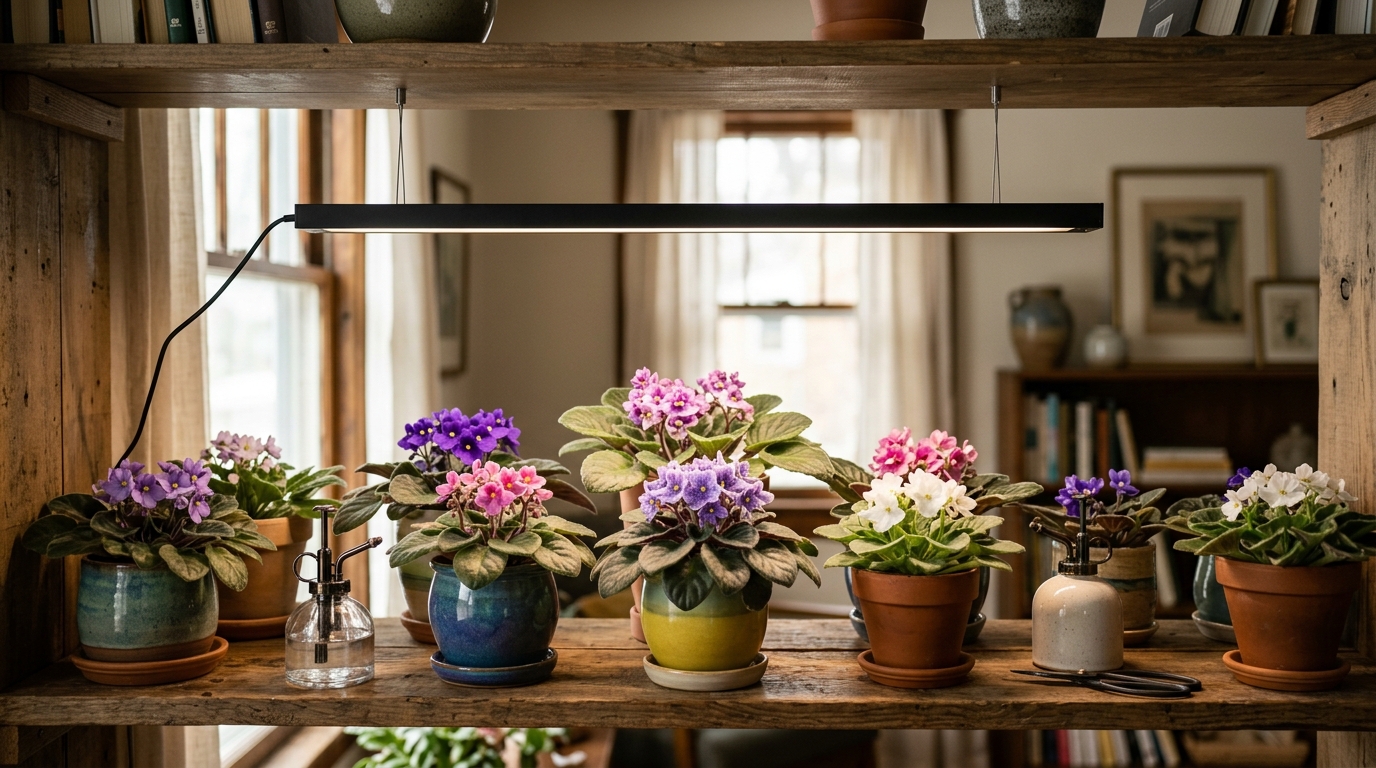
African violets bloom continuously under grow lights — the Barrina T5 LED bar mounted 12–15 inches above a shelf is the top choice for most growers with multiple plants. For a single plant, a Sansi 36W E26 screw-in delivers adequate output at a fraction of the cost. African violets need only 150–250 PPFD and 12–14 hours daily, far less than succulents or vegetables, which makes them one of the easiest flowering plants to grow successfully under artificial light.
How much light do African violets actually need?
African violets (Saintpaulia ionantha) originate from the shaded mountain forests of eastern Africa, growing under tree canopies where light is bright but indirect. Indoors they need 150–250 PPFD — significantly less than succulents (200–400 PPFD) or vegetables (300–800 PPFD) — which means even modest grow fixtures deliver reliable results.
The bloom trigger is light intensity and duration. African violets flower when they receive the right PPFD for a consistent 12–14 hours daily. Too little light (under 100 PPFD) produces dark, stretchy leaves and almost no flowers. Too much light (over 300 PPFD without adequate distance) scorches leaves to a bronzed, cupped, or bleached appearance.
Color temperature affects flowering. Warm-spectrum LEDs (3000–4000K) promote flowering and rich leaf color. Cool-white (5000–6500K) supports vegetative leaf growth. The best grow light fixtures for African violets combine warm and cool wavelengths in a full spectrum — or mix one warm-white and one cool-white T5 tube in older fluorescent setups to achieve the same balance.
Photoperiod matters. African violets need a consistent dark period. Running lights more than 16 hours per day actually reduces bloom frequency by disrupting the rest cycle. A timer set to 13–14 hours on and 10–11 hours off delivers optimal results for continuous flowering throughout the year.
Signs your light level is wrong. Light-starved African violets produce dark green, stretching leaves, fewer crowns, and almost no blooms. Light-stressed plants show bronze or tan patches on upper leaf surfaces, cupped or downward-curling leaves, and faded bloom color. Both conditions are corrected by adjusting distance rather than replacing fixtures — move the light up to reduce intensity, down to increase it.
Symmetry comes from overhead lighting. African violets grow as flat, symmetric rosettes when light comes from directly above. Side lighting from a window causes petioles to elongate unevenly as the plant reaches toward the light source, producing an asymmetric, lopsided rosette. Overhead grow lighting eliminates this and produces the classic flat form that characterizes a well-grown specimen.
Quick comparison
| Product | Best for | Rating | Notes | |
|---|---|---|---|---|
| Barrina T5 LED Grow Light Bars | Multi-plant African violet shelves and dedicated AV stands | ★★★★★ | About $35-55 per 4-pack. Linkable. The most popular choice among dedicated AV growers. | Check price |
| Sansi 36W Full Spectrum E26 | Single lamp setup for 2-4 African violets | ★★★★☆ | About $20-25. High-output screw-in bulb. Fits any E26 floor or table lamp. | Check price |
| Spider Farmer SF-300 LED Panel | Dedicated African violet corner or small grow cabinet | ★★★★★ | About $45-60. 30W actual draw. Full-spectrum white. Right size for a compact AV collection. | Check price |
| Juhefa Clip-on LED Grow Light | Single African violet on a desk or windowsill | ★★★★☆ | About $15-20. Built-in timer. Best for supplementing window light on a single plant. | Check price |
The picks
Best for shelves: Barrina T5 LED Grow Light Bars
Best for multi-plant African violet shelves, dedicated AV stands, and growers maintaining more than 5 plants
Barrina T5 LED Grow Light Bars for African Violets
Barrina T5 LED bars have become the standard fixture in dedicated African violet collections because they mount under shelves, link together from a single outlet, and deliver consistent PPFD across the full shelf footprint. At 12-15 inches above the crowns, a single 4-foot bar produces 150-250 PPFD — exactly the target range for continuous blooming. The full-spectrum white output lets you see true leaf color and catch early signs of stress, over-watering, or crown problems without color distortion. A 4-pack runs $35-55 and powers a 4-shelf AV stand, giving this setup the best cost-per-plant value for growers with more than a handful of plants.
★★★★★ 4.6 · 5,800 reviews
Check current price on Amazon→Pros
- Linkable design allows multiple bars from one outlet for clean cable management
- Even PPFD distribution across full shelf width prevents bright and dim zones
- Full-spectrum white output shows true leaf and bloom color without distortion
- Low-profile mounting under shelves preserves access to plants and looks tidy
- Best cost-per-plant value for a dedicated African violet shelf or stand
Cons
- Requires a shelf structure for mounting — not a standalone option for floor plants
- Visible hardware works well in a dedicated plant room but looks utilitarian in main living areas
- Single 2-foot bar covers about 12 inches; wide shelves may need two bars side by side
Best screw-in: Sansi 36W Full Spectrum E26
Best for 2-4 African violets in a floor lamp or table lamp when a shelf system is not practical
Sansi 36W Full Spectrum E26 Grow Light Bulb
African violets need less light intensity than most flowering plants, which means the Sansi 36W screw-in bulb — positioned 12-15 inches above the crowns — delivers adequate PPFD for continuous blooming without requiring a dedicated fixture. Screw it into an open floor lamp or ceramic socket (no shade — heat buildup inhibits output and risks leaf damage), position it directly above 2-4 plants grouped on a small table or stand, and run it 13-14 hours on a timer. The full-spectrum output at approximately 250 PPFD at 12 inches covers the African violet sweet spot. At $20-25 it is the fastest and most affordable path to dedicated AV lighting without purchasing any new equipment.
★★★★☆ 4.4 · 1,200 reviews
Check current price on Amazon→Pros
- Fits any E26 socket — uses lighting you already own with no new fixture purchase needed
- Delivers adequate PPFD at 12-15 inches for continuous African violet blooming
- Full-spectrum output supports both flowering and healthy leaf growth
- Most affordable dedicated grow solution for a small group of 2-4 plants
Cons
- Runs warm — keep in an open fixture without a shade; maintain a 12-inch minimum plant distance
- Heavier than standard bulbs; check socket rating before installing in lightweight clip-on lamps
- Covers only 2-4 plants at close range — not a scalable solution for a larger collection
Best compact panel: Spider Farmer SF-300
Best for a dedicated African violet corner, small grow cabinet, or a collection of 8-15 plants in a compact space
Spider Farmer SF-300 LED Grow Light
When a shelf-bar setup is too casual and a full-sized panel is too large, the Spider Farmer SF-300 fills the gap. At 30W actual draw it delivers 150-250 PPFD over a 1.5-by-1.5-foot footprint at 15-18 inches — well within the African violet target range — and the Samsung LM301H diodes combine warm and cool wavelengths in a full-spectrum white output that promotes both foliage and flowering. Hang it above a dedicated table, a vintage washstand repurposed as a plant stand, or a converted wire shelf unit, and it covers a collection of 8-15 standard-size African violet pots with consistent coverage. At $45-60 it bridges the gap between screw-in bulbs and multi-bar shelf systems.
★★★★★ 4.5 · 3,400 reviews
Check current price on Amazon→Pros
- Samsung LM301H diodes deliver efficient output with accurate full-spectrum white light
- Right footprint size for a compact dedicated AV corner or small grow cabinet
- Covers 8-15 standard AV pots without the complexity of a multi-bar shelf system
- Adjustable hanging height makes it easy to dial in the correct distance
Cons
- Requires a hanging solution or grow cabinet — not as simple as a screw-in bulb
- Footprint too small for a full shelf of 20 or more plants
- Cost premium over Barrina T5 bars for similar results on a comparable plant count
Best budget: Juhefa Clip-on LED Grow Light
Best for a single African violet on a desk, nightstand, or windowsill where supplemental lighting extends the photoperiod
Juhefa Clip-on LED Grow Light
A clip-on grow light cannot replace a proper shelf fixture for a serious African violet collection, but for a single plant on a desk or nightstand where window light is marginal, the Juhefa provides enough supplemental output to maintain steady blooming. Position the gooseneck head 8-10 inches above the crown, set the built-in timer to run 13 hours, and it reliably keeps one African violet in bloom through the darker winter months. At $15-20 it is the lowest-cost entry into dedicated AV grow lighting and works best supplementing window light rather than replacing it entirely.
★★★★☆ 4.2 · 3,100 reviews
Check current price on Amazon→Pros
- Clip-on design installs in seconds with no permanent mounting required
- Built-in timer automates the light schedule without an external outlet timer
- USB or outlet powered for flexible placement anywhere in the home
- Lowest-cost entry into dedicated African violet grow lighting under $20
Cons
- Output insufficient as the sole light source without supplemental window light backing it up
- Covers one plant at a time — impractical for any collection larger than a single specimen
- Gooseneck positioning needs periodic adjustment as the plant grows and as you rotate the pot
What to skip
Standard incandescent and low-output LED bulbs. A standard 9W LED bulb or incandescent produces negligible PPFD beyond 6 inches. African violets need 150–250 PPFD at the leaf canopy — impossible to achieve with standard household lighting regardless of bulb count or placement.
Blurple red-blue grow lights. These function for photosynthesis but distort visual monitoring. African violet leaves, crowns, and blooms show subtle early signs of stress, disease, or over-watering that are invisible under the pink-purple glow of blurple fixtures. Full-spectrum white is essential for daily health observation and catching problems early.
High-output vegetable grow lights. Mars Hydro TS 1000, Spider Farmer SF-2000, and similar 100W+ panels designed for vegetables deliver 400–800 PPFD at working distance — two to four times what African violets need. Even at maximum hanging height, these produce enough intensity to bleach leaves and suppress blooming. Use the SF-300 (30W) rather than the SF-2000 for an African violet setup.
Fixtures without timers. Consistent photoperiod is critical for African violet flowering. Running lights manually leads to irregular schedules that disrupt the blooming cycle. Always pair your fixture with a digital outlet timer or choose one with a built-in timer. See our grow light schedule guide for recommended hours by plant type.
Placement and setup tips for African violets
Mount at 12–15 inches for most fixtures. At 12 inches, a single Barrina T5 4-foot bar delivers approximately 200 PPFD — the target for active blooming. At 15 inches output drops to about 150 PPFD — adequate for maintaining established plants between bloom cycles. Place the center of the plant crown directly below the center of the fixture rather than at the edges where output falls off. See our grow light distance guide for a reference chart by plant type.
Use overhead mounting, not side placement. African violets grow as flat rosettes because they orient leaves toward an overhead light source. A window that provides side light from the east or west causes petioles to elongate unevenly as the plant reaches. Overhead grow lighting produces the symmetric, flat-rosette form that experienced growers aim for.
No direct sunlight alongside grow lights. Even diffuse direct sun through a south-facing window in summer can bleach African violet leaves within hours. Under grow lighting the angle and intensity are fully controlled — one reason dedicated AV growers prefer fixtures to window placement. East-facing window morning light is safe; direct afternoon sun is not.
Rotate pots every two weeks. Even with even overhead output, African violets grow slightly toward the dominant light source over time. Rotating pots 90 degrees every 2 weeks keeps the rosette symmetrical — especially important for exhibition growers and for show-quality specimen plants.
Match watering and fertilizing to the light schedule. African violets maintain active growth year-round under grow lights and benefit from consistent feeding with a balanced, low-nitrogen African violet fertilizer at quarter strength with each watering. See our indoor plant fertilizing guide for details on frequency and formulation.
FAQ
Frequently asked questions
Why are my African violets not blooming under a grow light?
How far should a grow light be from African violets?
Can African violets get too much light from a grow light?
What color temperature is best for African violet grow lights?
How many hours of light do African violets need per day?
Can I grow African violets under the same grow light as other houseplants?
Bottom line
Best for a dedicated African violet shelf: Barrina T5 LED bars. Best screw-in for 2-4 plants: Sansi 36W E26. Best compact panel for a dedicated AV corner: Spider Farmer SF-300. Best budget option for a single plant: Juhefa clip-on.
African violets need far less light than most grow-light guides suggest — 150–250 PPFD at 12–15 inches, run 13–14 hours daily. The modest requirement means inexpensive T5 LED bars or a quality screw-in bulb produce excellent results without specialized equipment. Pair your fixture with a digital timer, a consistent watering routine, and a balanced African violet fertilizer, and these plants bloom nearly year-round under artificial light.
More guides in this cluster: grow light schedule guide for all plant types, grow light distance by plant type, grow lights for general houseplants, and how to fertilize indoor plants properly.