roundups
Best Plant Fertilizers for Indoor Plants 2026
The best fertilizers for indoor plants — liquid, slow-release, and organic picks for herbs, houseplants, and vegetable starts, tested and ranked.
 Priya Anand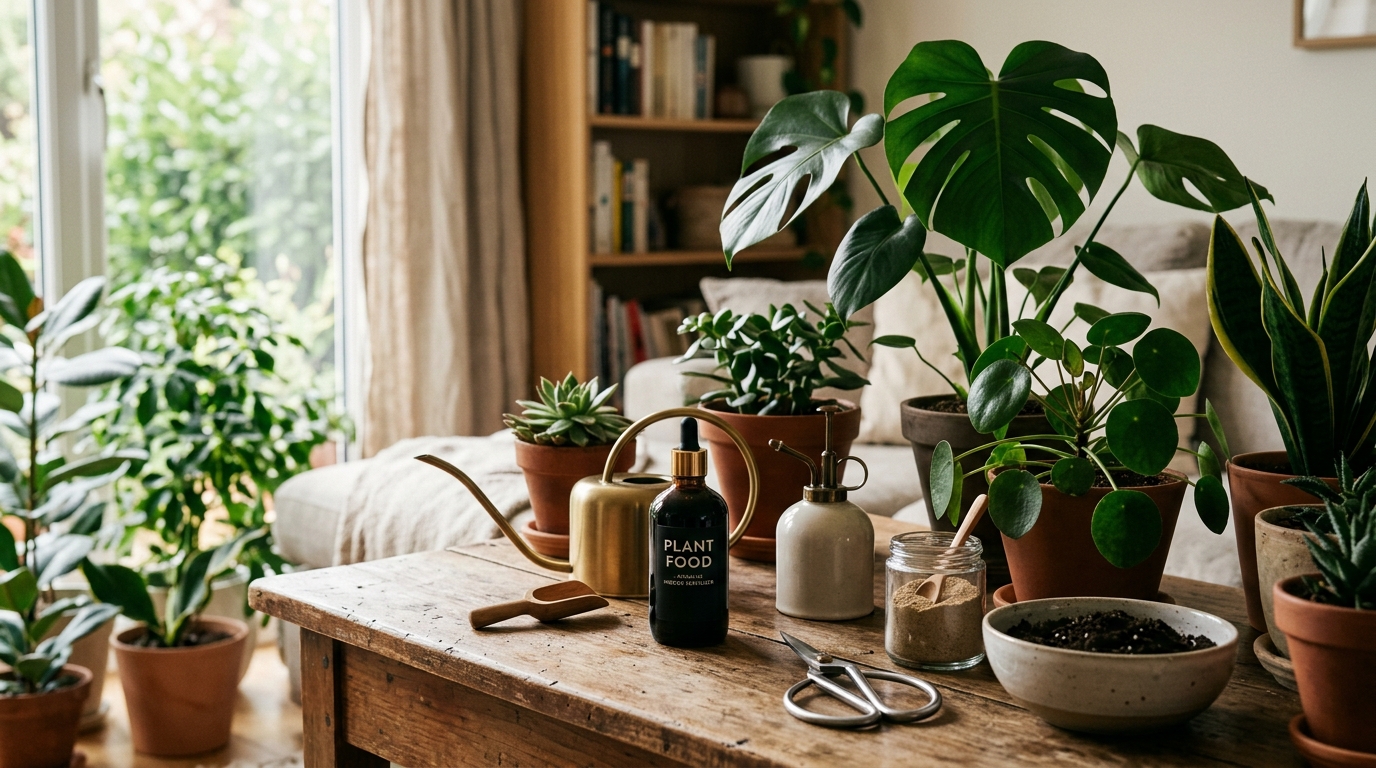
The best fertilizer for most indoor plants is Espoma Organic Indoor! Liquid Plant Food — it feeds gently enough for houseplants without burning roots, works across a wide range of species, and is formulated for potting mix that lacks a natural nutrient cycle. For herbs and vegetables that need faster, stronger results, Jack’s Classic 20-20-20 is the step-up pick.
Why do indoor plants need fertilizer?
Outdoor plants draw nutrients from a constantly replenishing soil biology — earthworms, decomposing leaves, and rain cycling minerals through the ground. Indoor potted plants have none of that. They sit in a fixed volume of potting mix that exhausts its nutrients in 2-4 months, then stalls.
Regular fertilizing replaces what watering flushes out and what roots consume. Without it, growth slows visibly, older leaves yellow from the bottom up (a classic nitrogen deficiency sign), and flowering plants stop blooming. With a consistent feeding program, the same plant in the same pot grows actively for years.
How to read an N-P-K ratio
Every fertilizer label lists three numbers separated by hyphens — nitrogen (N), phosphorus (P), and potassium (K). They represent the percentage of each nutrient by weight:
- Nitrogen (N): Drives leafy, vegetative growth. High-N formulas (10-4-3, 24-8-16) are ideal for foliage houseplants and leafy herbs like basil and mint.
- Phosphorus (P): Supports root development and flowering. Higher-P formulas help newly potted plants establish and push flowering plants to bloom.
- Potassium (K): Regulates water use, strengthens cell walls, and builds disease resistance. Critical for fruiting crops and succulents.
For general indoor houseplants, a balanced ratio like 20-20-20 or 5-5-5 works well across the board. For herbs, a slightly higher N is beneficial. For succulents and cacti, use a low-N formula designed for those species.
Liquid vs. slow-release fertilizer for indoor plants
Liquid fertilizers dissolve in water and are applied through normal watering. Nutrients reach roots immediately. You control the dose, can adjust for season and plant type, and can stop instantly if you see signs of over-fertilizing. The tradeoff: you need to fertilize every 1-4 weeks.
Slow-release granules are prilled pellets worked into the top inch of potting mix. They release nutrients gradually over 4-6 months via osmosis — triggered by soil moisture and temperature. Huge convenience advantage: one application per season, no weekly measuring. The tradeoff is reduced control; you cannot easily reduce the dose if a plant overreacts.
Most indoor gardeners use liquids for plants they actively tend (herbs, seedlings, vegetables) and slow-release for passive houseplants (pothos, snake plants, dracaena) where consistent low-level feeding is the priority.
Quick comparison
| Product | Best for | Rating | Notes | |
|---|---|---|---|---|
| Espoma Organic Indoor! Liquid Plant Food | Best overall; gentle for all houseplants | ★★★★★ | About $12-15. Liquid concentrate. Organic. 2-2-2 ratio. Dilute in water each week. | Check price |
| Jack's Classic All Purpose 20-20-20 | Best water-soluble; herbs and vegetables | ★★★★★ | About $15-20. Water-soluble powder. Strong, fast results. Use at half dose for sensitive houseplants. | Check price |
| Osmocote Smart-Release Plant Food Plus | Best slow-release; low-maintenance care | ★★★★★ | About $13-18. Slow-release granules. 15-9-12 ratio. Feeds for 4 months. | Check price |
| FoxFarm Grow Big Liquid Concentrate | Best for herbs and leafy vegetable starts | ★★★★★ | About $20-25. High-nitrogen liquid. 6-4-4. Strong vegetative growth for culinary herbs. | Check price |
| Miracle-Gro Succulent Plant Food | Best for succulents and cacti | ★★★★☆ | About $6-10. Liquid pump. Low-N formula. Safe for cacti and drought-tolerant plants. | Check price |
The picks
Best overall: Espoma Organic Indoor! Liquid Plant Food
Best for general houseplants, foliage plants, and mixed indoor collections
Espoma Organic Indoor! Liquid Plant Food
Espoma Indoor! is the best starting fertilizer for most home growers because it threads the needle between effective and safe. The 2-2-2 organic formula is derived from poultry manure and alfalfa, which means it feeds slowly and gently — significantly less likely to burn roots than synthetic concentrates at similar prices. Dilute one cap per quart of water and use every watering during the growing season, or every other week for slower-growing houseplants. The organic base also promotes soil biology in potting mix, which matters as the mix ages and the microbial ecosystem matters more. Espoma is formulated specifically for the indoor environment, where plants grow more slowly, pots have limited drainage, and over-fertilizing is a chronic problem. It is the one to start with if you are new to fertilizing houseplants.
★★★★★ 4.5 · 3,400 reviews
Check current price on Amazon→Pros
- Organic 2-2-2 formula is gentle — minimal risk of burning roots or leaves
- Works across a wide range of houseplants without species-specific adjustments
- Easy dosing: one cap per quart, applied through normal watering
- Promotes soil biology in potting mix — benefits plant health over time
- Formulated specifically for indoor conditions, not a repurposed outdoor product
Cons
- Low N-P-K ratio means slower results compared to synthetic 20-20-20 products
- Requires consistent weekly application during growing season for best effect
- Organic smell is noticeable when mixed — not strong, but present
Best water-soluble: Jack’s Classic All Purpose 20-20-20
Best for herbs, vegetable starts, and any plant where fast, strong growth is the priority
Jack's Classic All Purpose 20-20-20 Water Soluble Fertilizer
Jack's Classic 20-20-20 is the benchmark water-soluble fertilizer for serious indoor growers. The equal N-P-K ratio and high concentration deliver noticeably faster growth than organic options — you will see the difference in basil or tomato seedlings within two weeks of starting a feeding program. Dissolve one teaspoon per gallon, apply every 7-14 days, and plants respond quickly. The tradeoff is that at full strength it can burn sensitive houseplants like ferns or calathea. Use at half dose for sensitive foliage plants. Jack's is sold in a resealable bag and a small quantity goes a long way — a 1.5-pound bag covers an active herb collection for a full growing season.
★★★★★ 4.7 · 8,900 reviews
Check current price on Amazon→Pros
- Balanced 20-20-20 formula delivers strong, fast vegetative growth
- Water-soluble powder dissolves completely — no residue or clogged spray nozzles
- Highly concentrated — a 1.5-pound bag lasts an entire growing season for most home growers
- Excellent for herbs, vegetable starts, and any plant where active growth is the goal
- Trusted by commercial growers — widely recommended in the indoor gardening community
Cons
- Synthetic — can burn roots if applied at full strength to sensitive plants like ferns or calathea
- Requires measuring and mixing every application — more effort than slow-release options
- Not organic; some growers prefer to avoid synthetic nitrogen sources
Best slow-release: Osmocote Smart-Release Plant Food Plus
Best for passive houseplants and any setup where weekly fertilizing is not practical
Osmocote Smart-Release Plant Food Plus Outdoor and Indoor
Osmocote is the standard slow-release fertilizer for good reason: it works, it lasts, and it requires zero routine effort after application. Work the granules into the top inch of potting mix at the labeled rate — about one tablespoon per gallon of soil volume — and they release a steady, measured supply of nutrients every time you water for the next four months. The 15-9-12 ratio is well-suited for foliage houseplants, and the 11-micronutrient supplement in the Plus formula covers secondary deficiencies that plain N-P-K misses. The result is consistent, low-maintenance feeding that prevents the feast-and-famine cycle of erratic liquid application. Osmocote is particularly useful for growers with large houseplant collections who cannot realistically maintain a weekly liquid feeding program.
★★★★★ 4.6 · 12,000 reviews
Check current price on Amazon→Pros
- Feeds for 4 months from a single application — no weekly mixing or measuring
- Nutrient release is triggered by moisture and temperature, matching plant growth cycles
- 11-micronutrient supplement addresses deficiencies that N-P-K alone misses
- Widely available and competitively priced for the quantity supplied
- Works for a broad range of houseplants, vegetables, and herbs
Cons
- Cannot be reduced once applied — excess granules cannot easily be removed from potting mix
- Less effective in very cold or dry conditions when osmotic release slows
- Not organic; the prilled coating is a plastic polymer that leaves residue in soil over time
Best for herbs: FoxFarm Grow Big Liquid Concentrate
Best for culinary herbs, leafy vegetable starts, and any plant where dense foliage is the goal
FoxFarm Grow Big Liquid Concentrate Fertilizer
FoxFarm Grow Big is the preferred liquid fertilizer among herb growers because the 6-4-4 formula leans into nitrogen — the nutrient that drives leafy, dense canopies. Basil, mint, cilantro, parsley, and chives all respond visibly to Grow Big within the first few weeks: fuller leaves, faster new growth, and stronger stems. It also contains earthworm castings and Norwegian kelp, which add trace minerals and plant hormones beyond what pure synthetic formulas provide. Mix three teaspoons per gallon and apply every week during active growth. Grow Big is aggressive enough that you should cut the dose to one teaspoon per gallon for slow-growing ornamental houseplants.
★★★★★ 4.5 · 6,200 reviews
Check current price on Amazon→Pros
- High-nitrogen 6-4-4 formula drives fast, dense leafy growth in culinary herbs
- Contains earthworm castings and kelp for additional trace minerals and plant hormones
- Visible growth response in basil and mint within 2-3 weeks of starting a feeding program
- Works well under grow lights where active growth cycles need strong nutrient support
Cons
- Too aggressive for ornamental foliage plants at full dose — use at one-third strength for those
- Higher price per ounce than some alternatives ($20-25 for 32 oz)
- Requires weekly mixing and application for best results
Best for succulents: Miracle-Gro Succulent Plant Food
Best for cacti, succulents, aloe, and drought-tolerant houseplants
Miracle-Gro Succulent Plant Food
Standard fertilizers at normal doses will burn succulents, which evolved in low-nutrient soils and are highly sensitive to nitrogen excess. Miracle-Gro Succulent Plant Food is formulated with a low nitrogen ratio and a pump dispenser that delivers a pre-measured dose — two pumps per 8 ounces of water, applied once every two weeks during the growing season. The formula is designed specifically for cacti, succulents, aloe, and jade without the risk of root burn from all-purpose concentrates. At $6-10 for a bottle lasting a full growing season, it is inexpensive insurance against over-fertilizing an entire succulent collection. Stop completely in fall and winter when succulents go dormant.
★★★★☆ 4.4 · 7,800 reviews
Check current price on Amazon→Pros
- Formulated specifically for succulents and cacti — low N ratio prevents nitrogen burn
- Pump dispenser delivers a precise pre-measured dose every time
- Inexpensive — about $6-10 per bottle, lasting an entire growing season
- Two-week feeding schedule matches the slow growth rate of succulents
Cons
- Formulated only for succulents — not appropriate for foliage houseplants or herbs
- Low concentration means it is ineffective for plants with higher nutrient needs
How to fertilize indoor plants without burning them
Start at half strength. New plants in fresh potting mix already have nutrients from the mix manufacturer. Beginning at half the labeled dose and building up prevents root burn from aggressive early fertilizing.
Stop in winter. Most houseplants slow dramatically in low light and short days. Fertilizing a dormant plant pushes salt buildup without driving growth. Resume in early spring when new leaves begin to emerge.
Flush the pot periodically. Water-soluble salts accumulate in potting mix over time, eventually reaching concentrations that damage roots. Every 4-6 weeks, water thoroughly until liquid runs freely from the drainage holes — this flushes accumulated salts. A white crust on the soil surface or pot rim is a sign that flushing is overdue.
Match the fertilizer to the plant type. A generic 20-20-20 formula at full strength is ideal for herbs and vegetables but too aggressive for ferns, calathea, and orchids. Those sensitive plants want diluted liquid organics or a balanced slow-release at reduced rates.
What to skip
Fertilizing a stressed plant. If a plant is wilting from underwatering, recovering from root rot, or recently repotted, do not fertilize. It cannot absorb nutrients efficiently under stress, and the salt concentration will worsen the problem. Address the underlying issue first, wait for recovery, then resume feeding.
Bloom fertilizers during vegetative phases. High-phosphorus bloom formulas (0-10-10, 5-50-17) are designed for inducing flowers. Using them on a foliage houseplant starves it of nitrogen and produces pale, slow growth. Use balanced formulas for foliage and leafy growth; switch to bloom formulas only when actively trying to induce flowering.
Kitchen scraps as direct fertilizer. Coffee grounds and banana peels contain nutrients, but applying them directly to potting mix creates mold, fungus gnats, and anaerobic pockets that damage roots. Compost them first, or use a properly processed worm casting product instead.
FAQ
Frequently asked questions
How often should I fertilize indoor plants?
Can I use outdoor fertilizer on indoor plants?
What does over-fertilizing look like?
Do succulents need fertilizer?
Is organic fertilizer better than synthetic for indoor plants?
Can I fertilize a newly repotted plant?
Bottom line
Best overall indoor plant fertilizer: Espoma Organic Indoor! ($12-15, gentle and broadly compatible). Best for herbs and vegetables: FoxFarm Grow Big or Jack’s Classic 20-20-20. Best slow-release: Osmocote Smart-Release Plus (one application per season). Best for succulents: Miracle-Gro Succulent Plant Food ($6-10).
Pair good fertilizing with the right watering approach — see our guide to watering indoor plants and match your nutrients to your growing medium with our potting soil roundup. If you are just getting started, our beginner grow kit guide covers everything you need from the ground up.