guides
Aquaponics Setup Guide for Beginners
Set up your first aquaponics system: fish selection, nitrogen cycling, equipment, and plant care covered step by step for beginners.
 Priya Anand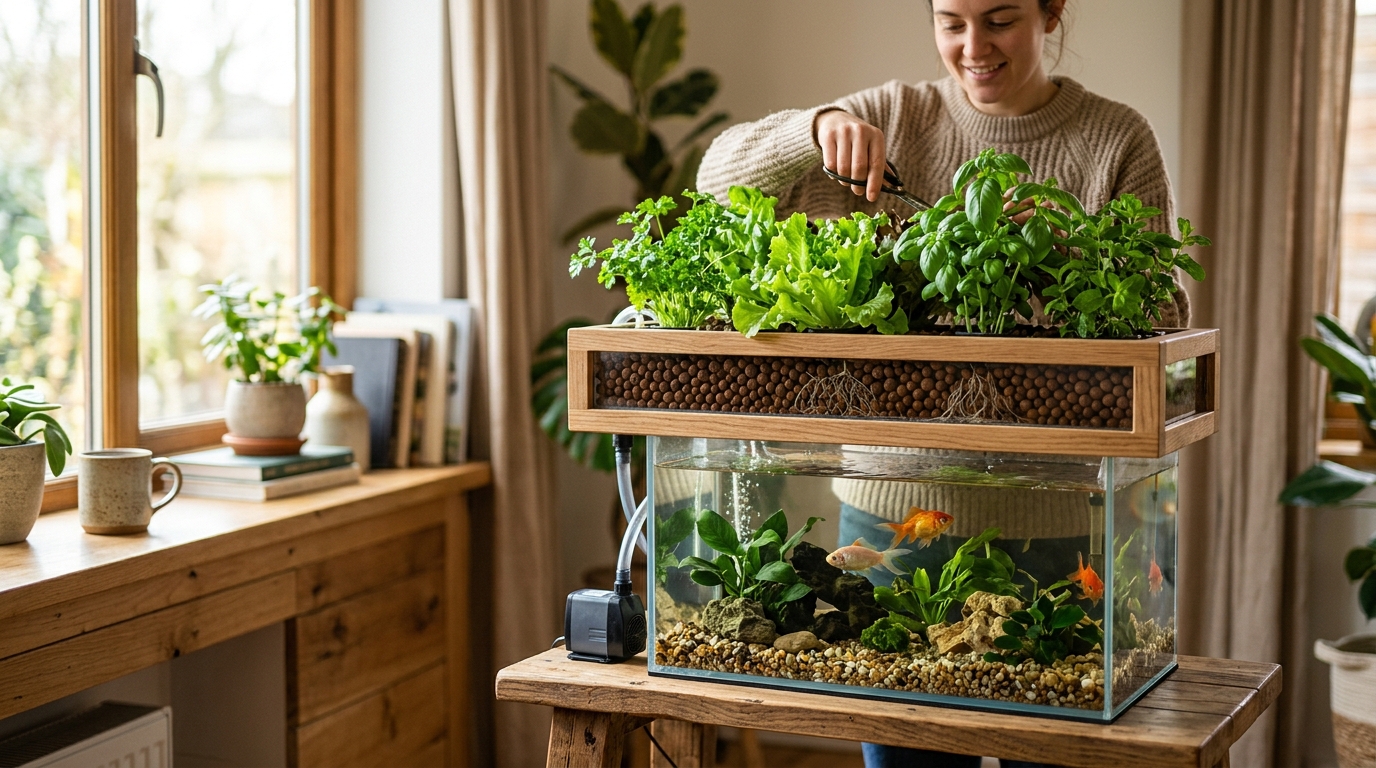
An aquaponics system combines a fish tank with a plant growing bed — fish produce ammonia-rich waste, beneficial bacteria convert that waste into plant-available nitrogen, and plants filter the water clean for the fish. The most beginner-friendly design is a media bed system: one fish tank, one grow bed packed with clay pebbles, and a small water pump cycling every 30–60 minutes. Budget $150–300 to build your first system and expect an edible harvest in 6–8 weeks.
What is aquaponics and how does it work?
Aquaponics is a closed-loop food system that combines aquaculture (raising fish) with hydroponics (growing plants in water). Fish produce ammonia as waste. Beneficial bacteria colonize the grow media and convert ammonia into nitrite, then nitrite into nitrate — a process called the nitrogen cycle. Plants absorb nitrate as fertilizer, purifying the water before it returns to the fish tank.
The result is a self-sustaining ecosystem. A balanced system uses roughly 10% of the water a comparable soil garden requires, produces zero runoff, and can grow both fresh vegetables and fish for the table simultaneously. Once established, the primary daily task is feeding the fish and checking that the pump is running.
Choosing your aquaponics system type
Four system designs are used in home aquaponics. For a first build, media bed is the clear choice.
| Product | Best for | Rating | Notes | |
|---|---|---|---|---|
| Media Bed (Flood and Drain) | Beginners and small home systems | ★★★★★ | A grow bed filled with clay pebbles floods with fish tank water on a timer and drains back to the tank. Simple to build, easy to troubleshoot, and forgiving of beginner mistakes. Supports a wide range of plant types including deep-rooted vegetables. No separate solids filter needed. | Check price |
| Deep Water Culture (DWC) Raft | High-volume leafy green production | ★★★★★ | Plants float on foam rafts in a channel that receives pre-filtered fish water. Produces very high yields of lettuce and herbs but requires a separate solids filter before water enters the raft channel. Better suited for second or third systems after mastering the basics. | Check price |
| Nutrient Film Technique (NFT) | Compact herb and lettuce systems | ★★★★☆ | A thin film of fish water flows through sloped channels past hanging plant roots. Works well with leafy greens but clogs easily with root mass and requires solids filtration. Not recommended as a first build due to clogging risk and narrow crop range. | Check price |
| Wicking Bed | Passive low-tech setups | ★★★★☆ | Plants grow in a bed that wicks water from a reservoir through a capillary layer of growing medium. Very low-tech and requires no electricity for the grow bed itself. Delivers lower nutrient levels than flood-and-drain; best for small herbs and leafy greens. | Check price |
Choose media bed for your first build. It handles solids without a separate filter (the clay pebble media acts as the biofilter), accommodates a wide variety of plants, and gives you direct visibility into root health and media condition.
What equipment do you need?
A basic indoor media bed aquaponics system needs the following. Costs are approximate for a 20-gallon beginner setup.
| Product | Best for | Rating | Notes | |
|---|---|---|---|---|
| Fish tank (20-40 gallon aquarium) | Housing fish and anchoring the system | ★★★★★ | A 20-gallon aquarium is the standard starting point. Larger tanks hold more stable water chemistry but cost more to fill and heat. Use an opaque or dark-sided tank to reduce algae growth — a clear glass aquarium works but will need a black sleeve or wrap on the sides. | Check price |
| Grow bed (media bed tray) | Growing plants above the fish tank | ★★★★★ | A plastic storage tote, a dedicated grow tray, or an aquaponics-specific media bed that sits on a stand above the fish tank. The grow bed volume should be at least equal to the fish tank volume for adequate biofiltration — a 20-gallon tank pairs with a 20-gallon grow bed. | Check price |
| Submersible water pump (100-200 GPH) | Cycling water from tank to grow bed | ★★★★★ | A small submersible pump rated at 100-200 gallons per hour is enough for a 20-gallon system. The pump sits in the fish tank and sends water up to the grow bed on a timed or continuous flood cycle. | Check price |
| Bell siphon or cycle timer | Draining grow bed back to fish tank | ★★★★★ | A bell siphon is a passive drain mechanism that automatically floods and drains the grow bed without a timer — it takes some adjustment to dial in but runs without electricity. A simpler alternative is a pump on a cycle timer set to run 15 minutes on / 45 minutes off. | Check price |
| Clay pebbles (hydroton media) | Filling the grow bed | ★★★★★ | Expanded clay pebbles are pH-neutral, reusable, and provide excellent surface area for beneficial bacteria to colonize. Fill the grow bed to a depth of 10-12 inches. Rinse thoroughly before first use to remove dust that would cloud the fish tank. | Check price |
| Aquarium air pump and airstone | Oxygenating fish tank water | ★★★★★ | Fish need dissolved oxygen continuously. An aquarium air pump and airstone keep oxygen levels high enough to prevent fish stress, especially during warm weather when dissolved oxygen drops. Run the air pump around the clock. | Check price |
| API Freshwater Master Test Kit | Monitoring ammonia, nitrite, nitrate, and pH | ★★★★★ | The API Master Test Kit includes liquid reagent tests for pH, ammonia, nitrite, and nitrate — all four parameters you need to monitor during cycling and ongoing operation. Liquid tests are more accurate than strip tests for tracking small changes in ammonia and nitrite. | Check price |
| Aquarium heater (for warm-water fish) | Maintaining stable water temperature | ★★★★★ | Required for tilapia (target 72-82 degrees F) but not for goldfish, which are comfortable down to 50 degrees F. An adjustable submersible heater with a built-in thermostat prevents temperature swings that stress fish and disrupt bacterial colonies. | Check price |
Total cost for a 20-gallon beginner system: $100–200 for equipment, plus $20–40 for fish and $10–20 for starter plants or seeds. Complete beginner aquaponics kits run $200–400 and include everything pre-sized and matched.
Step 1: Assemble and leak-test the system
Before adding any water, fish, or plants, build and test your system dry.
- Set your grow bed stand or shelf above or beside the fish tank. The drain pipe from the grow bed must clear the top of the fish tank with enough fall for gravity drainage — at minimum 6 inches of vertical drop from grow bed floor to tank water surface.
- Cut or drill a bulkhead hole in the bottom of the grow bed for the drain fitting. Use a hole saw sized for your bulkhead (commonly 1-inch or 3/4-inch pipe diameter).
- Install the bulkhead fitting and run drain tubing from the grow bed back to the fish tank. Aim the drain outlet toward the far end of the tank from the pump intake to maximize water circulation.
- Run the pump output line from the fish tank up to the grow bed inlet. Install your bell siphon inside the grow bed or connect the pump to a cycle timer.
- Fill the fish tank with dechlorinated tap water. Add a quality water conditioner such as API Stress Coat or Seachem Prime, following label dosing for your tank volume. Run the pump and check every fitting for leaks. Let the system run leak-free for 24 hours before cycling.
Dechlorination is required every time you add tap water. Chlorine and chloramine in tap water kill the beneficial bacteria that power the nitrogen cycle. Never skip this step.
Step 2: Cycle the nitrogen cycle (4–6 weeks)
The nitrogen cycle is the foundation of aquaponics. Beneficial bacteria colonize your clay pebble media and convert fish waste into plant fertilizer. This process takes 4–6 weeks and must complete before the system can reliably support fish at full stock density.
Fishless cycling method (recommended for beginners):
- Fill the system with dechlorinated water and run the pump continuously.
- Add pure ammonia (clear, unscented) to bring the ammonia reading to 2–4 ppm. Measure with the API test kit.
- After 5–7 days, check for rising nitrite levels. Rising nitrite confirms the first bacterial population (Nitrosomonas) has established and is converting ammonia.
- Every 2–3 days, add a small dose of ammonia to keep the level between 1–3 ppm. This feeds the growing bacterial colony.
- After another 7–14 days, nitrate levels will begin rising while nitrite drops. This confirms the second bacterial population (Nitrobacter) has established and the full cycle is working.
- Cycling is complete when you can dose 2–3 ppm ammonia and see it drop to near-zero within 24 hours, with nitrite also at near-zero. Elevated nitrate is expected and normal — plants will consume it.
Monitoring targets during cycling:
| Parameter | Target during cycling | Healthy steady-state |
|---|---|---|
| Ammonia | 1–3 ppm (dosed) | Below 0.5 ppm |
| Nitrite | Rising then falling | Below 0.5 ppm |
| Nitrate | Steadily rising | 20–80 ppm |
| pH | 6.8–7.4 | 6.8–7.2 |
Do not add fish until cycling is complete. Introducing fish to an uncycled system exposes them to ammonia and nitrite at lethal concentrations.
Step 3: Choose and add fish
The best fish for a beginner aquaponics system are tolerant of water quality variability, produce adequate waste to fertilize a modest grow bed, and are widely available at pet stores.
Goldfish are the top recommendation for indoor beginners. They are inexpensive ($1–5 each), tolerate a wide temperature range (50–75°F), produce generous waste relative to body size, and do not require a heater in most indoor environments. A 20-gallon tank comfortably supports 4–6 goldfish without stressing the bacteria colony.
Tilapia are the most popular aquaponics fish globally. They grow fast, tolerate water quality swings, and are edible at harvest. They require warm water (72–82°F), so an aquarium heater is necessary. A 40-gallon or larger tank is better for tilapia given their adult size of 12–18 inches.
Koi work well for larger outdoor or display systems. They produce excellent waste output but require 50+ gallons per adult fish and are expensive to replace if the system fails.
Stocking density rule: Start at 1 inch of fish length per 1 gallon of tank water. A 20-gallon tank supports roughly 4–6 small goldfish (3–4 inches each) or 3–4 juvenile tilapia. Overstocking before the system is fully established overwhelms the bacterial colony and causes ammonia spikes.
Add fish 24–48 hours after confirming cycling is complete. Float the bag in tank water for 20–30 minutes to equalize temperature before releasing the fish.
Step 4: Add plants
Aquaponics produces nitrogen-rich water ideal for leafy greens and fast-growing herbs. Fruiting plants like tomatoes and peppers need higher phosphorus levels that a standard fish load does not naturally deliver, so start with leafy crops and add fruiting plants once the system is stable.
Best plants for beginner aquaponics:
- Butterhead and romaine lettuce — ready to harvest in 4–6 weeks, very forgiving
- Basil — thrives in warm conditions, continuously productive when pinched regularly
- Kale and Swiss chard — heavy nitrogen feeders that use the system output well
- Mint and parsley — low-maintenance, spread to fill available media bed space
- Spinach — fast-growing and tolerates the cooler water temperatures that goldfish prefer
How to plant into the media bed:
- Start seeds in rockwool cubes soaked in pH 7.0 water for 30 minutes. Germinate under a humidity dome at 70–75°F.
- Once seedlings have roots emerging from the rockwool cube (7–14 days after sprouting), transplant the entire cube into the clay pebble media bed.
- Surround the rockwool cube with clay pebbles up to the base of the seedling stem. Roots will grow down through the pebbles and into the flood zone.
- During the flood cycle, water should rise to within 1–2 inches of the media surface. The bed should drain completely between flood cycles — roots require air exposure between waterings.
Alternatively, transplant seedlings started in soil by gently washing all soil from the roots before placing them in the media bed. Some residual fine soil is acceptable; avoid large clumps that can clog the drain.
Step 5: Monitor and maintain the system
A healthy aquaponics system needs regular monitoring during the first 4–8 weeks after fish and plants are added. Once stable, maintenance drops to a brief daily check and a weekly water test.
Weekly monitoring checklist:
| Test | Target range | Action if out of range |
|---|---|---|
| pH | 6.8–7.2 | Add pH Up or pH Down in very small increments |
| Ammonia | Below 0.5 ppm | Reduce fish feeding or do a 20% partial water change |
| Nitrite | Below 0.5 ppm | Reduce feeding and check bacteria colony health |
| Nitrate | 20–80 ppm | Add more plants if consistently above 80 ppm |
| Water temperature | Per fish species | Adjust heater setting or increase aeration to cool warm water |
Fish feeding: Feed only as much as fish consume within 5 minutes. Uneaten food decays and spikes ammonia. Start with once-a-day feedings and increase only after confirming ammonia stays below 0.5 ppm.
Topping off water: Plants and evaporation will lower the water level over time. Top off with dechlorinated tap water as needed. Nutrients do not evaporate, so adding plain water maintains concentration while restoring volume.
Partial water changes: When nitrate climbs above 80–100 ppm, or after any disease event, a 10–20% partial water change dilutes the problem without disrupting the bacterial colony. Always treat replacement water with dechlorinator before adding it to the system.
Troubleshooting common aquaponics problems
Fish gasping at the water surface Low dissolved oxygen is the most common cause. Increase aeration by adding a second airstone or increasing air pump output. Also check water temperature — warm water holds less oxygen, so fish in water above 78°F need more aeration than fish in cooler water.
Ammonia or nitrite spike in an established system Indicates bacterial die-off (from chlorine exposure, pH crash, or accidental disruption) or a sudden jump in organic waste from overfeeding or a dead fish. Reduce feeding immediately, remove any dead fish, and do a 20% water change. Retest in 24 hours. Do not add fish or increase feeding until levels normalize.
Plants yellowing with older leaves affected first This pattern indicates nitrogen deficiency. Check that pH is between 6.8–7.2 — nutrient uptake blocks below 6.5 even when nitrate is present. If pH is in range, the fish load is too light for the plant density: add more fish, reduce the plant count, or supplement with a small dose of aquaponics-safe liquid iron if yellowing appears in new growth (which suggests iron deficiency rather than nitrogen).
Algae accumulation on tank walls and media Algae grows wherever light and nutrients meet. Cover fish tank sides with a black wrap or sleeve and minimize light exposure to the water surface. Some algae is harmless and fish will eat it; excessive algae competes for nutrients and can crash oxygen levels at night when photosynthesis stops.
Bell siphon not triggering or not stopping The most common mechanical issue in media bed systems. A siphon that will not start is usually caused by too-slow inflow — increase pump output. A siphon that will not stop (siphon lock) is caused by too-fast inflow — reduce pump output with an inline valve or by using a smaller pump. The bell cover must sit tightly over the standpipe with no air gaps to generate the siphon effect.
FAQ
Frequently asked questions
How long does it take to set up an aquaponics system?
How much does a beginner aquaponics system cost?
Do aquaponics systems smell bad?
Can I eat the fish from my aquaponics system?
What is the correct fish-to-plant ratio for aquaponics?
Can I run an aquaponics system without a grow light?
Bottom line
An aquaponics system is one of the most rewarding indoor garden projects you can build. For $150–300, a 20-gallon media bed system will produce fresh lettuce, herbs, and greens continuously while using a fraction of the water a soil garden requires. The nitrogen cycling period is the single most important phase — invest the 4–6 weeks it takes, and you will have a self-sustaining ecosystem that practically runs itself once stable.
Start with goldfish, lettuce, and basil. Monitor pH and ammonia closely for the first month. Once you have a stable, producing system behind you, scaling to a larger tank or adding fruiting plants becomes straightforward.
For related reading: aquaponics vs hydroponics, DIY hydroponics guide, best hydroponic systems, and how to set up a grow tent.